







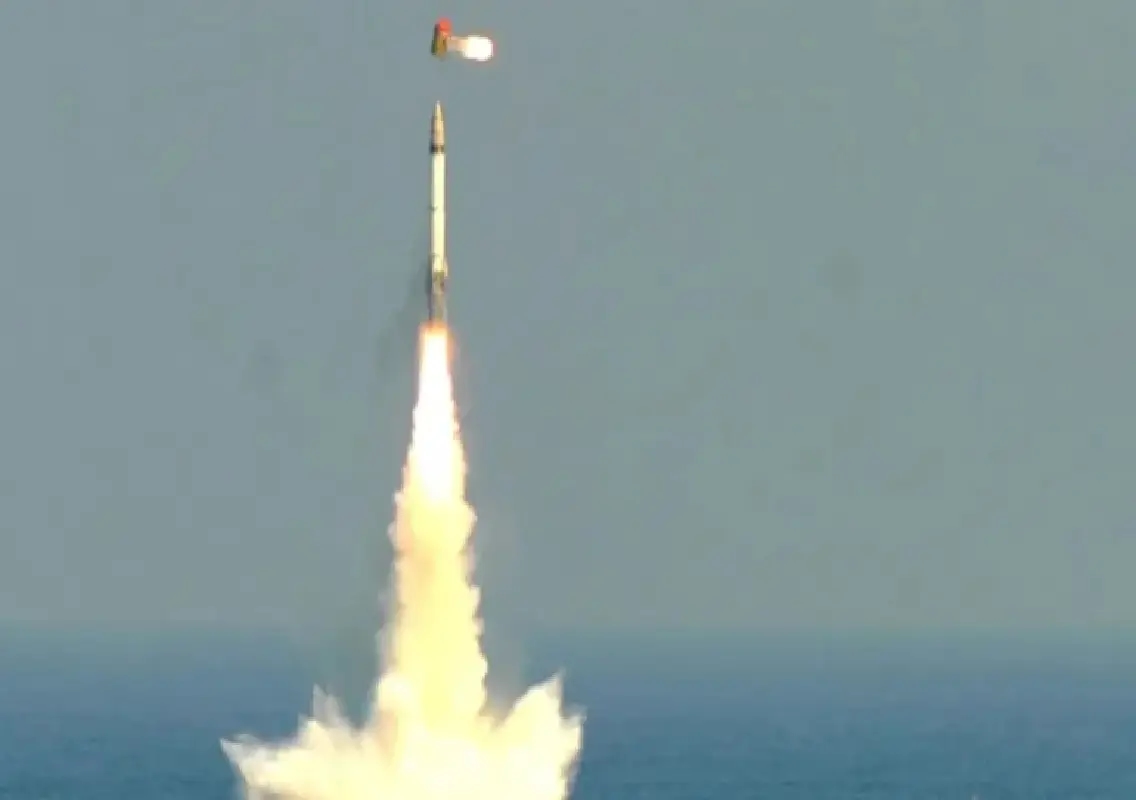


New Delhi: India has successfully tested the K-4 submarine-launched ballistic missile (SLBM) from a nuclear-powered submarine, significantly strengthening the country’s sea-based nuclear strike capability and reinforcing the credibility of its nuclear deterrence posture.
Successful test from INS Arighaat
The intermediate-range ballistic missile was test-fired from the nuclear-powered submarine INS Arighaat in the Bay of Bengal earlier this week. The test was conducted off the coast of Visakhapatnam and is being seen as a major milestone in India’s strategic weapons programme.
Designed to strike targets up to 3,500 kilometres away, the K-4 missile provides India with the ability to deliver nuclear warheads from beneath the sea, a capability possessed by only a handful of countries globally. Defence sources described the test as successful, with all mission objectives met.
The launch demonstrates India’s growing confidence in operating long-range strategic missiles from its indigenous nuclear submarine fleet, an area that has been under sustained development for over a decade.
Strengthening the nuclear triad
With the successful testing of the K-4 missile, India further consolidates its nuclear triad — the ability to deliver nuclear weapons from land, air and sea. The K-4 SLBM was officially commissioned into the Indian Navy on August 29, 2024, marking India’s entry into an elite group of nations capable of undersea nuclear missile launches.
Sea-based nuclear weapons are considered the most survivable leg of a nuclear deterrent. Ballistic missile submarines can remain hidden underwater for long periods, making them extremely difficult to detect or destroy in a first strike. This ensures a credible second-strike capability, a cornerstone of India’s nuclear doctrine.
The successful test from INS Arighaat underscores the Indian Navy’s readiness to deploy these systems during deterrence patrols, thereby enhancing strategic stability in the region.
Missile design and capabilities
The K-4 missile is derived from the Agni-III land-based ballistic missile but has been extensively modified for submarine launch. Unlike land-based missiles, submarine-launched ballistic missiles must be ejected from underwater launch silos using compressed gas before breaching the ocean surface. Only after clearing the water does the missile’s rocket motor ignite, propelling it towards its target.
This complex launch sequence was successfully validated during the test. Defence officials noted that the missile’s guidance and control systems performed as expected, reinforcing confidence in its operational reliability.
The K-4 is capable of carrying a nuclear warhead weighing up to 2.5 tonnes. Its range of 3,500 km allows India to cover strategic targets deep within adversary territory while keeping its submarines safely within secure patrol zones.
Arihant-class submarines and stealth advantage
The missile is designed to be deployed on India’s Arihant-class nuclear-powered ballistic missile submarines (SSBNs). These submarines are the most secretive and survivable assets in the Indian armed forces.
Arihant-class submarines are built to operate in near-total silence, enabling them to patrol vast stretches of ocean undetected for extended durations. This stealth capability makes them the most elusive leg of India’s nuclear triad.
Because of their ability to remain hidden, SSBNs ensure that even in the event of a devastating first strike on land-based assets, India retains the capability to respond decisively. The K-4 missile significantly enhances this deterrent by providing longer range and greater payload capacity.
Strategic and regional implications
The test of the K-4 missile comes amid evolving security dynamics in the Indo-Pacific region. While Indian officials have not linked the test to any specific geopolitical development, defence analysts view it as part of India’s long-term effort to modernise and strengthen its strategic forces.
With a range of 3,500 km, the K-4 bridges a critical gap between shorter-range submarine-launched missiles and longer-range land-based systems. It allows India to maintain credible deterrence without having to move submarines dangerously close to hostile shores.
Experts note that such capabilities contribute to strategic stability by discouraging adversaries from contemplating coercive or aggressive actions, knowing that India retains a survivable second-strike option.
Tribute to APJ Abdul Kalam
The ‘K’ in the K-series of missiles is widely acknowledged as a tribute to former President Dr APJ Abdul Kalam, who played a pivotal role in shaping India’s missile development programmes. Dr Kalam was a key architect of the Integrated Guided Missile Development Programme (IGMDP), which laid the foundation for indigenous missile systems such as Agni, Prithvi and the K-series.
The successful test of the K-4 is seen as a continuation of that legacy, reflecting decades of sustained investment in research, development and indigenous defence manufacturing.
Conclusion
The successful test-firing of the K-4 missile from INS Arighaat marks a major step forward in India’s strategic capabilities. By demonstrating a reliable, long-range submarine-launched nuclear missile, India has significantly strengthened the most secure leg of its nuclear triad.
As the Indian Navy continues to operationalise its Arihant-class submarines and associated missile systems, the K-4 will play a central role in ensuring credible deterrence, reinforcing national security and maintaining strategic balance in the region.