







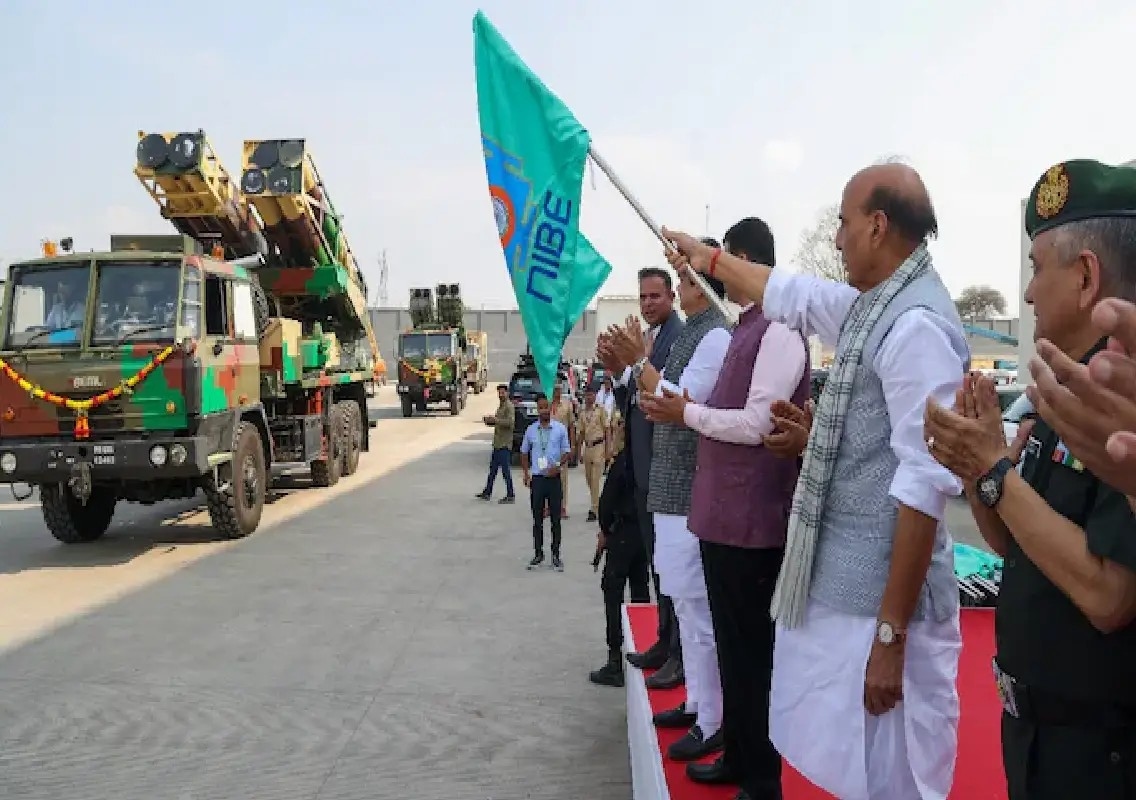


Shirdi: India on Saturday unveiled its first indigenous 300-km Universal Rocket Launching System “Suryastra”, with Defence Minister Rajnath Singh describing the system as a “strategic game-changer” capable of strengthening the country’s future warfare capabilities. The launch took place during the inauguration of a private-sector Defence Manufacturing Complex developed by NIBE Group in Shirdi, Maharashtra, in the presence of Maharashtra Chief Minister Devendra Fadnavis.
Along with unveiling the Suryastra system, Rajnath Singh also laid the foundation stone for a missile complex linked to the project.
Suryastra unveiled as indigenous defence capability expands
The newly introduced Suryastra system has been presented as an indigenous long-range rocket platform designed to strengthen India’s strike capabilities.
Speaking during the event, Rajnath Singh said the system reflected the country’s progress in developing advanced military technologies through domestic capabilities.
He stated that indigenous technologies would play an increasingly important role in strengthening national security and future defence preparedness.
The minister described the rocket system as a major addition to India’s evolving military infrastructure and said technological self-reliance remained a key national objective.
Defence minister highlights changing nature of warfare
During his address, Rajnath Singh said military conflicts across the world are increasingly becoming technology-driven rather than relying solely on troop strength.
According to him, future wars are expected to be influenced by factors such as automation, precision-guided systems, advanced munitions and emerging technologies.
Referring to ongoing international conflicts and changing security environments, he said technological superiority was becoming a decisive factor in defence strategy.
He added that India had also demonstrated advancements in military capability during recent operations and stressed the need to continue investing in next-generation defence systems.
The minister urged stakeholders to work towards making India a leading centre for munitions manufacturing and automated defence technologies.
Private sector role in defence manufacturing growing
Rajnath Singh also highlighted the changing structure of India’s defence manufacturing sector over the last decade.
According to him, private sector participation, which previously remained limited in defence production, has steadily increased and now contributes significantly to the overall ecosystem.
He said the government’s objective is to further expand private-sector participation in the coming years.
The minister noted that Indian companies are increasingly moving beyond component manufacturing and entering the development of advanced defence platforms and technologies.
He stated that the country’s defence ecosystem is gradually transitioning towards innovation-led manufacturing.
New defence and technology facilities introduced
Apart from the Suryastra launch, several additional facilities and technologies were also introduced during the event.
These included indigenous TNT Plant Technology, RDX Plant Technology and a Renewable Bio-Energy Compressed Biogas Plant.
An agreement was also exchanged between the NIBE Group and Black Sky for cooperation in satellite assembly technologies.
Rajnath Singh stated that the new facilities could contribute to strengthening India’s defence manufacturing network while creating opportunities for ancillary industries and smaller enterprises.
He said increased production of missiles, ammunition, rocket systems and satellite-related technologies could support employment generation and help equip young professionals with specialised technical skills.
Chief Minister Devendra Fadnavis also praised efforts under the Aatmanirbhar Bharat and Make in India initiatives, stating that growing participation by public and private sectors has contributed to strengthening India’s defence manufacturing ecosystem.