







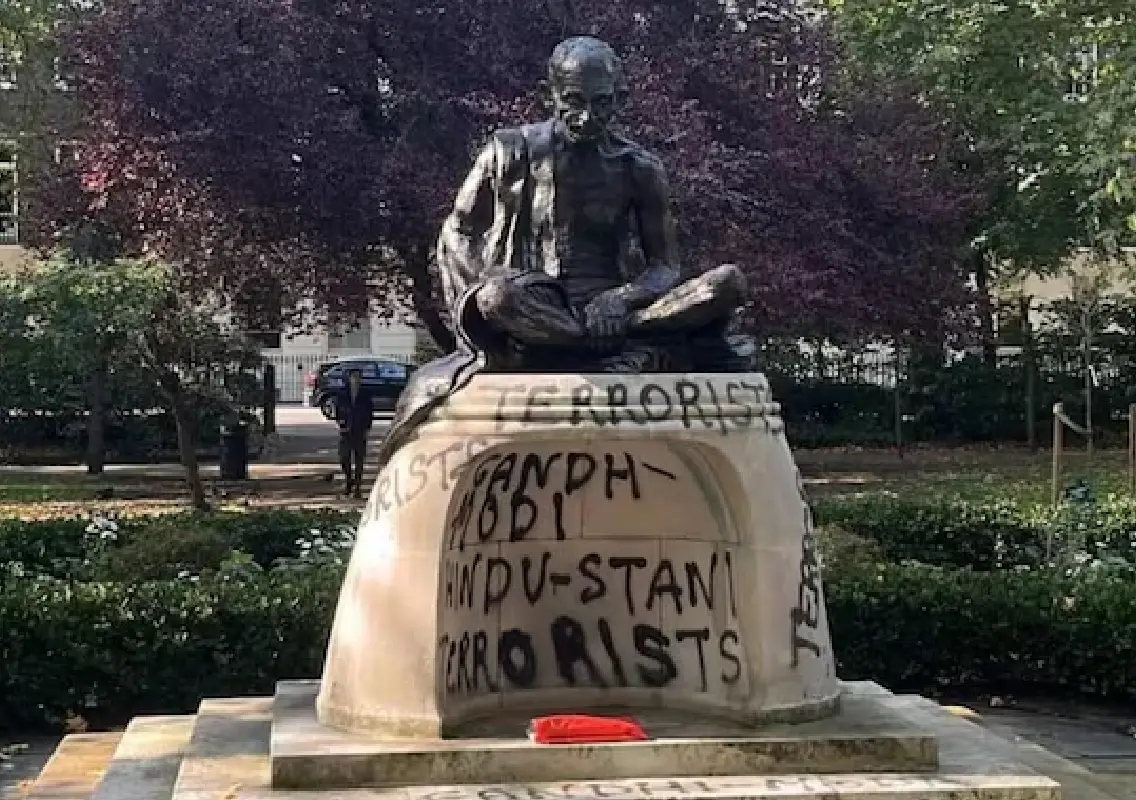


The Indian High Commission in the United Kingdom on Sunday strongly condemned the vandalism of Mahatma Gandhi’s statue at Tavistock Square, terming it a “shameful act” and an assault on the global legacy of nonviolence.
Mission reacts strongly
In a statement posted on X, the High Commission said the attack was not just an act of damage to property but “a violent attack on the idea of nonviolence, three days before the International Day of Nonviolence, and on the legacy of the Mahatma.”
Officials said the matter has been taken up with local authorities at the highest level, urging swift investigation and restoration. A team from the High Commission visited the site immediately after the incident and began coordinating with London authorities to ensure the statue is restored “to its original dignity.”
A landmark of peace
The bronze statue of Gandhi at Tavistock Square has stood for more than 55 years as a global symbol of peace and resilience. Sculpted by artist Fredda Brilliant, it was unveiled on 17 May 1968 by then British Prime Minister Harold Wilson.
Since then, the memorial has become one of London’s most recognised tributes to Gandhi, often visited by world leaders and peace activists. Its location in Tavistock Square, central London, underscores the capital’s tradition of honouring figures associated with peace and reconciliation.
Part of a larger peace park
The square is home to several other memorials that reinforce its identity as London’s “peace park.” According to a 2005 article in Economic and Political Weekly, the Gandhi statue was later joined by a cherry tree planted in memory of Hiroshima bombing victims, a field maple planted in 1986 by the League of Jewish Women to mark the United Nations’ International Year of Peace, and a granite memorial unveiled in 1995 by composer Michael Tippett in honour of conscientious objectors.
@HCI_London is deeply saddened and strongly condemns the shameful act of vandalism of the statue of Mahatma Gandhi at Tavistock Square in London. This is not just vandalism, but a violent attack on the idea of nonviolence, three days before the international day of nonviolence,…
— India in the UK (@HCI_London) September 29, 2025
Together, these installations represent a collective reminder of humanity’s struggle against violence and war.
International Day of Nonviolence link
The incident comes just days before the world observes the International Day of Nonviolence on October 2, marking Mahatma Gandhi’s birth anniversary. The UN-designated day is celebrated globally as a tribute to Gandhi’s philosophy of peace, satyagraha, and resistance without violence.
The timing of the vandalism has drawn sharp criticism, with many commentators noting the symbolic insult to Gandhi’s principles at a moment meant to reinforce them.
A call for accountability
Community groups in London have also expressed outrage, calling for strict measures to protect statues and memorials of historical figures who embody peace and justice.
The Indian High Commission has assured that it will pursue the matter until the statue is fully restored, stressing that the act of vandalism cannot diminish Gandhi’s enduring influence across the world.