







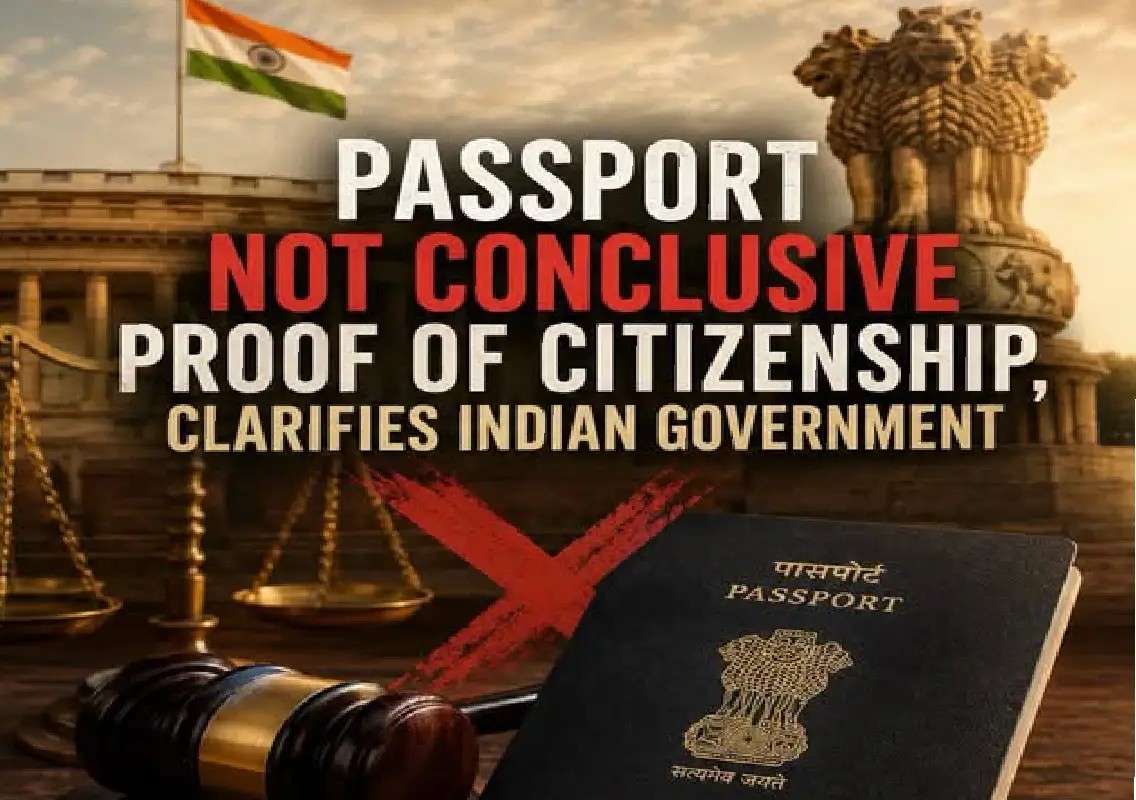


The Ministry of External Affairs (MEA) has clarified that an Indian passport, while issued only to Indian citizens, is primarily a travel and identity document and does not, by itself, constitute conclusive legal proof of Indian citizenship.
The clarification highlights the distinction between a passport as an international travel document and citizenship status, which is determined under the provisions of the Citizenship Act.
Passport is a travel and identity document
According to the MEA, an Indian passport facilitates international travel and serves as proof of identity and nationality before foreign authorities.
However, for legal and constitutional purposes within India, citizenship is established in accordance with the Citizenship Act and related government provisions rather than solely through possession of a passport.
Officials emphasised that the passport should not be treated as a standalone certificate of citizenship in matters where legal determination of nationality is required.
Citizenship governed by law
The clarification comes amid discussions on social media regarding the legal status of Indian passports and the documents required to establish citizenship.
Experts note that while passports are generally issued only after verification of an applicant’s eligibility, questions relating to citizenship are ultimately governed by statutory provisions under the Citizenship Act.
The government has maintained that citizenship claims are assessed based on applicable laws and supporting records prescribed by competent authorities.
Social media debate follows clarification
The clarification sparked widespread discussion online, with users debating whether an Indian passport alone should be regarded as sufficient evidence of citizenship.
Some questioned the wording printed inside Indian passports, while others raised queries regarding dual citizenship and the legal distinction between nationality, identity and citizenship.
India does not permit full dual citizenship. Indian citizens who voluntarily acquire the citizenship of another country are generally required to surrender their Indian passport in accordance with existing laws.
The MEA’s clarification reiterates that while an Indian passport reflects an individual’s nationality for international travel, citizenship itself remains a legal status governed by the Citizenship Act.