







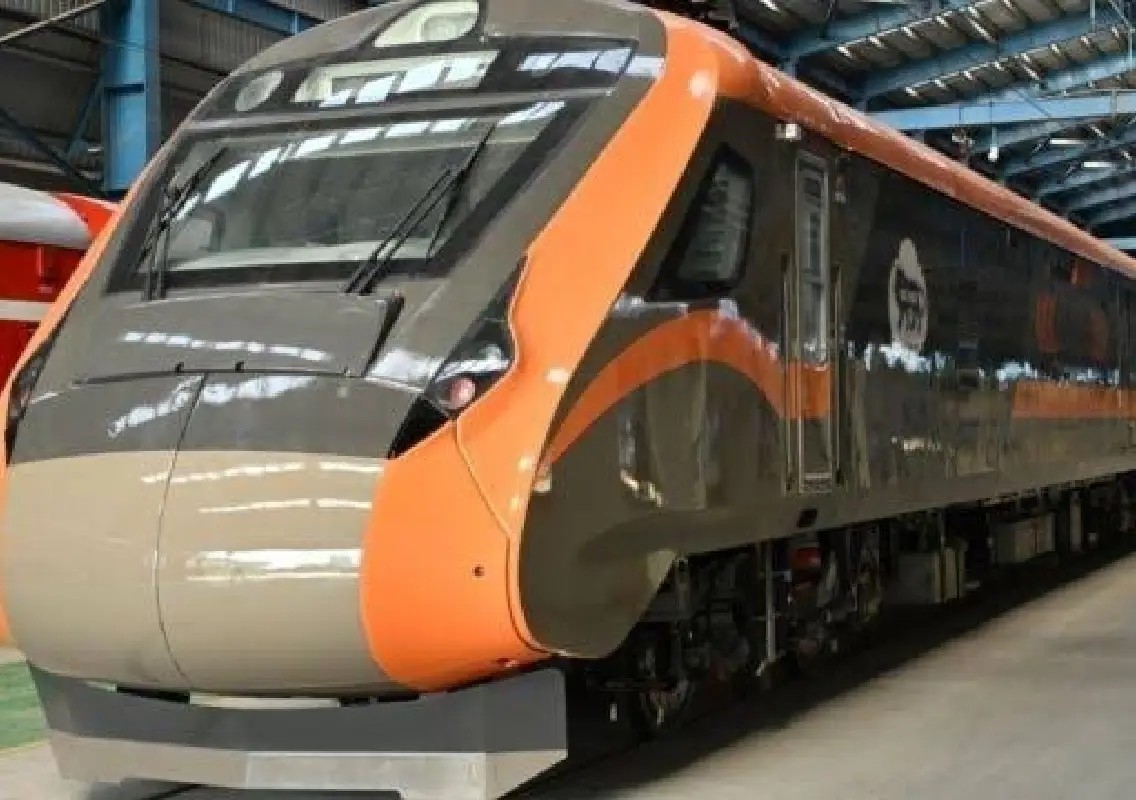


New Delhi : Indian Railways has begun trial runs of the country’s first Vande Bharat freight train on the Ahmedabad-Mumbai route, marking a significant step in the expansion of the Vande Bharat platform beyond passenger services.
The trial is aimed at evaluating the train’s performance and operational suitability for high-speed cargo transportation. The initiative is expected to strengthen India’s rail-based logistics network by enabling faster and more reliable movement of goods between two major commercial centres.
The development comes as Indian Railways continues to modernise its freight infrastructure and improve the efficiency of cargo transportation across the country.
Vande Bharat technology enters freight operations
Vande Bharat trains have become closely associated with faster passenger services, but the latest initiative extends the technology to freight transportation.
The freight train is being tested to assess whether the trainset can provide the speed, reliability and operational efficiency required for cargo movement.
The Ahmedabad-Mumbai corridor is particularly significant because it connects major industrial, commercial and logistics centres across Gujarat and Maharashtra. The route passes through important economic hubs including Vadodara, Surat, Vapi and several other industrial areas.
A faster freight service on such a corridor could help reduce the time required to move high-value and time-sensitive goods between markets and distribution centres.
Trials will assess operational performance
The current trial phase will allow railway authorities to evaluate the train’s performance under actual operating conditions.
Testing is expected to examine factors such as speed, braking, stability, energy consumption and overall operational reliability. The findings will help determine how the Vande Bharat freight train can be integrated into regular railway operations.
Earlier trials of the prototype have already demonstrated its high-speed capability. The train reached a reported speed of 145 kmph during testing in August, indicating its potential for faster cargo transportation.
However, trial performance alone does not mean that regular commercial freight services will begin immediately. Further technical and operational assessments will be required before a final decision on deployment is taken.
Focus on faster cargo movement
One of the major objectives of the project is to reduce cargo transit times.
Conventional freight trains often operate at lower speeds and can be affected by congestion on railway routes shared with passenger services. Faster freight trainsets could provide an additional option for transporting goods where speed is commercially important.
This could be particularly useful for sectors handling products that have high time sensitivity or require rapid delivery.
A more efficient rail freight system can also help businesses reduce logistics costs and improve supply-chain reliability.
Dedicated Freight Corridors provide wider support
The Vande Bharat freight initiative comes at a time when India’s Dedicated Freight Corridor network is also expanding its capacity.
The country’s 2,843-km Dedicated Freight Corridor network has been developed to provide faster and more reliable freight movement while reducing congestion on conventional railway routes. Recent data showed freight trains operating at about 91 per cent of the network’s daily capacity in August 2026.
The Western Dedicated Freight Corridor connects Dadri in Uttar Pradesh with the Jawaharlal Nehru Port area in Maharashtra, while the Eastern Dedicated Freight Corridor links Ludhiana with Sonnagar.
These corridors allow longer trains and double-stack container operations and are designed to strengthen connections between production centres, markets and ports.
The Vande Bharat freight train therefore forms part of a wider effort to modernise India’s logistics infrastructure rather than being an isolated railway initiative.
Ahmedabad-Mumbai route has strategic importance
The Ahmedabad-Mumbai railway corridor is one of India’s important commercial routes.
It connects Gujarat and Maharashtra, two major economic states with significant manufacturing, industrial and trading activity. The corridor also provides links to important ports and logistics centres.
The route is already used by passenger Vande Bharat services, demonstrating the railway infrastructure’s importance for faster inter-city connectivity.
Introducing a high-speed freight service on the corridor could potentially provide businesses with another transportation option alongside conventional goods trains and road freight.
Potential benefits for India’s logistics sector
Faster rail freight could offer several advantages to India’s logistics sector.
Rail transportation can move large quantities of goods while reducing dependence on road-based freight for long-distance movement. Faster services could make rail more attractive for companies that prioritise delivery time.
Improved rail logistics can also support India’s manufacturing and export ambitions by connecting factories, distribution centres, ports and markets more efficiently.
The government has been focusing on reducing logistics costs and improving the country’s overall supply-chain infrastructure. The development of faster freight services is consistent with these broader objectives.
A new chapter for Vande Bharat
The beginning of freight trials represents an important evolution for the Vande Bharat platform.
What began primarily as a passenger-train programme is increasingly being associated with broader railway modernisation, including faster services and new applications of trainset technology.
The success of the freight trials will determine how widely the concept can be adopted.
If the train meets the required technical and operational standards, similar services could eventually be considered for other routes where faster cargo movement has strong commercial potential.
However, the immediate focus remains on testing and evaluation rather than announcing a nationwide freight service.
Trial results will determine the next step
The Ahmedabad-Mumbai trials are expected to provide Indian Railways with important information about the suitability of the Vande Bharat trainset for freight operations.
The railway authorities will need to assess the results carefully before determining commercial deployment, including the types of cargo that can be transported, operating schedules and the routes where such trains would provide the greatest benefit.
The initiative comes as India’s freight railway network undergoes significant transformation through dedicated corridors, modern rolling stock and improved logistics infrastructure.
For businesses, faster and more dependable rail transportation could eventually mean shorter delivery times and greater supply-chain efficiency.
For Indian Railways, the trials represent an opportunity to build on the success of Vande Bharat passenger services and apply modern train technology to the country’s growing freight requirements.
The Ahmedabad-Mumbai trial is therefore being watched as an important experiment in the future of high-speed cargo transportation in India. If successful, it could open the door to a new generation of faster rail freight services and further strengthen Indian Railways’ role in the country’s logistics network.