







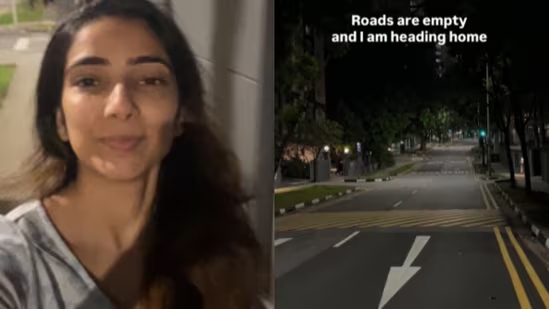


A late-night walk shared by an Indian woman living abroad has triggered widespread discussion on social media, highlighting how perceptions of personal safety can shape everyday life experiences.
Kritika Jain, an Indian resident in Singapore, posted a short Instagram video showing herself walking alone on a deserted road at around 3 am. The clip captured calm streets, silence, and Jain walking home without visible fear — a moment she said felt deeply significant to her.
“No fear, no hesitation”
In her post, Jain reflected on how natural and unremarkable the experience felt in Singapore. She said she was able to walk alone late at night without hesitation, fear, or the instinct to constantly look back.
She contrasted this with her experience in India, noting that she could not imagine stepping out alone at such an hour back home. According to Jain, this difference in everyday safety has shaped how she views the city she now lives in.
Safety as everyday normal
Jain explained that walking alone at night is common in Singapore and is not treated as a privilege, but as a normal part of daily life. She added that her affection for the city is not rooted in skyscrapers or tourist attractions, but in the sense of security it offers.
“This feeling of safety is something I never take for granted,” she noted, describing it as central to her sense of independence and peace of mind.
Mixed reactions online
The video received a range of responses from social media users. Many echoed Jain’s experience, praising Singapore’s civic sense and public safety.
One user commented, “The one month I lived there really spoiled me. Costly, but the civic sense people have there is amazing.” Another shared, “I used to go to hospitals at midnight for emergencies. Singapore felt completely safe at night.”
Others, however, pointed out that safety perceptions can vary across cities and countries, sparking a broader conversation on urban planning, policing, and social responsibility.
A wider conversation
Jain’s post has resonated with many, particularly women, by turning a simple moment into a reflection on how safety — or the lack of it — quietly influences freedom, confidence, and quality of life.