










New Delhi: India’s coal stocks fell sharply by 66.1 per cent between the beginning of April and the end of September 2026, marking the steepest depletion in four years, according to data from the National Power Portal.
Coal stocks declined from 54.9 million tonnes (MT) at the beginning of April to 18.6 MT by the end of September. The sharp fall comes as coal continues to account for the largest share of India’s electricity generation, even as renewable energy sources have expanded rapidly over the past decade.
The latest inventory data highlights the continued importance of coal to India’s power system and the potential significance of changes in coal availability at thermal power plants.
Coal stocks see steepest depletion since 2023
The 66.1 per cent decline recorded between April and September 2026 is significantly higher than the depletion seen during the corresponding periods of the previous three years.
Coal stocks fell by 22.8 per cent between April and September in 2025, while the decline was 31.8 per cent in 2024 and 36.8 per cent in 2023.
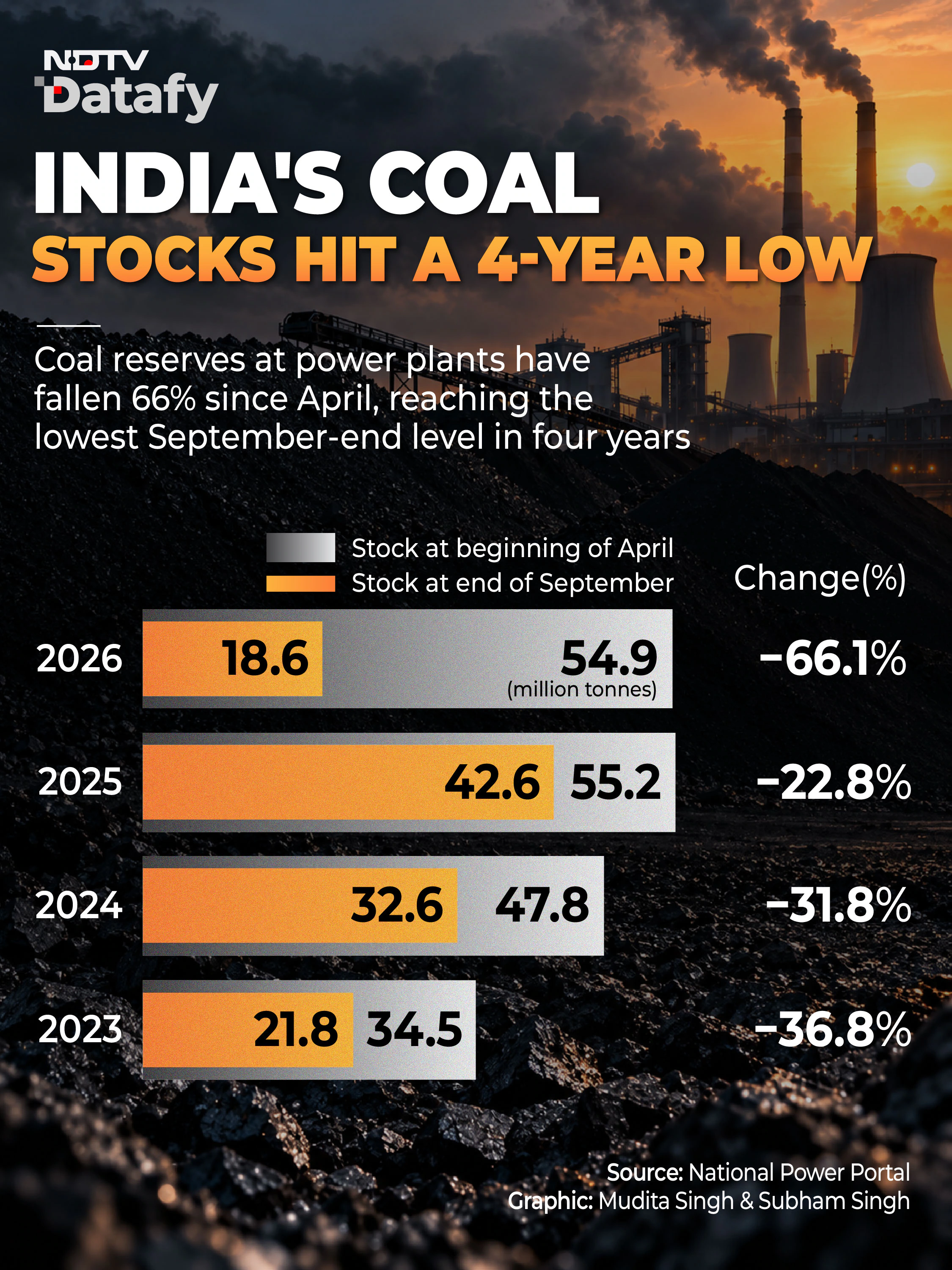
The latest fall therefore represents a substantially sharper reduction in coal inventories compared with recent years.
The movement in stocks is particularly important because April to September covers a period during which electricity demand and generation patterns can change significantly. Coal inventories at power stations act as an important buffer for thermal generation, allowing plants to continue operating when there are disruptions or fluctuations in coal supplies.
Coal remains India’s biggest source of electricity
Despite the rapid expansion of renewable energy, coal continues to dominate India’s electricity generation.
Coal-based power generation increased from approximately 835 billion units (BU) in FY15 to 1,281 BU in FY26, representing an increase of more than 53 per cent.
The figures show that coal generation has continued to expand even as India has added substantial renewable energy capacity.
This dependence means that coal availability remains closely linked to the functioning of the country’s electricity system. A sustained decline in inventories can therefore become an important factor for power producers, particularly when electricity demand rises.
Solar generation rises sharply
India’s solar power generation has grown dramatically over the same period.
Solar generation increased from just 4.6 BU in FY15 to approximately 174.8 BU in FY26.
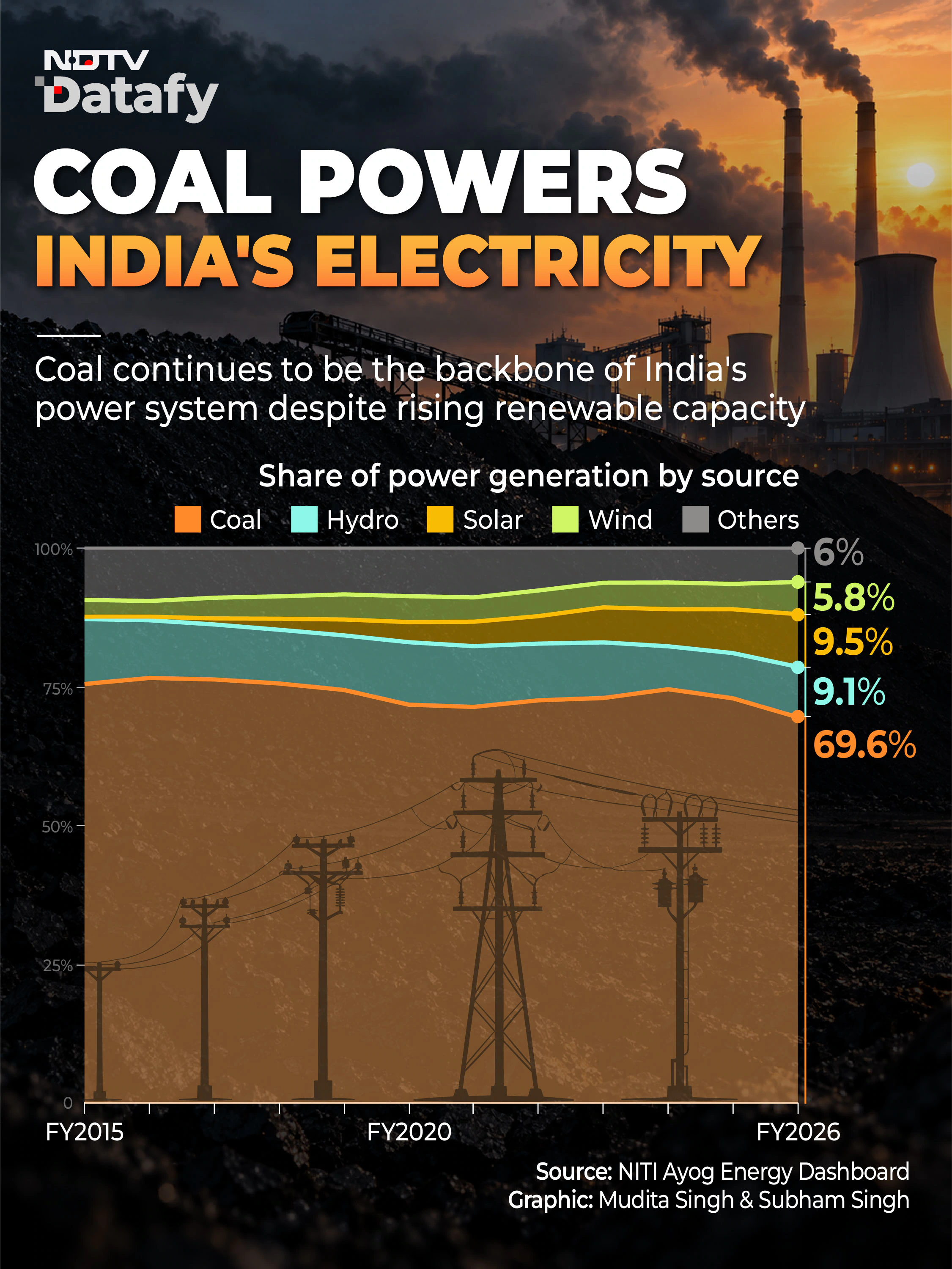
The increase reflects the rapid expansion of solar capacity and the growing contribution of renewable energy to the country’s overall electricity mix.
However, despite the substantial increase, solar generation remains well below coal-based generation in absolute terms.
The comparison illustrates the scale of India’s continuing dependence on thermal power. Solar has moved from a relatively small contributor to an increasingly important source of electricity, but coal still generates several times more power.
Wind power also expands
Wind generation has also increased over the past decade.
In FY15, wind power generation stood at around 33.8 BU. By FY26, it had risen to approximately 106.7 BU.
The increase demonstrates the broader diversification taking place in India’s power sector.
Wind and solar generation have both grown substantially, helping increase the share of renewable sources in the country’s electricity mix. However, their combined generation remains significantly below the output from coal-based power plants.
This means thermal generation continues to play a central role in meeting India’s electricity requirements, particularly when renewable generation varies according to weather and time of day.
Hydropower remains relatively stable
Hydropower generation has followed a different trajectory.
India generated approximately 129.2 BU of hydropower in FY15. By FY26, the figure had increased to around 167.2 BU.
The increase is considerably smaller than the growth recorded in solar generation and also below the expansion seen in coal-based generation.
Hydropower remains an important source of electricity because of its ability to provide relatively flexible generation in certain circumstances. However, its overall contribution has not increased at the same pace as solar and wind.
India’s power mix is changing gradually
The generation figures show that India’s electricity mix has been undergoing a gradual transition.
Solar generation has grown from a very small base, while wind generation has also increased. Hydropower has remained an established component of the electricity system.
At the same time, coal-based generation has continued to grow substantially in absolute terms.
The contrast is important because the expansion of renewable energy has not yet eliminated India’s dependence on coal. Instead, the country is operating with an increasingly diversified power mix in which thermal generation remains the dominant source.
The continued scale of coal-based generation means that coal supply and inventory levels remain closely watched by the power sector.
Why coal inventories matter
Coal stocks held at power stations provide an important cushion against supply disruptions and changes in demand.
When inventories fall sharply, power plants can become more dependent on regular coal supplies from mines and transport networks. This makes the reliability of the supply chain increasingly important.
A sustained depletion of stocks does not automatically mean a power shortage. The impact depends on factors including coal production, transportation, imports, power demand, plant efficiency and the pace at which inventories are replenished.
However, the 66.1 per cent decline between April and September is significant because it represents a much sharper reduction than seen in the corresponding periods of recent years.
Renewable growth has not displaced coal yet
India has made significant progress in expanding renewable energy, particularly solar and wind power.
The increase in renewable generation is changing the country’s energy mix and reducing the relative dependence on conventional sources over time. However, the absolute generation figures show that coal remains far ahead of individual renewable sources.
In FY26, coal-based power generation was around 1,281 BU, compared with 174.8 BU from solar, 106.7 BU from wind and 167.2 BU from hydropower.
The numbers underline the scale of the challenge involved in transitioning India’s electricity system while maintaining reliable power supply.
Coal remains central to power security
The latest stock data highlights a key feature of India’s energy transition: renewable energy is expanding rapidly, but coal remains central to the country’s power system.
The 66.1 per cent decline in coal stocks between April and September 2026 is the steepest depletion recorded in the four-year comparison provided by the National Power Portal data.
At the same time, coal-based generation has risen by more than half since FY15, while solar and wind generation have expanded from much smaller bases.
The figures point to a power sector undergoing significant change but still heavily reliant on thermal generation. As India continues to add renewable capacity, coal inventories and supply chains will remain important indicators of the country’s ability to meet electricity demand reliably.