







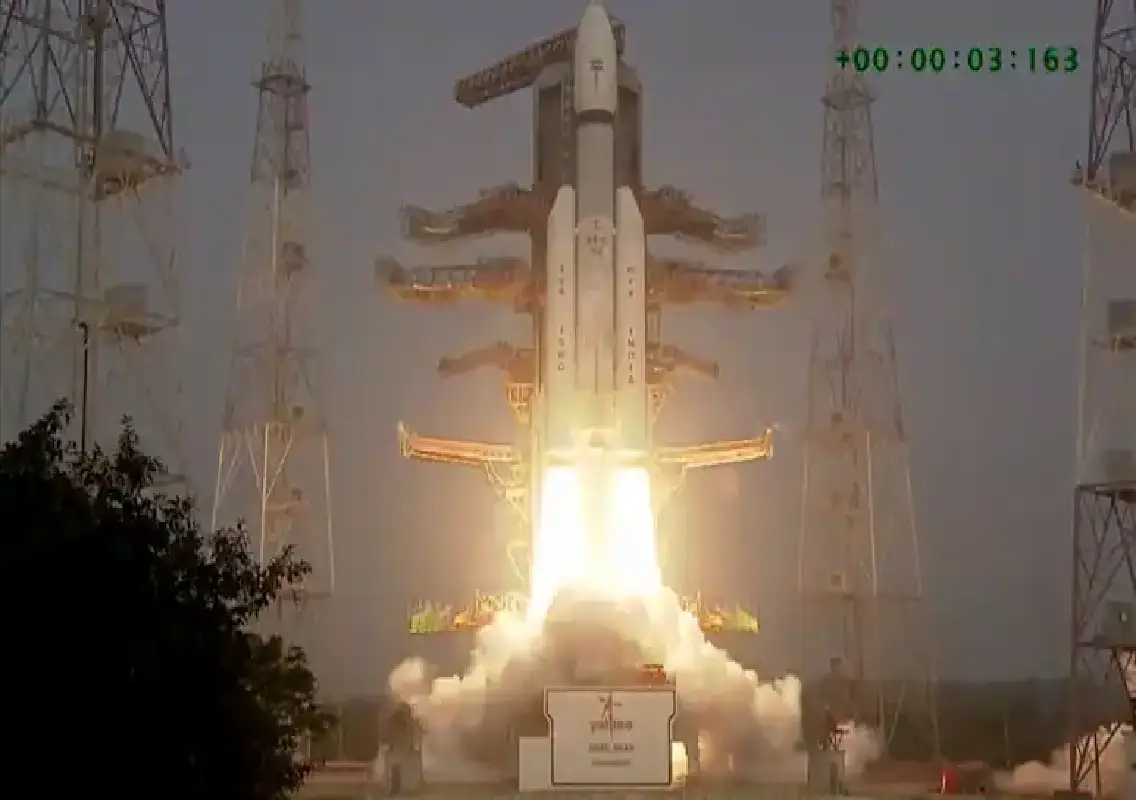


New Delhi: India’s heavy-lift launch vehicle LVM3-M6, popularly known as the ‘Baahubali’ rocket, successfully lifted off from the Satish Dhawan Space Centre in Sriharikota on Wednesday morning, carrying BlueBird Block-2, a next-generation communication satellite of US-based AST SpaceMobile, marking the heaviest payload ever launched by an Indian rocket.
Successful liftoff and precise orbital injection
After the completion of a 24-hour countdown, the 43.5-metre-tall Launch Vehicle Mark-3 roared into the sky at 8.55 am from the second launch pad. The rocket, powered by two S200 solid strap-on boosters, ascended majestically before placing the satellite into its designated low-Earth orbit approximately 15 minutes later.
The BlueBird Block-2 satellite separated successfully and was injected into an orbit at an altitude of around 520 km. Confirming the mission’s success, Dr V. Narayanan, Secretary, Department of Space and Chairman of the Indian Space Research Organisation (ISRO), said the satellite was placed “successfully and precisely” into the intended orbit.
“This is the heaviest satellite ever lifted from Indian soil using an Indian launcher. This mission further demonstrates the excellent track record of LVM3. It is one of the best performances by any launch vehicle in the global arena,” Dr Narayanan said.
A milestone for India’s commercial space programme
The LVM3-M6 mission marks the third fully commercial flight of the LVM3 rocket, undertaken under a commercial agreement between NewSpace India Limited (NSIL), ISRO’s commercial arm, and US-based AST SpaceMobile (AST & Science LLC).
The successful launch strengthens India’s credentials as a reliable global launch service provider, especially in the heavy-lift segment. With this mission, ISRO has further showcased its ability to handle complex, high-mass payloads for international clients, a capability crucial for expanding India’s footprint in the rapidly growing commercial space market.
PM Modi hails achievement
Prime Minister Narendra Modi congratulated ISRO and all stakeholders, calling the launch a proud milestone in India’s space journey.
“The successful LVM3-M6 launch, placing the heaviest satellite ever launched from Indian soil, the spacecraft of USA, BlueBird Block-2, into its intended orbit, marks a significant stride in India’s space sector. It strengthens India’s heavy-lift launch capability and reinforces our growing role in the global commercial launch market,” the Prime Minister said.
Satellite to enable direct-to-smartphone broadband
BlueBird Block-2 is part of AST SpaceMobile’s next generation of communication satellites designed to provide space-based cellular broadband connectivity directly to standard smartphones, without the need for any specialised hardware or satellite phones.
Once operational, the satellite aims to enable voice, data and internet services even in remote or underserved areas, using ordinary mobile devices. The technology is expected to play a key role in bridging connectivity gaps across the world.
Launch delayed briefly for safety
ISRO revealed that the launch was delayed by about 90 seconds as a precautionary measure. Initially scheduled for 8.54 am, the lift-off was pushed to 8.55.30 am after mission planners detected a potential conjunction risk along the rocket’s flight path.
Officials said there was a possibility of space debris or another satellite crossing the trajectory, prompting the last-minute delay to avoid any collision. ISRO noted that such adjustments are becoming increasingly common as Earth’s orbital environment grows more crowded with thousands of satellites.
About the LVM3 ‘Baahubali’ rocket
The Launch Vehicle Mark-3 is ISRO’s most powerful rocket and has been designed for heavy-lift missions. It is a three-stage vehicle comprising two S200 solid strap-on motors, a liquid core stage (L110), and a cryogenic upper stage (C25).
With a lift-off mass of about 640 tonnes and a payload capability of up to 4,200 kg to Geosynchronous Transfer Orbit (GTO), LVM3 has been the backbone of India’s ambitious space missions. In the past, it has successfully launched Chandrayaan-2, Chandrayaan-3, and multiple OneWeb satellite missions carrying a total of 72 satellites.
The previous LVM3 mission, LVM3-M5 carrying the CMS-03 satellite, was successfully completed on November 2, further underscoring the vehicle’s reliability.
Conclusion
The successful LVM3-M6 mission stands as a landmark achievement for India’s space programme, combining technological excellence with growing commercial relevance. By launching the heaviest satellite ever from Indian soil and doing so for an international client, ISRO has reaffirmed India’s position as a major player in the global space industry, paving the way for more high-value commercial and strategic missions in the future.