







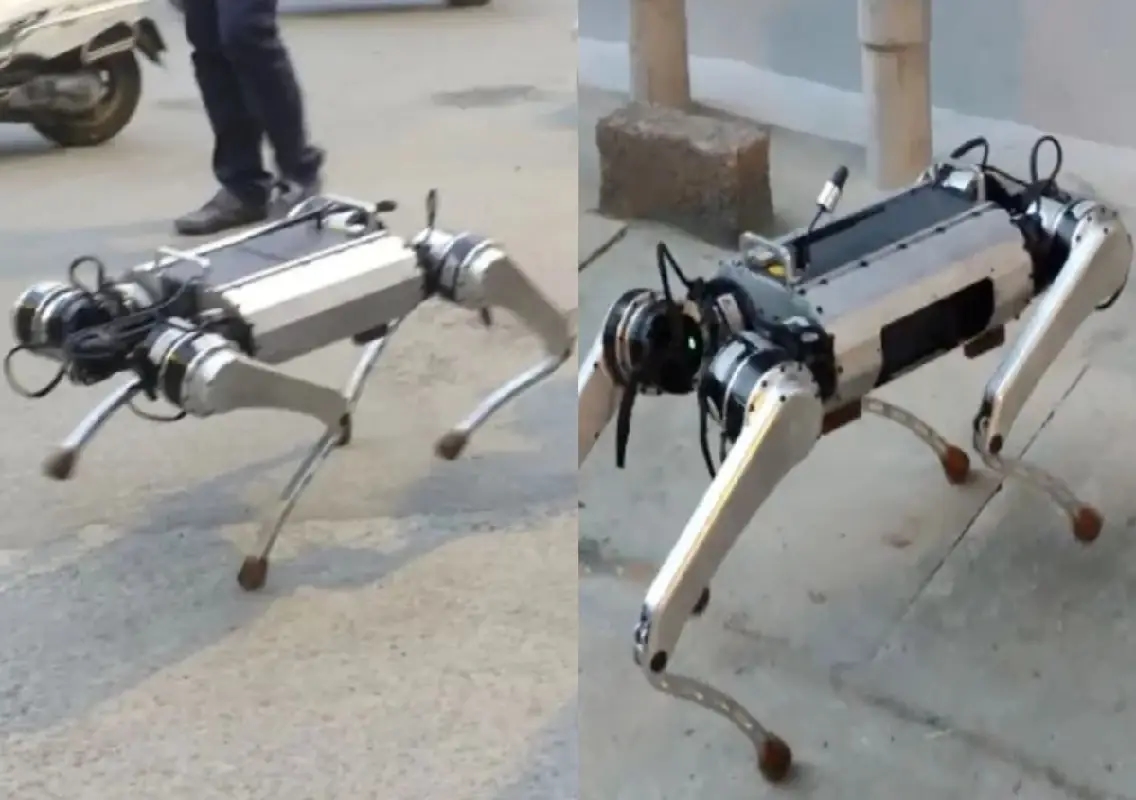


Delhi: Amid the ongoing India AI Impact Expo 2026 in the national capital, a Bengaluru-based robotics startup, General Autonomy, has captured social media attention by unveiling its indigenous quadruped robot named ‘Param’.
The company described Param as “India’s most powerful indigenous robot dog” and stressed that the machine was built from scratch by Indian engineers rather than assembled from imported components. In a post on X (formerly Twitter), the startup declared that the robot was “built in India, built by Indians” and positioned it as a symbol of the country’s deep-tech ambitions.
Viral video showcases capabilities
A now-viral video shared by the startup shows Param navigating through traffic in Bengaluru, demonstrating obstacle detection and autonomous movement. The robot is seen manoeuvring stairs up to 30 cm in height and performing a “crab walk” to enter low-clearance spaces.
According to the company, Param is equipped with autonomous navigation and tracking capabilities, along with automatic fall recovery. The machine appears to stabilise itself after stumbling, a key feature for real-world deployment in unpredictable environments.
Responding to queries online about the development timeline, the startup stated that while it had drawn on prior learning from its humanoid robotics programme, the quadruped project had been underway for about seven months. The team added that improvements are being made every fortnight as part of an ongoing refinement process.
Showcased before Prime Minister
Last month, Param was exhibited before Prime Minister Narendra Modi during an event marking a decade of the Startup India initiative. The demonstration took place in the presence of Union Minister Piyush Goyal as part of the National Startup Day 2026 Deep Tech showcase.
In a social media post, the company said it was honoured to present Param to the Prime Minister and shared a light-hearted remark attributed to him, advising the founder to “take care of Param in Delhi winters”.
The public showcase has further amplified interest in homegrown robotics and artificial intelligence-driven hardware systems emerging from India’s startup ecosystem.
Rising relevance of quadruped robots
Quadruped robots, often referred to as “robodogs”, are engineered for enhanced mobility across uneven and challenging terrain. Unlike wheeled machines, they can climb obstacles, maintain balance on irregular surfaces and operate in confined or debris-filled environments.
Globally, such systems are increasingly used for industrial inspections, hazardous search-and-rescue missions, defence logistics and academic research. Their ability to carry payloads and gather data in high-risk zones makes them particularly valuable for operations where human access is limited or unsafe.
With India placing renewed emphasis on deep-tech innovation and indigenous hardware development, startups like General Autonomy are positioning themselves at the forefront of robotics research and manufacturing.
Boost to India’s deep-tech ambitions
The attention around Param comes at a time when India is seeking to strengthen domestic capabilities in robotics, AI and advanced manufacturing. Industry observers say the success of such projects depends not only on engineering innovation but also on sustained funding, testing environments and policy support.
While it remains to be seen how Param will be deployed commercially or operationally, the demonstration at a national platform has generated significant interest in indigenous quadruped robotics.
As discussions at the India AI Impact Expo 2026 continue, Param has emerged as a talking point on social media, highlighting both the progress and aspirations of India’s robotics ecosystem.