


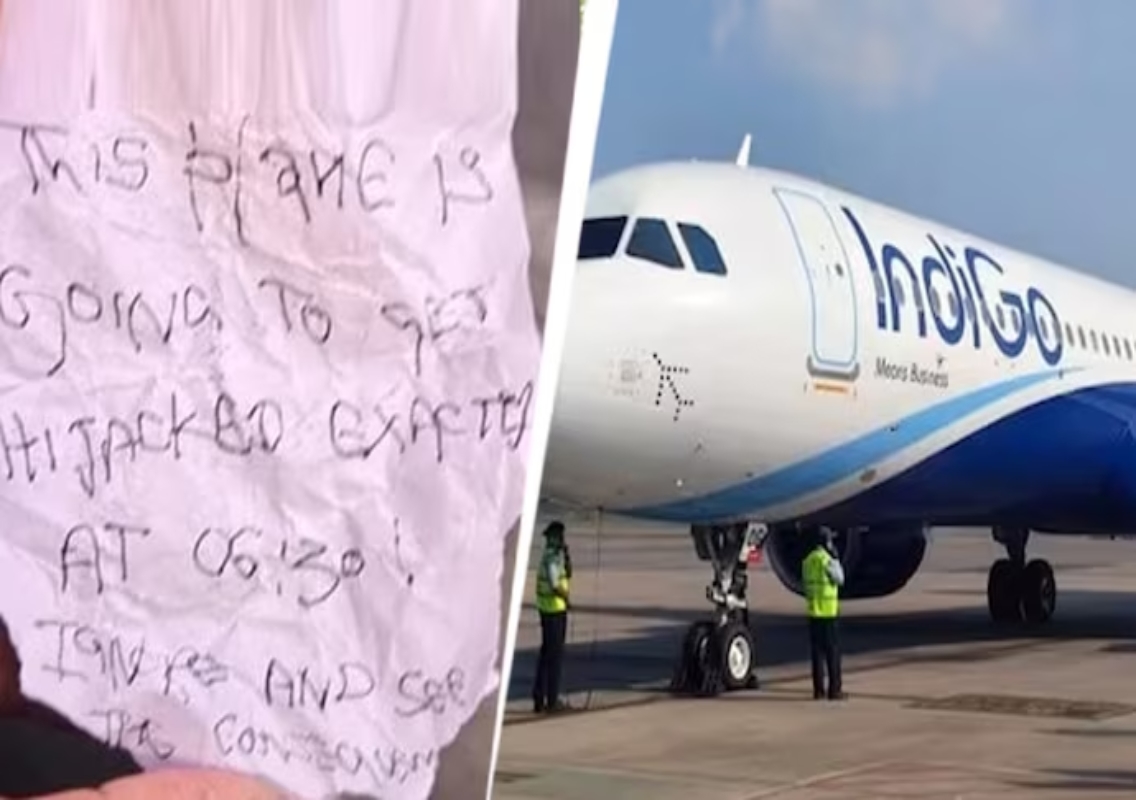


Bengaluru: A Lucknow-bound IndiGo flight returned to Kempegowda International Airport on Saturday evening, November 7, after a handwritten note threatening to hijack the aircraft was discovered inside its lavatory. The incident triggered an emergency response at the airport and a detailed security inspection before the aircraft was cleared to continue its journey.
The flight, identified as 6E 451, was operating from Bengaluru to Lucknow with 178 passengers on board. It had taken off from Bengaluru at approximately 5.50 pm. According to reports, the threat note was spotted by a passenger around 30 minutes after departure, prompting the cabin crew to alert the pilots.
The aircraft returned to Bengaluru as a precautionary measure in accordance with established safety procedures. Following its landing, security personnel carried out checks to establish whether the threat posed any genuine danger.
Later reports said the threat had been declared a hoax after the aircraft underwent a security search lasting around 90 minutes. The flight subsequently resumed its journey to Lucknow on Saturday night.
Passenger discovers threatening note inside aircraft
The security scare began when a passenger reportedly found a handwritten message inside the aircraft’s washroom. The note warned that the plane would be hijacked at a specified time and threatened consequences if the warning was ignored.
The passenger immediately informed the cabin crew about the message. The crew communicated the information to the pilots, who alerted air traffic control and decided to return to Bengaluru.
The discovery of a possible hijack threat is treated seriously in commercial aviation, even when the authenticity of the message has not been established. Pilots and airline personnel are required to follow security procedures rather than assume that a threatening message is harmless.
In this case, the decision to return the aircraft allowed the relevant authorities to inspect the plane and investigate the message without continuing the scheduled journey.
Emergency response at Kempegowda International Airport
The aircraft returned to Kempegowda International Airport in Bengaluru, where security personnel took charge of the situation. Reports said a full emergency was declared at the airport’s Terminal 1 following the threat.
After landing, the aircraft was isolated for security checks. Personnel conducted anti-sabotage inspections to ensure that there were no suspicious objects or other risks on board.
The checks reportedly continued for approximately 90 minutes. A senior police officer cited by The Times of India said the threat was subsequently declared a hoax. The aircraft was then allowed to resume its journey to Lucknow later that night.
The investigation also focused on determining who had written and left the threatening message inside the aircraft. Establishing the source of such a note is important even when the threat is ultimately found to be false.
IndiGo confirms precautionary return
IndiGo confirmed that a security threat had been reported on flight 6E 451, which was operating from Bengaluru to Lucknow on November 7.
The airline said the relevant authorities were informed immediately in line with its Standard Operating Procedure. The pilots then decided to return to the departure airport so that the required security checks could be completed.
The airline also apologised to passengers for the disruption and said it was taking steps to reduce their inconvenience. These included providing refreshments and sharing regular updates while the aircraft underwent the necessary procedures.
IndiGo reiterated that the safety and security of passengers, crew members and aircraft remained its priority.
The airline’s response reflected the standard precautionary approach followed when a security concern is reported during a flight. The aircraft cannot simply continue its journey until the required checks and clearances have been completed.
Flight resumes after security checks
Although the initial report indicated that security checks were underway, subsequent reports provided an update on the outcome. The suspected hijack threat was declared a hoax after the aircraft was searched, and flight 6E 451 resumed its journey to Lucknow later on Saturday night.
The incident caused an unexpected interruption to the travel plans of the 178 passengers. However, the decision to return to Bengaluru ensured that the threat could be assessed on the ground before the aircraft continued its scheduled operation.
Authorities also began investigating the origin of the handwritten note. The available reports did not establish who was responsible for leaving it inside the aircraft.
Hoax threats remain a concern for Indian aviation
False security threats can cause significant disruption to airlines, airports and passengers. Each reported threat requires an assessment by the relevant authorities, even when it eventually turns out to be a hoax.
According to information shared by the Ministry of Civil Aviation in Parliament in February 2025, Indian airlines received 728 hoax bomb threats during 2024. IndiGo accounted for 216 of those reported threats. The ministry also said that 13 people had been arrested in connection with such threats during that year.
Airports have established procedures for assessing threats involving aircraft. A Bomb Threat Assessment Committee is designated at each airport under the applicable Bomb Threat Contingency Plan to evaluate reported threats and determine the appropriate response.
The Bengaluru incident highlights why airlines and airport authorities cannot treat threatening messages casually. Even a handwritten note discovered inside an aircraft can trigger an emergency response, a return to the departure airport, passenger inconvenience and extensive security checks.
For passengers, the disruption can mean delays and uncertainty. For aviation authorities, however, completing the necessary checks before allowing an aircraft to continue is essential.
The IndiGo flight’s return to Bengaluru and its subsequent clearance demonstrate the precautionary approach adopted in response to an onboard security threat. While the message was ultimately declared a hoax, the investigation into its origin remains an important part of the response.