







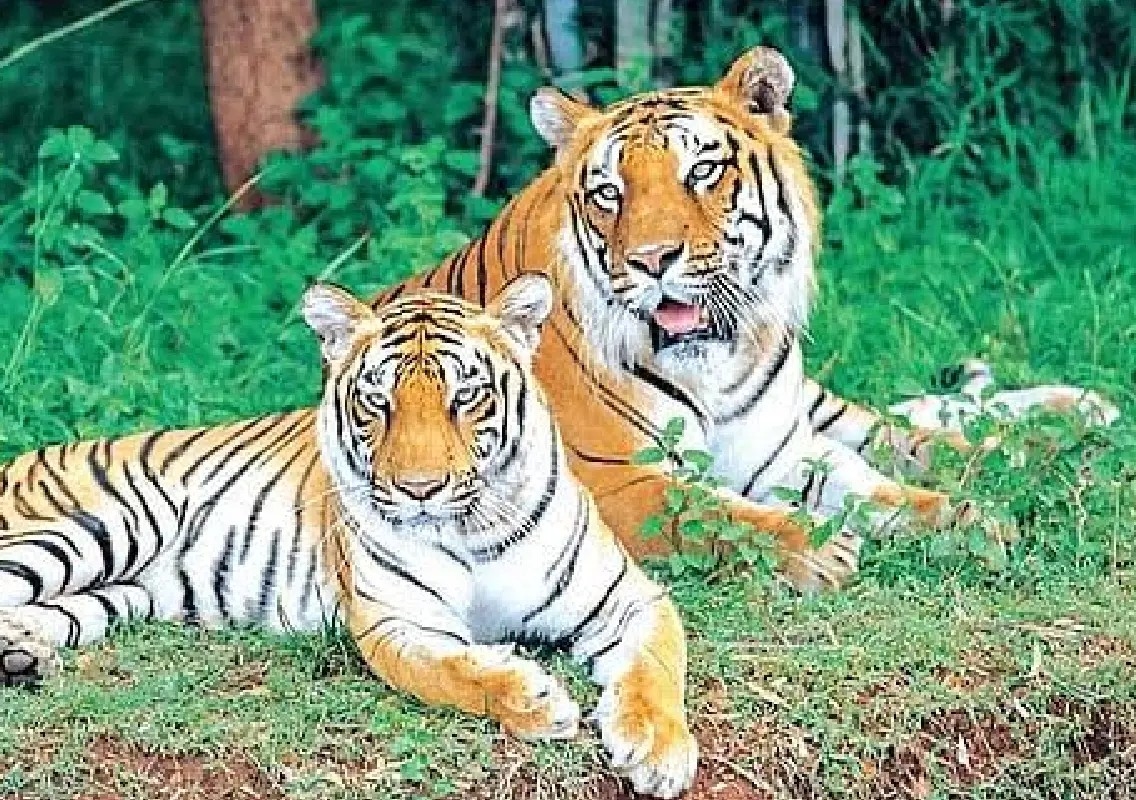


Adilabad : Kawal Tiger Reserve in Telangana has a seemingly favourable environment for tigers, with abundant prey including spotted deer, sambar, nilgai and wild pigs. Yet the reserve has no established resident tiger population, and researchers say extensive infrastructure along connecting corridors is preventing dispersing tigers from settling and breeding.
Kawal is strategically located between two important tiger landscapes: Tadoba-Andhari Tiger Reserve in Maharashtra to the west and Indravati Tiger Reserve in Chhattisgarh to the east. Its location gives the reserve considerable potential to support tigers moving through central India.
However, researchers have found that very few tigers have successfully reached Kawal and remained there. Since 2015, only 15 tigers have been confirmed entering the reserve from Maharashtra, and just two of them were females.
The findings highlight a critical challenge in wildlife conservation: protecting a forest inside a reserve may not be enough if animals cannot safely move between habitats.
Abundant prey but no resident tigers
Kawal has many of the ecological characteristics needed to support tigers.
The reserve contains populations of herbivores and other prey species, including chital, sambar, nilgai and wild pigs. Such prey availability would normally make the landscape suitable for a large carnivore such as the tiger.
Yet the absence of a stable resident population points to another problem — connectivity.
Tigers need large, connected landscapes to disperse, establish territories and find mates. When corridors linking protected areas become fragmented, animals may be able to enter a landscape occasionally but struggle to establish a sustainable breeding population.
Researchers studying Kawal say this is precisely what appears to be happening.
Highways and railways create barriers
The route between Maharashtra’s tiger populations and Kawal contains multiple infrastructure projects.
According to researcher Imran Siddiqui, the corridor has been fragmented by open-cast coal mines, the Ada irrigation project, electrified farm fences and the Hyderabad-Nagpur railway line. National Highway 44 represents another major barrier because of heavy traffic and high fencing.
These obstacles do not operate independently. Instead, they create a landscape containing multiple risks that tigers must negotiate while dispersing.
For a tiger attempting to establish a new territory, repeated encounters with roads, trains, mines and human activity can make an apparently suitable destination difficult to reach.
The problem is particularly significant for female tigers.
Female tigers face greater risks
Male tigers are generally more likely to disperse over long distances in search of territories. Researchers say males can sometimes navigate landscapes dominated by human infrastructure and take greater risks while moving.
Females, however, face different ecological pressures.
A female establishing a territory needs sufficiently quiet and secure habitat in which to raise cubs. Crossing busy highways, railway lines and areas affected by mining can therefore present particularly serious risks.
Researchers say this difference helps explain why male tigers occasionally reach Kawal while females rarely do.
The fact that only two of the 15 confirmed tigers entering the reserve from Maharashtra since 2015 were females is particularly important.
Without females establishing territories and raising cubs, occasional male dispersal cannot create a self-sustaining tiger population.
Human settlements add another challenge
Connectivity is not the only issue facing Kawal.
Wildlife Conservation Trust president and CEO Anish Andheria told Mongabay India that the reserve needs a core area free from human settlements, similar to arrangements in other tiger reserves.
As of 2023, Kawal’s core area contained 37 villages and 67 smaller settlements, according to the report.
The presence of communities inside protected landscapes makes conservation considerably more complicated.
Tiger conservation requires secure habitat, but communities living in these forests also have legal rights and livelihoods that must be respected.
Any effort to create more secure tiger habitat therefore needs to address both ecological requirements and the rights and welfare of local residents.
Relocation has created grievances
The history of relocation in Kawal illustrates the difficulty of achieving that balance.
When Kawal was declared a tiger reserve in 2012, authorities had assured local Adivasi communities that the new conservation status would not undermine their legal rights or livelihoods.
However, local Adivasi leader Siddam Bhujang Rao told Mongabay India that some families relocated from the reserve’s core did not receive the benefits promised under official relocation packages.
According to Rao, families had been promised land, water and model villages, but some were instead moved into houses with deteriorating infrastructure while the promised agricultural land was not provided.
Such experiences can undermine trust between conservation authorities and communities.
For long-term wildlife conservation to succeed, experts and community representatives increasingly emphasise the importance of ensuring that local people are not disadvantaged by conservation measures.
Can tigers be introduced artificially?
Wildlife managers have considered another possible solution: assisted dispersal.
Under this approach, female tigers from areas with high tiger densities, such as parts of Maharashtra, could potentially be moved directly into Kawal.
The idea is intended to overcome the difficulty of females crossing dangerous infrastructure corridors.
However, researchers caution that moving animals into the reserve does not address the underlying connectivity problem.
Siddiqui described manual translocation as no shortcut for repairing broken wildlife corridors. Local Adivasi leader Rao also opposed the proposal, saying that bringing tigers from elsewhere would not solve the fundamental problems.
The concern is that relocated tigers could still face fragmented habitat, human settlements and other pressures after being introduced.
Restoring corridors may offer a longer-term answer
The Kawal situation illustrates why wildlife corridors are becoming increasingly important in India’s tiger conservation strategy.
Protected areas cannot always function as isolated islands. Tigers and other large mammals need to move between forests for dispersal, breeding and genetic exchange.
The National Tiger Conservation Authority identifies corridor protection as an important component of tiger conservation, alongside protection of core and buffer habitats.
Restoring connectivity around Kawal could therefore involve addressing several issues at once — reducing the impact of highways and railways, managing mining-related disturbance, improving wildlife crossings and ensuring that development projects take animal movement into account.
Electrified farm fencing and other hazards would also need careful management.
Development and conservation must coexist
The Kawal case presents a broader challenge facing wildlife conservation across India.
Roads, railways, irrigation projects, mines and other infrastructure are essential for economic development and connectivity between human communities. At the same time, poorly planned infrastructure can divide habitats and prevent wildlife from moving through landscapes that were historically connected.
The solution is not necessarily to stop all infrastructure development. Instead, conservation planners increasingly focus on designing infrastructure in ways that maintain ecological connectivity.
Wildlife crossings, underpasses, overpasses, fencing modifications and restrictions on traffic in particularly sensitive areas can help reduce risks where roads and railways pass through important habitats.
Such measures need to be based on evidence about how animals actually move through the landscape.
Kawal’s tiger potential remains significant
Despite the challenges, Kawal’s ecological potential remains significant.
The reserve is connected geographically to major tiger populations in neighbouring states, while its prey base provides an important foundation for supporting the species.
The problem is therefore not simply a lack of food.
It is the combination of fragmented corridors, infrastructure, human settlements and the difficulty female tigers face while dispersing into the landscape.
The experience of Kawal shows that a tiger reserve’s boundaries alone cannot guarantee tiger recovery.
Protecting the path, not just the destination
India’s tiger conservation success has demonstrated the value of protected areas, but the Kawal experience highlights the next challenge: ensuring that animals can safely travel between those protected areas.
A forest may provide excellent habitat once a tiger reaches it, yet remain functionally inaccessible if roads, railway lines, mines and other infrastructure prevent animals from arriving and settling.
For Kawal, restoring safe connectivity could be more important than simply introducing additional tigers.
The reserve already has prey and forest habitat. What appears to be missing is a sufficiently secure pathway for breeding females and other dispersing animals to reach it and remain there.
The future of tigers in Kawal may therefore depend less on moving animals into the reserve and more on reconnecting the forests that surround it — while ensuring that conservation efforts respect the communities that have long lived in the landscape.