







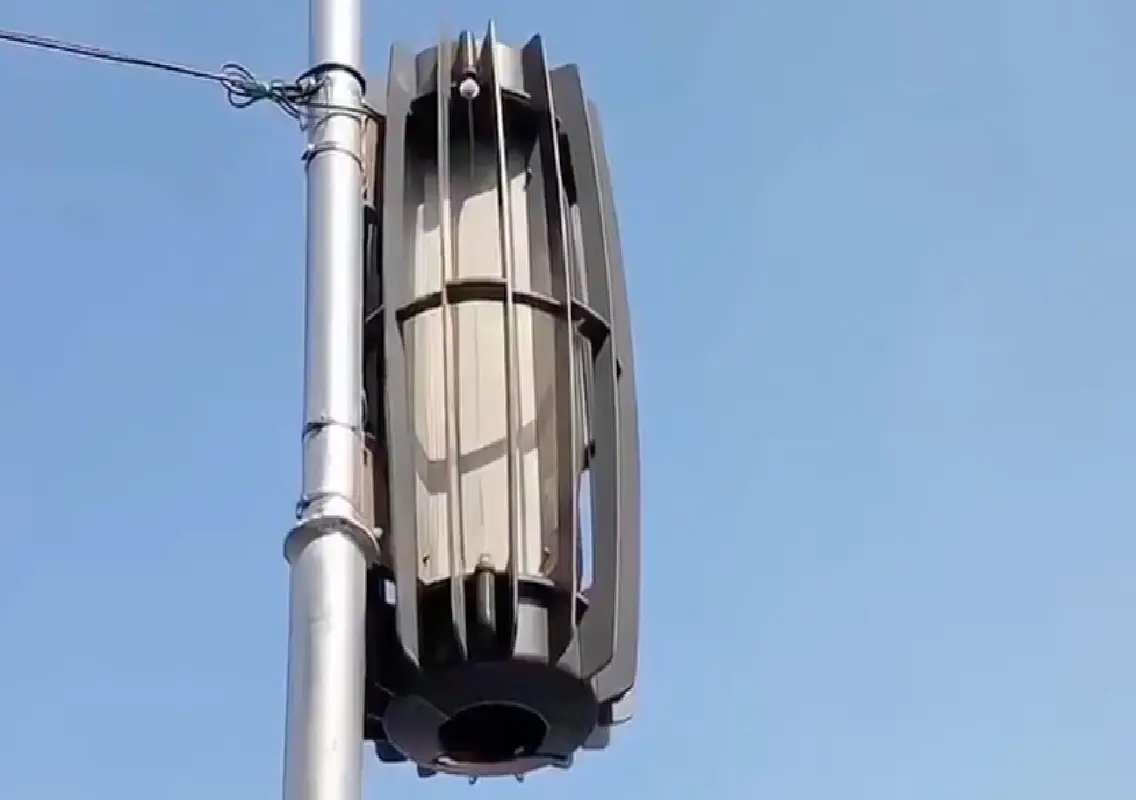


Jaipur: In a bid to tackle rising air pollution levels, the Jaipur administration has installed large outdoor air purifiers across key stretches of the city. The move comes at a time when the Air Quality Index (AQI) in the Rajasthan capital has been fluctuating between ‘moderate’ and ‘poor’ categories. On Friday, November 14, Jaipur recorded an AQI of over 190, indicating moderately polluted air.
According to officials, several modular “PAMARES”-style purification towers—each around eight metres tall—have been set up at high-traffic locations such as Jawahar Circle and Tonk Road. A total of four units have been deployed so far. These machines reportedly filter up to one million cubic metres of air per hour, making them among the largest air purification systems installed in any Indian city.
The rollout began on the intervening night of November 12 and 13, and the units are expected to become fully functional by November 15, according to reports.
Air purifier video sparks social media backlash
Even as the initiative gained attention, a viral video from Rambagh Street—showing one of the purifiers enclosed within a protective metal cage—triggered widespread questioning on social media. Netizens criticised not only the cage but the very concept of using outdoor purifiers to combat a city-wide pollution problem.
Many argued that while the machines might offer hyperlocal relief, they are unlikely to make a measurable dent in broader pollution levels caused by vehicular emissions, industrial activity, construction dust, and seasonal particulate matter.
Users on X (formerly Twitter) expressed frustration over the choice of measure, calling the purifiers “gimmicky” and “impractical”.
“A lot of taxpayer money could be saved,” one user wrote.
“There’s no way that works,” commented another.
Several users pointed out that the installation of these machines contradicts recent instances of tree cutting across the city. “Plant more trees instead!! Installing purifier and cutting trees,” one post remarked.
Another user wrote: “God and nature has given us natural air purifiers in the form of trees and we are the only foolish species who try to prove ourselves smart by making and installing air purifiers to clean our own air after polluting it.”
Some citizens also highlighted that real air purification requires large-scale airflow, far beyond what compact street units can achieve. “People should know these tiny air purifiers are just political stunts. Real air cleaning needs huge airflow, and HEPA filters are hard to maintain,” a comment said, recommending vertical gardens, moss walls and misting systems as more sustainable alternatives.
Debate over effectiveness
Environmental experts have long argued that outdoor air purifiers—despite high filtration capacities—are best suited for closed or semi-enclosed spaces, such as underpasses, bus stands, or market areas. Their effectiveness in open urban environments remains limited due to constant movement of polluted air.
While the Jaipur administration has not yet released official performance data, the initiative has sparked conversations about long-term strategies. Critics say that the city needs stronger measures such as:
- increasing green cover,
- improving public transport,
- regulating dust from construction sites, and
- monitoring industrial emissions.
Understanding the AQI scale
For residents, the AQI reading remains an important indicator of daily exposure risk. As per national standards:
- 0–50: Good
- 51–100: Satisfactory
- 101–200: Moderate
- 201–300: Poor
- 301–400: Very poor
- 401–500: Severe
With Jaipur hovering around the moderate zone, doctors advise that vulnerable groups, including elderly citizens and children, avoid prolonged outdoor activity on days when particulate levels spike.
Conclusion
As the city awaits full activation of the new air purification towers, the debate reflects broader concerns about environmental planning. While authorities see the initiative as a technological intervention, many residents believe that restoring natural green buffers and enforcing stricter pollution-control norms would offer more sustainable relief.