







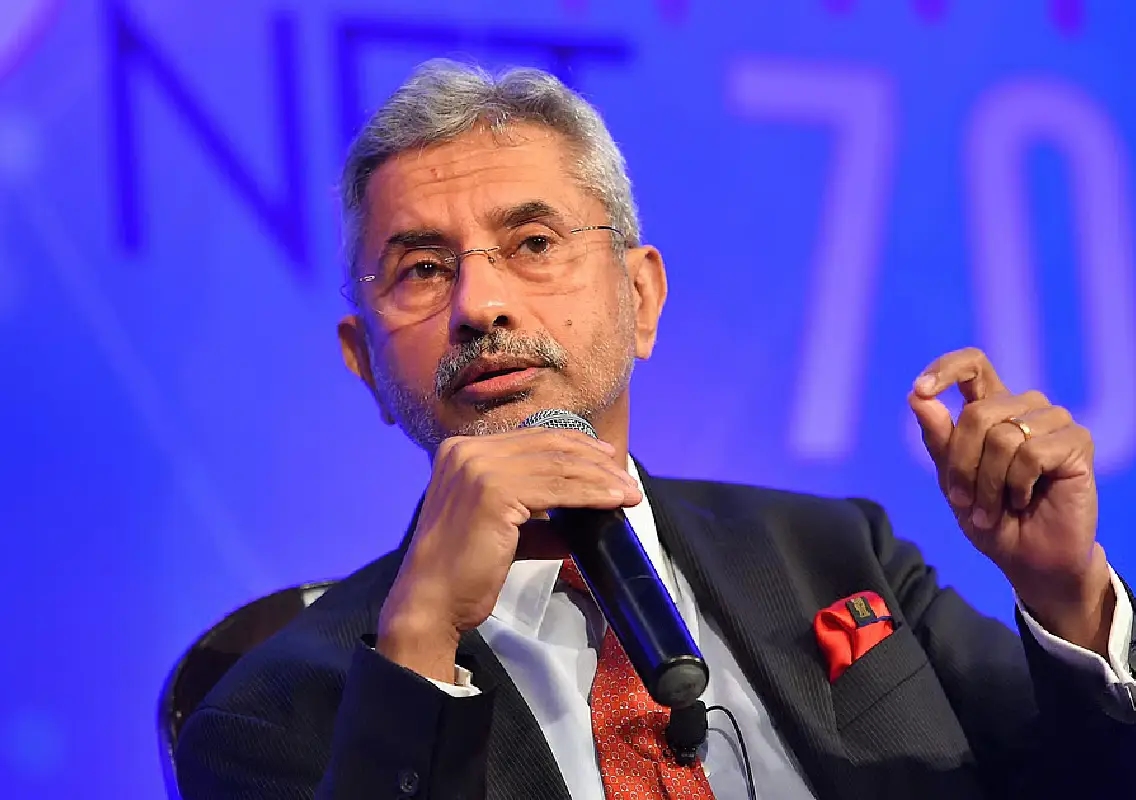


External Affairs Minister S Jaishankar on Sunday highlighted the deepening impact of US-China relations on global politics, warning that growing competition between the two powers is shaping a risk-laden international environment. Speaking at the 4th Kautilya Economic Conclave in the national capital, he outlined how shifting global alliances, energy transitions, and economic uncertainties are redefining the geopolitical order.
US-China ties shaping world politics
Jaishankar said that the evolving relationship between the United States and China will be a defining factor in the trajectory of global politics. “Clearly, what we can see is that the US-China relationships in many ways are going to influence the direction of global politics,” he said.
He described how both powers are recalibrating their strategic outlooks. “In the case of the United States, it is not only more assertive, but it has encouraged its national interest goals to drive its approach towards partnerships and cooperation,” he said.
On China, Jaishankar observed that the shift has come at a time when many of its new concepts, mechanisms, and institutions are still taking shape. “This change perhaps catches them at a time when many of the new frameworks they were pushing are not yet in place,” he noted.
Europe’s shifting geopolitical balance
Turning to Europe, Jaishankar pointed out how the earlier balance between the US, Russia, and China has been disrupted. “What was a sweet spot in terms of US-Russia-China, US-security, Russia-energy, and China-trade has actually got turned around, and every one of those aspects today has become a challenge,” he said.
He emphasised that the war in Ukraine, the energy transition, and shifting security priorities have left Europe grappling with a more uncertain strategic environment.
Changing global energy dynamics
The minister also noted a major transformation in global energy dynamics. “One of the big changes of the last few years has been that the United States, which for decades worried about its exposure to external energy requirements, has not only become self-sufficient, it is actually today a significant exporter of energy,” he said.
Jaishankar added that the US has made energy exports a critical part of its strategic outlook. In contrast, China has emerged as a global leader in renewable energy, he observed. “Just as the US has become a champion of fossil fuels, China has also established itself as a leader in renewables. So pretty much any path you take on renewables, all roads lead back there as well,” he said.
Intensifying global competition
Jaishankar also commented on a broader shift in how major powers exercise influence. “We have seen in the cases of major polities that their belief in balance of power is probably much less. They seem to think that they may not need the rest of the world as much as they did before,” he said.
He warned that this perception, coupled with expanding power margins, has emboldened nations to exercise unilateral influence. “If they have margins of power, they are prepared to exercise those margins in pursuit of their policies and actions,” he added.
The minister cautioned that international competition is intensifying, saying, “We have seen the global needle move much more towards competition. There is today a tendency to weaponise almost everything, and if a State has a tool in its toolkit, there is much less reticence, particularly on the part of major powers, to use that.”
‘A paradoxical global economy’
Speaking on the state of the global economy, Jaishankar described what he termed a paradoxical environment. “The intensity of multiple happenings converging on the global economy at the same time is setting into motion a paradoxical situation,” he said.
He explained that while certain global trends encourage higher risk-taking, the same trends also create a drive to de-risk every aspect of politics and economics. “It is almost like you are raising the height of the trapeze and removing the safety net with each passing day. That is the state of the international polity today,” Jaishankar concluded.