


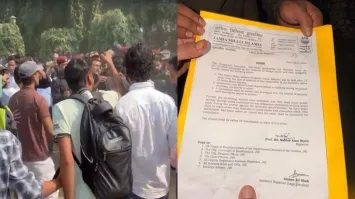


New Delhi: Jamia Millia Islamia has announced a timeline for restoring its students’ union and holding elections, addressing a key demand of students who have been protesting for more than two weeks. The university has set May 15, 2027, as the deadline for approving and implementing the union constitution, with polling expected around mid-August.
The administration also announced that disciplinary proceedings initiated against students involved in the agitation would be withdrawn. Orders relating to expulsion and suspension, along with restrictions on campus entry, are also set to be revoked under the latest order issued by the Registrar’s Office on Thursday.
The announcement marks a significant development in the prolonged demand for an elected students’ body at Jamia Millia Islamia, where students’ union elections have not been held since 2006. The university has also appealed to the protesters to end their agitation and announced that classes and examinations would return to the campus after being shifted online in recent days.
Jamia announces dates for union constitution and elections
According to the latest order, the Jamia Millia Islamia Students’ Union (JMISU) constitution will be approved and implemented by May 15, 2027.
The university has further stated that elections will be conducted within the stipulated period following July 16, 2027. Under the timeline outlined by the administration, polling is expected to take place around mid-August 2027.
The order also states that once the union constitution is approved, the university will issue a formal notification for elections in accordance with the guidelines of the Lyngdoh Committee, which provides recommendations on student union elections in higher educational institutions.
The announcement addresses one of the principal objections raised by the protesting students: the absence of a clear and time-bound commitment from the administration.
The latest order follows an earlier settlement attempt on October 26, when the university said elections would take place 15 days after approval of the students’ union constitution. Students rejected that arrangement, arguing that it did not specify when the constitution itself would be approved.
Why students rejected the October 26 order
The October 26 order had attempted to address the agitation by revoking suspension and show-cause notices issued to students during the protest.
However, the order did not provide a fixed deadline for approving the union constitution. It also did not explicitly address all the disciplinary measures that students wanted withdrawn, including rustication orders and restrictions on entering the campus.
The students maintained that the absence of a definite timetable could allow the process to be delayed indefinitely.
They had demanded that the constitution be drafted and approved by December 20, with elections held within 15 days thereafter. The latest timeline differs from that demand, setting May 15, 2027, as the deadline for approval and implementation of the constitution and placing the election process later in the year.
The revised order therefore provides a more specific framework for restoring the union, although the election process remains several months away.
Disciplinary action against protesters to be withdrawn
The latest order also addresses the students’ demand for the withdrawal of disciplinary action taken during the agitation.
The administration has stated that show-cause notices and disciplinary proceedings initiated against students participating in the protest will be withdrawn. Orders concerning expulsion and suspension, as well as restrictions on campus entry, are also to be revoked.
These provisions go beyond the October 26 order, which had referred specifically to the withdrawal of suspension and show-cause notices issued during the protest.
The broader scope of the latest order is significant because the students had objected to being required to accept a settlement that did not address all the consequences they faced for participating in the agitation.
The administration has appealed for the protest to end following the revised announcement. Whether the new terms will satisfy the protesters will depend on their response to the specified deadlines and the proposed withdrawal of disciplinary measures.
Students opposed apology conditions in earlier settlement
The earlier settlement attempt had included conditions that became another point of disagreement.
According to the October 26 order, the protesting students had undertaken to apologise at a press conference for any defamatory statements, actions or social media posts directed against the administration. The order also directed that the relevant social media posts be removed immediately and that the protest be called off once the order was issued.
The protesters rejected these conditions, arguing that students should not be required to apologise for exercising their right to peaceful protest.
The disagreement highlighted the gap between the administration’s attempt to end the agitation and the students’ demand for a settlement that addressed their concerns without imposing conditions they considered unacceptable.
The latest order focuses on the timeline for the constitution and elections, alongside the withdrawal of disciplinary measures. The administration has also appealed for the agitation to end and for normal academic activities to resume on campus.
Why Jamia has not held union elections since 2006
The Jamia Millia Islamia Students’ Union was dissolved in 2006, and the university has not conducted elections for a students’ union since then.
The administration has previously attributed the dissolution to a series of violent incidents, the last of which it said involved an attack on the Vice-Chancellor.
From 2012 onwards, the university also cited a pending petition before the Delhi High Court as a reason elections could not be held. Students have disputed the administration’s position on the matter.
The absence of an elected students’ union has remained a longstanding concern for students seeking formal representation in university affairs.
Student unions typically provide an elected platform through which students can raise concerns about campus facilities, academic policies, welfare measures and disciplinary decisions. The restoration of the JMISU would therefore establish a formal electoral mechanism for student representation after a gap of more than two decades.
The constitution is central to that process because it must set out the union’s structure, membership, election procedures and functioning.
Constitution committee had cautioned against immediate elections
On October 23, the committee responsible for drafting the students’ union constitution said announcing elections immediately would be premature because the union did not have an approved constitution or an established electoral mechanism.
The committee’s position underlined the procedural steps required before elections could take place. Without a constitution, the university would need to establish the rules governing the union and the conduct of the electoral process.
The latest order now provides a deadline for approving and implementing the constitution, followed by an election notification under the Lyngdoh Committee guidelines.
The process will require the administration to complete the constitutional work and establish the arrangements necessary for polling. The timetable is intended to give students a clearer indication of when the elected body could return.
However, the actual election schedule will depend on the formal notifications and steps taken by the university as the deadline approaches.
Classes and examinations to return to campus
The university has also announced that classes and examinations will return to the campus after being restricted to online mode during the agitation.
The shift to online academic activities had been introduced over the preceding days as the protest continued. The decision to resume on-campus teaching and examinations forms part of the administration’s appeal for normal activities to restart.
The disruption has added pressure on both the university and students, particularly as the agitation has continued for more than two weeks.
The administration’s latest move seeks to address the central demand for an elected students’ union while also restoring regular academic functioning.
Jamia protest follows agitation at Aligarh Muslim University
The developments at Jamia come after a similar agitation at Aligarh Muslim University in Uttar Pradesh, where students demanded the restoration of students’ union elections.
The AMU administration agreed to restore elections following a 19-day hunger strike and scheduled polling for November 5.
The parallel protests have brought renewed attention to student representation at two prominent central universities.
While the circumstances and timelines at the two institutions differ, both agitations have focused on the demand for elected student bodies and a formal mechanism for student participation in university affairs.
At Jamia, the latest order represents an attempt to resolve the immediate dispute through a defined timetable and the withdrawal of disciplinary action.
What happens next?
The immediate question is whether the revised timeline and the broader withdrawal of disciplinary measures will persuade the protesting students to call off their agitation.
The university has now committed to approving and implementing the JMISU constitution by May 15, 2027, with elections expected around mid-August under the announced schedule. It has also appealed for the protest to end and for classes and examinations to return to campus.
The next steps will involve completing the constitution, issuing the formal election notification and establishing the procedures required for polling in accordance with the Lyngdoh Committee guidelines.
For students, the announcement provides a clearer timeline than the earlier settlement attempt. For the administration, the challenge will be to implement the commitments while restoring normal academic activities.
After nearly two decades without students’ union elections, the proposed timetable sets out a path towards restoring an elected body at Jamia Millia Islamia. Whether the current agitation ends will depend on how students respond to the revised terms and whether the administration follows through on its commitments.