





Mumbai: Reliance Industries’ Jio Platforms is preparing for its stock market debut on October 28, 2026, after attracting strong investor demand for its Rs 30,213-crore initial public offering (IPO). The issue was subscribed 22.19 times, supported by heavy institutional interest and a record number of applications. However, the performance of previous mega IPOs suggests that strong demand alone may not guarantee a successful listing.
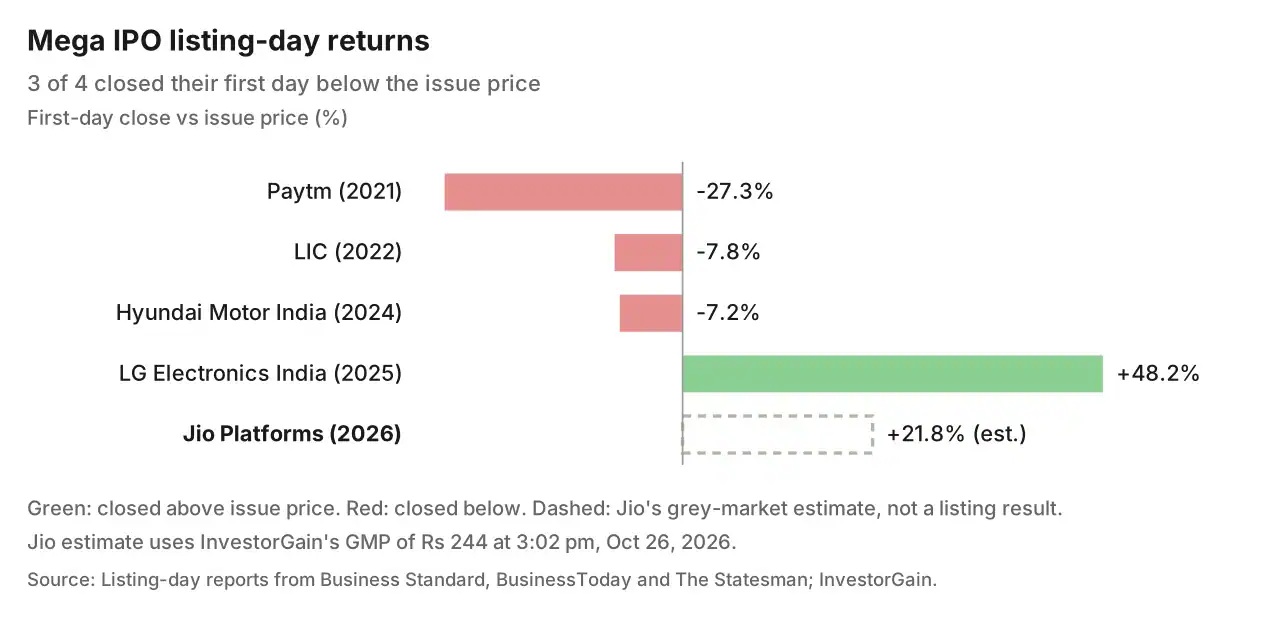
India’s largest public offerings have delivered mixed results on their first trading days. Paytm, Life Insurance Corporation of India (LIC) and Hyundai Motor India all closed below their respective issue prices on debut, while LG Electronics India delivered a substantial listing-day gain in October 2025. The National Stock Exchange’s recent listing also offered a reminder that an initially positive debut does not necessarily translate into sustained gains.
Jio enters the market with several advantages, including substantial institutional demand and an IPO structured entirely as a fresh issue. However, a weakening stock market, elevated oil prices and continued foreign investor selling could influence its debut.
The central question is whether Jio’s strong subscription numbers and business profile will be enough to overcome the uncertain market environment.
India’s mega IPOs have delivered mixed listing-day results
The performance of India’s largest IPOs reveals a clear difference between investor enthusiasm before listing and the actual price investors are willing to pay once trading begins.
Among the offerings highlighted in recent market data, Paytm, LIC and Hyundai Motor India all ended their first trading sessions below their issue prices. LG Electronics India, by contrast, closed substantially higher despite its offering also being an offer for sale.
The comparisons suggest that the level of demand, particularly from institutional investors, and the market environment surrounding a listing can influence how a newly listed company performs.
Paytm suffered the sharpest debut
Paytm’s Rs 18,300-crore IPO, launched in November 2021, remains one of the most striking examples of a weak debut among India’s major offerings.
The issue was priced at Rs 2,150 per share and received subscriptions of 1.89 times the shares on offer. The stock listed at a discount and continued to decline during its first trading session.
Paytm closed its debut on the BSE at Rs 1,564, approximately 27.3% below the issue price. The fall represented a significant loss in market value for investors who had been allotted shares at the IPO price.
The listing demonstrated that a large offering and substantial public attention do not necessarily translate into strong demand once trading begins.
Paytm’s experience also highlighted the importance of investor confidence in a company’s valuation, business model and ability to deliver sustainable growth.
LIC closed below its issue price
The Life Insurance Corporation of India’s IPO in May 2022 was the country’s largest public offering at the time.
The government raised approximately Rs 20,557 crore by selling a 3.5% stake in the state-owned insurer. The shares were offered at Rs 949 apiece, and the issue was subscribed 2.95 times.
LIC listed on the BSE at Rs 867.20 and finished its first trading day at Rs 875.45, a decline of approximately 7.75% from the issue price.
The subdued debut came despite LIC’s established position in India’s insurance industry and the scale of public interest surrounding the offering.
Its performance illustrated that brand recognition and a large investor base may not be sufficient to support an IPO price if market participants believe the valuation leaves limited room for gains.
Hyundai Motor India faced valuation concerns
Hyundai Motor India’s Rs 27,870-crore IPO in October 2024 surpassed LIC’s offering to become India’s largest IPO at that time.
The company priced its shares at Rs 1,960, but the stock closed its first trading day at approximately Rs 1,819, around 7.2% below the issue price.
The IPO received subscriptions of about 2.4 times the shares on offer. Demand from retail and wealthy individual investors was relatively subdued amid concerns over valuation.
Market conditions also deteriorated around the listing. The Nifty declined approximately 2.6% between the opening of the IPO and listing day, while the Nifty Auto index fell about 7%.
Hyundai’s debut therefore reflected both concerns about the price investors were being asked to pay and a difficult environment for equities.
LG Electronics India showed how strong demand can help
LG Electronics India provided a contrasting example when it listed in October 2025.
Its Rs 11,607-crore IPO was priced at Rs 1,140 per share and subscribed approximately 54 times. Institutional demand was particularly strong, with qualified institutional buyers bidding for more than 165 times their allocated portion.
The stock opened on the BSE at Rs 1,715, a premium of around 50% over the issue price. It ended the session near Rs 1,689, retaining a gain of approximately 48%.
The result stood out because the offering was structured entirely as an offer for sale, meaning the proceeds went to selling shareholders rather than directly to the company.
That performance provides an important comparison for Jio. It suggests that an offer-for-sale structure does not automatically lead to a weak debut and that strong investor demand can support substantial listing gains.
However, LG’s performance should not be treated as a guarantee that another heavily subscribed IPO will deliver a similar outcome. Each offering has its own valuation, business prospects and market conditions.
NSE’s listing offers a reminder about longer-term performance
The National Stock Exchange’s Rs 22,563-crore offer for sale provides another useful comparison.
Priced at Rs 1,785 per share, the issue received subscriptions of approximately 4.26 times. NSE listed on the BSE on September 24 at Rs 1,800 and ended its first session near Rs 1,818, a gain of less than 2% over the issue price.
The subsequent share-price movement was less encouraging. According to the figures cited in the source data, NSE shares had slipped to around Rs 1,669 by the following Friday, approximately 6.5% below the issue price.
The performance illustrates the distinction between a stock’s listing-day outcome and its returns over a longer period.
A positive debut can reflect immediate buying interest, but the stock’s subsequent performance depends on earnings expectations, valuation, market sentiment and other factors. Investors therefore need to consider more than the opening price when evaluating an IPO.
What the previous mega IPOs reveal
The previous listings point to three factors that may help explain the differences in debut-day performance.
First, the overall subscription level matters, although it is not a reliable predictor on its own. Paytm, LIC and Hyundai all received subscriptions below three times, while LG Electronics attracted much stronger demand. NSE’s more moderate subscription was followed by a relatively small listing gain.
Second, institutional participation can be an important indicator of demand. LG Electronics received particularly strong bids from qualified institutional buyers, while Jio’s institutional subscription has also been substantial.
Third, market conditions can affect how investors approach a new listing. Hyundai’s debut coincided with a decline in the broader market and the automobile index, while Jio faces a period of weakness in Indian equities.
The structure of an IPO also deserves attention, but it is not necessarily the deciding factor. Hyundai, LIC and LG Electronics all conducted offers for sale, yet their listing-day outcomes differed sharply.
Jio’s entirely fresh issue distinguishes it from those offerings, but that difference alone cannot determine its performance.
Jio IPO subscription points to strong demand
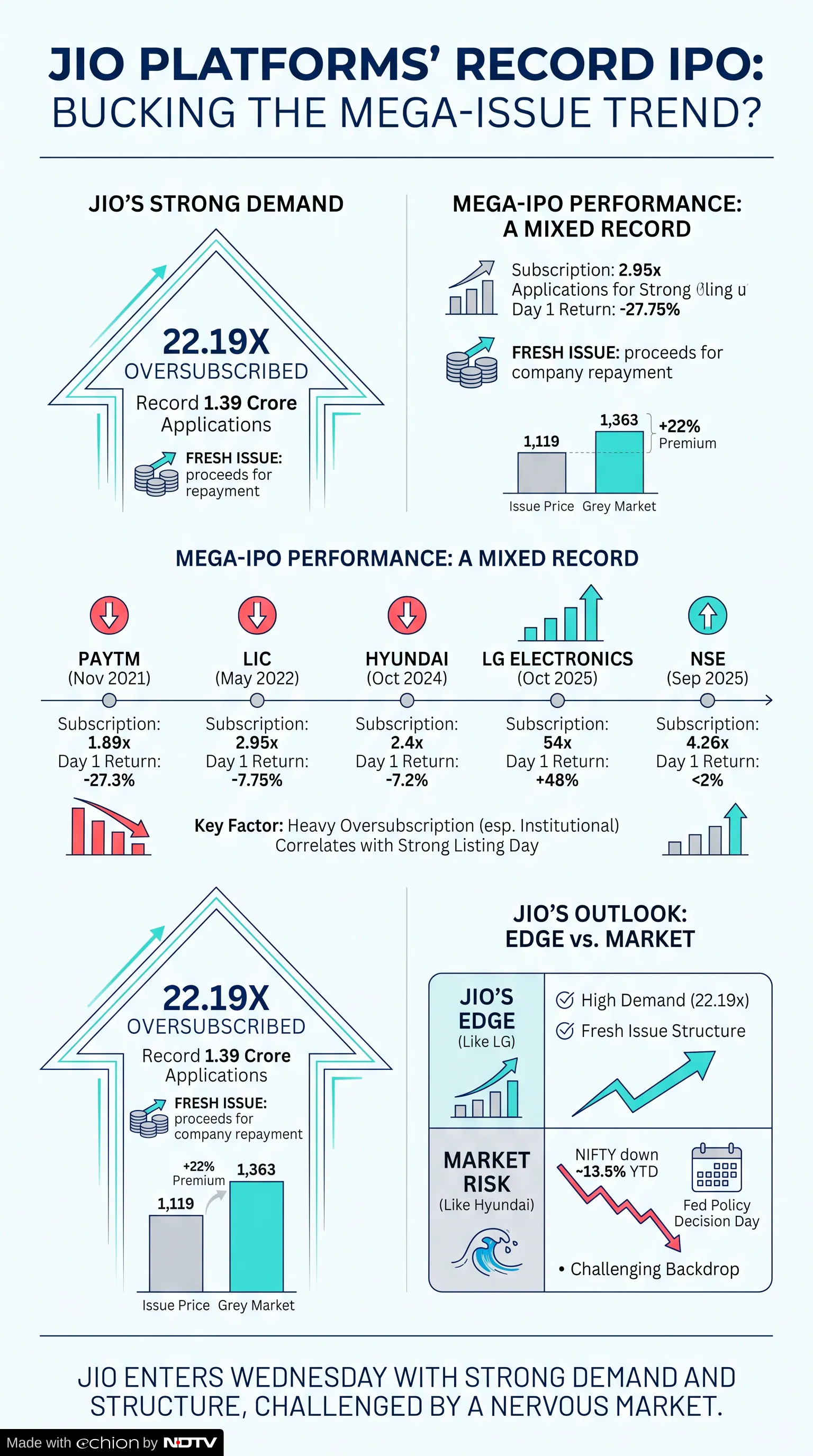
Jio Platforms’ Rs 30,213-crore IPO was subscribed 22.19 times, according to the figures provided.
Qualified institutional buyers led the demand, subscribing to their allotted portion 70.55 times. Retail investors subscribed 2.72 times their quota.
The issue also attracted approximately 1.39 crore applications, setting a record according to the supplied data.
The subscription figures indicate substantial interest in Jio’s offering, particularly among institutional investors. Its overall demand is significantly higher than that recorded for Paytm, LIC and Hyundai Motor India.
However, subscription levels measure demand during the IPO process, not the price at which investors will ultimately trade the shares after listing. The market’s assessment of Jio’s valuation and future earnings will become clearer once regular trading begins.
Jio’s fresh-issue structure sets it apart
Unlike an offer for sale, in which existing shareholders sell shares and receive the proceeds, Jio Platforms’ IPO consists entirely of a fresh issue of 27 crore shares.
The money raised will therefore go to the company. According to the supplied details, up to Rs 27,500 crore is earmarked for repayment of borrowings at its telecom subsidiary, Reliance Jio Infocomm.
Reducing debt at the telecom arm could help the group manage its financing obligations. However, the impact on Jio Platforms’ overall financial position will depend on the final use of the proceeds and the wider financial structure of the business.
The fresh-issue format is one of the distinguishing features of the offering, although investors will still need to assess the company’s valuation, growth outlook and financial performance.
Grey market premium points to a strong opening
The unofficial grey market also indicated optimism ahead of Jio’s listing.
According to InvestorGain figures cited in the source material, Jio’s grey market premium stood at Rs 244 at 3.02 pm on Monday. Against the issue price of Rs 1,119, that implied an indicative price of approximately Rs 1,363, or nearly 22% above the issue price.
The reported premium had been around Rs 250 on the day the IPO closed.
Grey market premiums are unofficial, unregulated indicators of investor sentiment. They can change quickly and do not guarantee the actual listing price or the returns investors will receive.
The premium therefore suggests expectations of a strong opening but should not be treated as a reliable forecast of the stock’s market performance.
A difficult market could complicate Jio’s debut
Despite the strong subscription figures, Jio faces a challenging broader market environment.
The Nifty was reported to be down approximately 13.5% for the year and trading near its 52-week low. Elevated oil prices and continued selling by foreign investors have added to concerns about Indian equities.
A weak market can affect IPO performance by making investors more cautious about valuations and reducing their willingness to buy newly listed shares at a premium.
Jio is also scheduled to list on the day of a US Federal Reserve policy decision, with the announcement expected after Indian markets close. The policy outcome and accompanying signals about interest rates could influence global financial sentiment, although the direction of any market reaction is uncertain.
These conditions create a contrast between Jio’s strong IPO demand and the more cautious environment in which its shares will begin trading.
Will Jio avoid the mega-IPO listing-day problem?
Jio enters its listing with several factors working in its favour: substantial institutional demand, a record number of applications and a fresh-issue structure that directs proceeds to the company.
Its subscription levels are also much stronger than those recorded for Paytm, LIC and Hyundai Motor India, all of which closed their debut sessions below their issue prices.
However, LG Electronics’ performance shows that strong demand can translate into a substantial listing gain, while NSE’s subsequent decline demonstrates that an initially positive debut does not guarantee sustained returns.
Jio’s outcome will depend on the interaction between investor demand, valuation, market sentiment and expectations for its business. The grey market premium provides one indication of sentiment, but the actual listing price will be established through trading on the exchanges.
The October 28 debut will therefore provide the clearest initial test of whether Jio can convert strong IPO demand into a successful listing in a nervous market.