







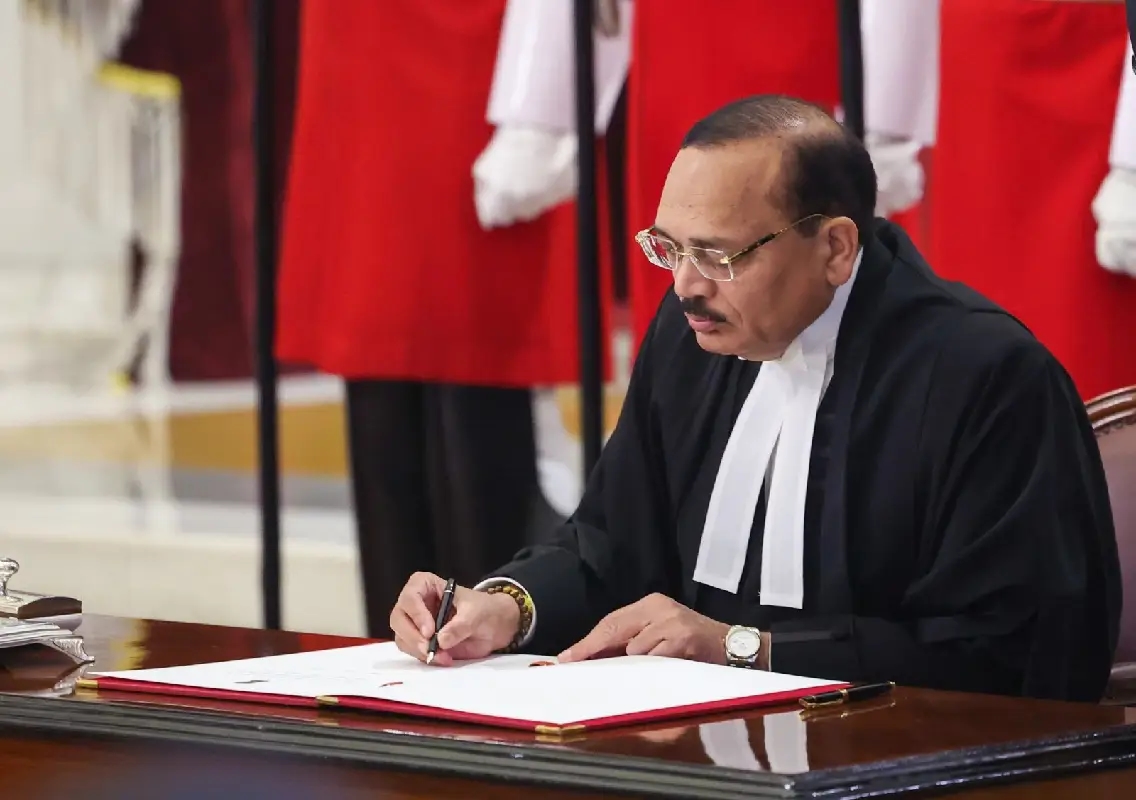


New Delhi: Justice Surya Kant was sworn in as the 53rd Chief Justice of India (CJI) on Monday, marking the culmination of a remarkable journey from a Haryana village to the nation’s highest judicial office. President Droupadi Murmu administered the oath at Rashtrapati Bhavan, in the presence of Vice-President CP Radhakrishnan, Prime Minister Narendra Modi and several cabinet ministers.
Journey from Haryana village to India’s top judicial post
Born on 10 February 1962 in Petwar village in the Narnaud region of Hisar, Justice Surya Kant’s early education took place in local schools, after which he pursued law at Maharshi Dayanand University, Rohtak, graduating in 1984. He began practising at the Hisar district court and later shifted to Chandigarh, where he established a strong reputation at the Punjab and Haryana High Court, specialising in constitutional, service and civil law.
At the age of 38, he became Haryana’s youngest advocate general in 2000 and was designated a senior advocate the following year. He was elevated as a judge of the Punjab and Haryana High Court in 2004. In October 2018, he took charge as chief justice of the Himachal Pradesh High Court before his elevation to the Supreme Court in May 2019.
Displaying an enduring commitment to academic excellence, Justice Kant secured a master’s degree in law from Kurukshetra University with first-class first while serving on the bench.
Key constitutional rulings over six years in Supreme Court
Justice Surya Kant has authored more than 300 judgments during his six-year tenure at the Supreme Court. He served on the Constitution bench that upheld the abrogation of Article 370, the bench that examined Section 6A of the Citizenship Act, and the bench that granted interim bail to former Delhi chief minister Arvind Kejriwal while upholding the legality of his arrest.
He was also part of the bench that delivered the presidential reference judgment clarifying timelines for gubernatorial and presidential assent to state bills. His judicial work has been marked by a blend of constitutional clarity and humanistic reasoning.
As executive chairman of the National Legal Services Authority (NALSA), he launched the Veer Parivar Sahayata Yojana 2025, a scheme aimed at providing free legal aid to soldiers, veterans and their dependants.
Top priorities for the Supreme Court under Justice Kant
A day before assuming office, Justice Kant outlined his administrative and judicial priorities in an interview to Hindustan Times. With nearly 90,000 cases pending before the Supreme Court, he identified arrears as one of the most urgent challenges.
“My immediate focus is on optimum utilisation of judicial force to reduce pendency,” he said. He added that many matters stuck in the Supreme Court prevent related issues from moving forward in high courts and lower courts. He intends to identify such cases, ensure appropriate bench constitution and prioritise long-pending matters.
Justice Kant emphasised the need for discipline across the judiciary, noting that courts function as collective institutions whose credibility rests on consistency and efficiency. He aims to strengthen case management systems, deploy technology, upgrade infrastructure and reinforce procedural guidelines to ensure smoother functioning.
Judicial philosophy shaped by a farmer’s patience and a poet’s empathy
Reflecting on his formative years on a farm in Petwar, Justice Kant said that “a farmer’s patience taught me that true growth requires time, care and resilience”. He equated the judicial process with cultivation, noting that justice cannot be rushed but must follow due process.
He also spoke of the “poet’s empathy” that guides him in understanding the human stories behind disputes. His humanistic approach, he said, enables him to balance legal rigor with compassion. While judges must remain neutral interpreters of the law, he believes they must also remain connected to social realities.
Mediation as a key reform focus
Apart from speeding up disposals, Justice Kant views mediation as a “game changer” in reducing judicial burdens. He stressed the need for government departments to adopt mediation more actively, thereby easing pressure on courts and enabling quicker resolution of disputes.
He underlined that reform is a continuous process and expressed his commitment to strengthening the institution through a combination of empathy, communication, discipline and technological modernisation.
With his swearing-in, the Supreme Court begins a new chapter under a chief justice known for both administrative acumen and a humanistic judicial philosophy.