


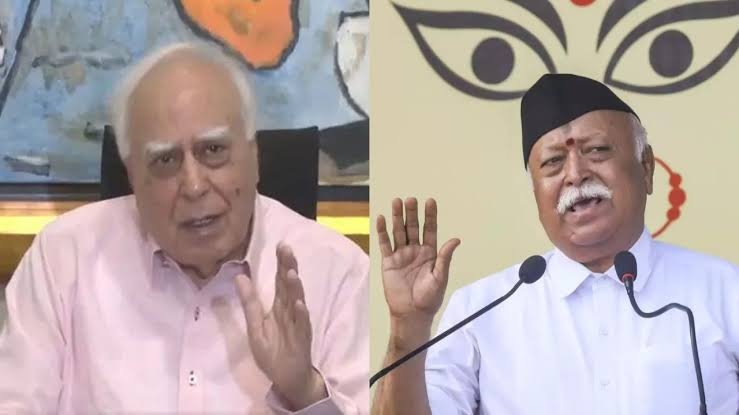


New Delhi: Rajya Sabha MP Kapil Sibal has criticised Rashtriya Swayamsevak Sangh (RSS) chief Mohan Bhagwat over his remarks on regime change, arguing that Indians want a change of government through democratic means rather than violent protests or uprisings.
Speaking at a press conference in New Delhi on Saturday, Sibal said the country needed political change and claimed that people had already made up their minds. He also questioned Bhagwat’s comparison of calls for regime change in India with recent political developments in Nepal, Bangladesh, Albania and France.
“When, how, and most peacefully it will happen, only time will tell,” Sibal said, according to the Press Trust of India (PTI).
The exchange followed Bhagwat’s address at the RSS’s annual Vijayadashami Utsav in Nagpur on Tuesday, during which he warned that movements seeking regime change did not necessarily resolve fundamental problems and could instead deepen social divisions.
While Bhagwat cautioned against political movements being used by forces pursuing their own interests, Sibal maintained that the change being sought in India was a democratic transfer of power. He also questioned whether concerns about foreign interference were diverting attention from issues such as unemployment, education and governance.
Sibal rejects comparison with unrest abroad
Sibal said he was surprised that Bhagwat had compared calls for regime change in India with developments in countries including Nepal, Bangladesh, Albania and France.
He argued that some of the political upheavals witnessed in those countries had involved violence, which he said should not be supported. According to Sibal, the Indian context was different because the change being sought was a change of government through elections and other democratic processes.
“What India wants is a change of government through democratic means, and I think that Mohan Bhagwat understands that, but yet is not willing to acknowledge it,” Sibal said.
The Independent MP also challenged Bhagwat’s assertion that changing a government would not necessarily bring about fundamental change. Sibal asked why the RSS had supported Arvind Kejriwal in the past if it believed that a change in the political establishment could not produce meaningful results.
His remarks placed the focus on the distinction between a peaceful democratic transition and political upheavals that occur outside established constitutional processes.
Sibal defends Jantar Mantar protesters
Sibal also defended young people who had gathered at Jantar Mantar in New Delhi to protest, describing their demonstrations as peaceful.
He said the protesters had not carried weapons or stones and had instead undertaken a hunger strike. Sibal alleged that any violence associated with the protest had been caused by outside agencies, although this claim was not established as a finding by the information reported by PTI.
The MP also questioned the circumstances surrounding a truck reportedly carrying stones that was found at the protest site. He asked where the vehicle had come from and why its presence had not been adequately investigated.
“Nobody has yet inquired as to where that truck came from or how that truck came,” Sibal said, according to PTI.
He also referred to the role of the Union government and the Lieutenant Governor in the administration of the area, questioning the handling of law and order.
The allegations concerning the truck and the involvement of outside agencies remain Sibal’s claims. Establishing whether they are accurate would require evidence from the relevant authorities and an investigation into the circumstances of the protest.
RSS accused of benefiting from political change
Sibal also referred to the political developments that preceded the BJP-led government’s rise to power at the Centre in 2014.
He alleged that the RSS had supported Kejriwal during an earlier phase of political change and claimed that the developments of that period had contributed to the fall of the Congress-led United Progressive Alliance (UPA) government.
Sibal argued that the change in government at the Centre had taken place through the electoral process, with Narendra Modi becoming Prime Minister following the 2014 general election.
“It was through the legal process — in other words, there was an election, Modi ji came to power, and we have suffered 12 years of power under Modi ji, and RSS has benefited greatly,” he said.
He questioned Bhagwat’s position that changing a government would not address fundamental problems, arguing that the RSS itself had supported political developments that helped bring about a change in power.
The remarks reflected Sibal’s political criticism of the RSS and the BJP-led government. His interpretation of the RSS’s role in earlier political developments remains an allegation and should be distinguished from the established fact that the government changed through a general election.
Education and unemployment among issues raised
Sibal accused Bhagwat of focusing on alleged foreign attempts to destabilise India while giving insufficient attention to domestic concerns.
He referred to protests by the group he called the Cockroach Janata Party over the state of school education. Sibal alleged that Bhagwat had remained silent on the issue because, in his view, the RSS benefited from the BJP-led government.
He also raised concerns about alleged manipulation of voter lists, reported incursions in Arunachal Pradesh and eastern Ladakh, and the detention of young people, academics and opposition leaders.
Questioning Bhagwat’s remarks about foreign forces seeking to destabilise India, Sibal argued that unemployment and inadequate access to educational opportunities were among the country’s pressing concerns.
“It is the middle-class children out there who don’t get employment; it is the poor people who don’t get any opportunities in education,” he said.
His comments sought to shift the discussion towards public welfare and governance, suggesting that these issues required attention alongside concerns about external interference.
The claims concerning voter lists, border developments and detentions were raised by Sibal as part of his criticism. Each issue requires separate consideration based on the relevant evidence and official records.
What Bhagwat said about regime change
Addressing the RSS’s annual Vijayadashami Utsav in Nagpur on Tuesday, Bhagwat warned that agitations seeking regime change did not necessarily resolve a country’s fundamental problems.
Citing developments in Bangladesh, Nepal, France and Albania, he argued that political movements could be used by groups pursuing their own interests to alter the political situation without delivering the outcomes they promised.
“They claim that changing a regime will change the situation, but that has never really happened,” Bhagwat said.
He also alleged that some global powers wanted India to develop but did not want it to become so powerful that it could challenge their dominance. According to Bhagwat, attempts were being made to weaken and divide the country, with some domestic elements helping those efforts.
Bhagwat acknowledged that protests were inevitable in a democracy but maintained that demonstrations should aim to resolve problems rather than deepen social divisions.
“Problems will remain, and protests are inevitable in a democracy. But what should the purpose of protests be? They should be aimed at finding solutions,” he said.
His address therefore focused on the risks of political unrest, the possibility of external interference and the need for protests to contribute to solutions rather than further polarisation.
Debate highlights differing views on democratic change
The exchange between Sibal and Bhagwat highlights differing perspectives on political change, public protest and the role of external forces.
Sibal argued that Indians seeking a change of government wanted it to happen peacefully through democratic means. He rejected comparisons with political upheavals abroad and questioned whether warnings about foreign interference were distracting attention from domestic concerns such as jobs and education.
Bhagwat, meanwhile, maintained that protests should focus on resolving problems and warned that movements driven by political interests could deepen divisions. He also expressed concern about what he described as external attempts to weaken India.
The two positions approach the issue from different angles: Sibal emphasised electoral change and government accountability, while Bhagwat stressed the potential risks of unrest and political mobilisation.
The broader debate also underlines the importance of distinguishing peaceful protest and electoral competition from violence or attempts to undermine constitutional processes. The allegations raised during the exchange remain subject to public scrutiny and should be assessed on the basis of evidence rather than political assertions alone.