







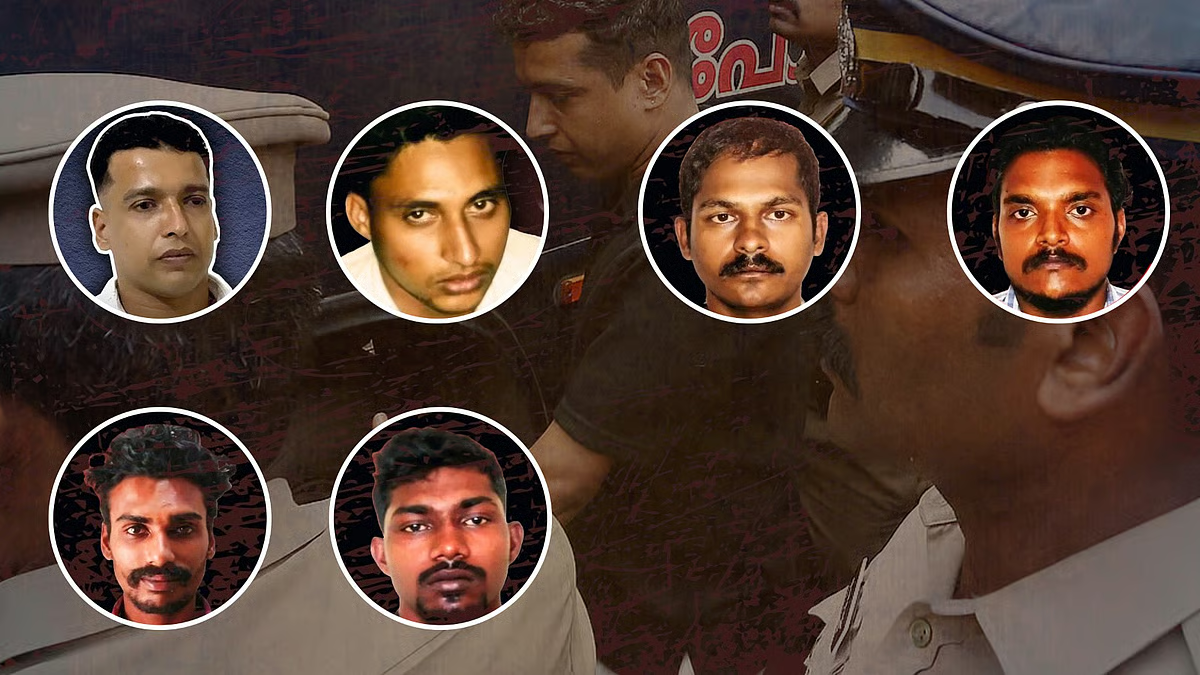


As the Ernakulam Additional Special Sessions Court heard final arguments before pronouncing sentence in the 2017 Kerala actor abduction and sexual assault case, the courtroom witnessed a sharp legal debate on how accountability should be fixed in cases involving criminal conspiracy and gangrape.
Both the prosecution and defence repeatedly referred to the 2012 Delhi gangrape and murder case, widely known as the Nirbhaya case, but drew contrasting conclusions from the landmark precedent that reshaped India’s sexual violence laws.
Prosecution seeks equal punishment
Public Prosecutor Aja Kumar argued that all six convicts deserved equal punishment under the principle of joint liability. Citing the Nirbhaya judgment, he contended that in cases of criminal conspiracy, the distinction between who committed the physical act and who facilitated it was irrelevant.
“In a criminal conspiracy, who committed the physical act has no significance,” he told the court, urging a minimum of 20 years of rigorous imprisonment, extendable to life. He stressed that the abduction, confinement, and restraint of the survivor were integral to the crime and that the offence had “deeply shaken the public conscience”.
According to the prosecution, without the collective actions of the accused, the sexual assault could not have taken place.
Judge cautions against sentencing by sentiment
Responding to the submissions, Judge Honey M Varghese questioned whether sentencing should treat direct perpetrators and facilitators identically. While acknowledging the seriousness of facilitation, she observed that differences in roles “are not insignificant”.
At the same time, the judge cautioned against turning sentencing into a public messaging exercise. “Punishment can act as a deterrent, but a judgment is not written for society. It is guided by law, not by what society wants,” she said, adding that courts cannot be swayed by sensation or bias.
Defence argues for differentiation
For the defence, Pulsar Suni’s lawyer Pratheeksh Kurup argued that the Nirbhaya case involved extreme brutality and repeated acts of rape by all accused, making it inappropriate to draw a direct parallel. He submitted that the maximum punishment should be reserved for the gravest cases.
Advocate KV Sabu, appearing for Salim H and Pradeep, sought leniency by pointing to the absence of prior criminal records and their lack of direct involvement in the rape. Defence pleas were accompanied by emotional personal appeals from the convicts, citing family responsibilities and health concerns.
Verdict and sentence
The arguments came days after actor Dileep, earlier accused of conspiracy, was acquitted in the same case. On Friday, December 12, Judge Varghese sentenced Pulsar Suni and five others to 20 years of rigorous imprisonment each and ordered compensation of ₹5 lakh to the survivor. She also directed secure handling of the memory card containing the assault visuals.