







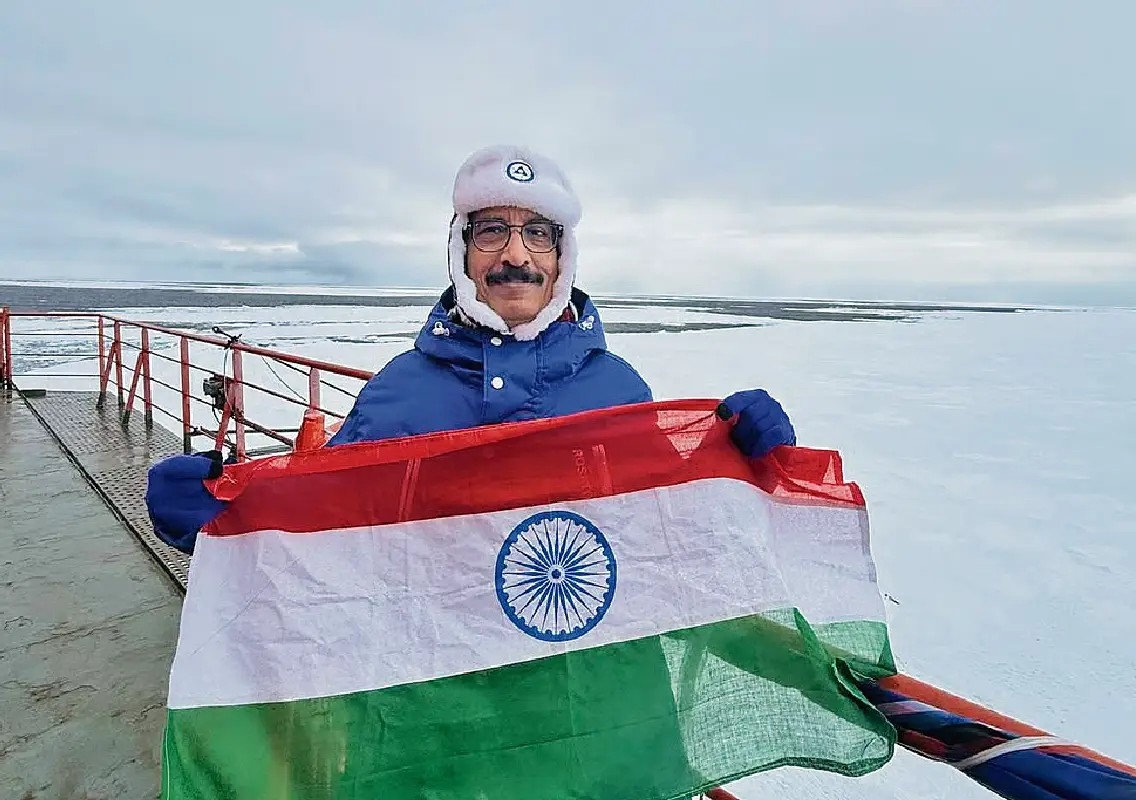


Kochi: Marine scientist and academician Dr S Bijoy Nandan has achieved a remarkable milestone by becoming the first Malayali to step on the North Pole, while also witnessing visible signs of environmental change in the Arctic.
Nandan, dean and scientist emeritus at the Department of Marine Sciences at Cochin University of Science and Technology (CUSAT), reached the northernmost point of Earth on August 8 as part of the international ‘Icebreaker of Knowledge’ expedition.
A historic journey to the Arctic
The expedition was organised by Rosatom and brought together scientists, experts and talented students from across the world. Among the Indian participants was 15-year-old Lucky Rawat from Uttarakhand.
The team travelled aboard the nuclear-powered icebreaker 50 Let Pobedy from Murmansk. After reaching 89.6616 degrees North, the participants disembarked and walked through snowdrifts to reach 90 degrees North.
Nandan recalled standing on a frozen ocean nearly 4,000 metres deep amid a blizzard, with winds exceeding 10 metres per second.
Arctic ice reveals worrying changes
The 2,500-km voyage also gave Nandan an opportunity to observe the changing Arctic environment. He reported seeing depleted ice sheets, broken icebergs and barren hills.
According to Russian scientists accompanying the expedition, the reduction in snow cover has become evident over the past two decades. Instead of thick ice sheets, the team observed pancake ice formations in several areas.
The expedition also spotted a polar bear, an animal increasingly threatened by changes in its Arctic habitat.
Science meets education
The programme selected students aged 14 to 16 through a multi-stage international talent hunt. Thousands of students applied, with a limited number eventually chosen to participate.
The journey combined scientific learning with direct exposure to one of the world’s most fragile environments. For Nandan, the expedition was not only a personal achievement but also an opportunity to document changes taking place in the Arctic and encourage young minds to engage with environmental science.