


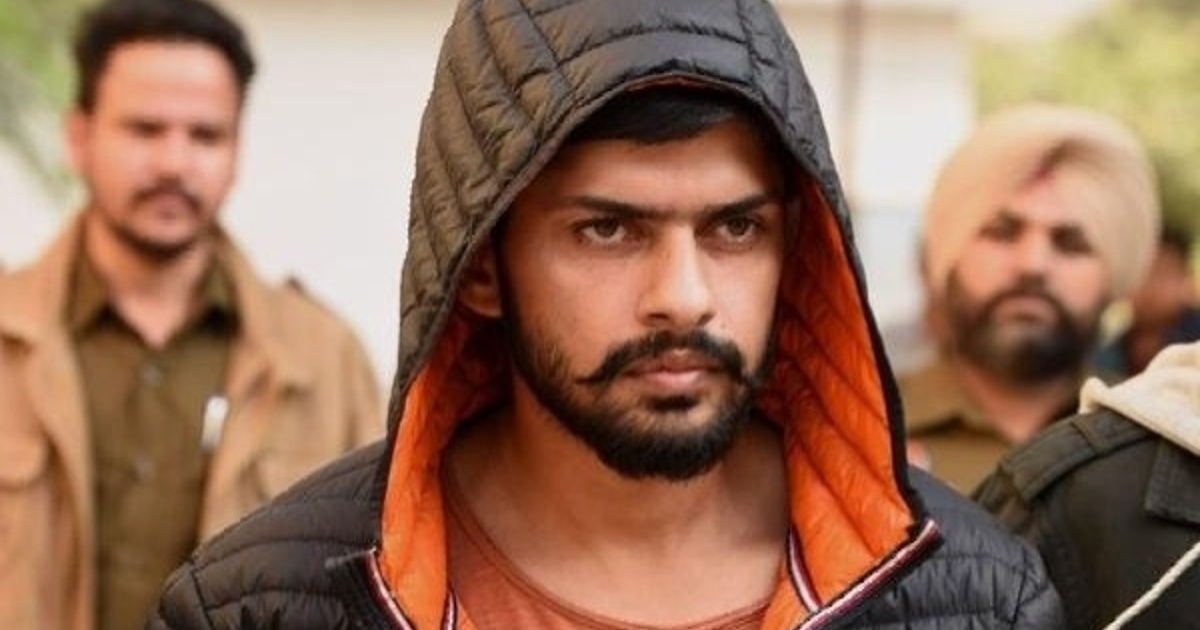


Chandigarh: Lawrence Bishnoi, the gangster whose name has become associated with high-profile murder cases, extortion threats and an alleged transnational criminal network, has emerged as one of India’s most widely discussed underworld figures. From his student politics days in Chandigarh to cases linked to Punjab, Mumbai and overseas investigations, his rise has drawn attention to how organised crime can operate across borders even when an alleged leader is in prison.
Bishnoi, who is lodged in Gujarat’s Sabarmati Central Jail, has been linked by investigators and media reports to a network accused of carrying out targeted killings and intimidation. His gang has claimed responsibility for some attacks, while authorities have alleged his involvement in other cases. These allegations must be distinguished from convictions, and claims about his influence or reach require careful scrutiny.
His story also intersects with the Bishnoi community’s religious traditions, the killing of Punjabi singer Sidhu Moose Wala, the murder of politician Baba Siddiqui and tensions surrounding investigations in Canada. Together, these developments have turned Bishnoi into a figure whose public image extends well beyond the criminal cases against him.
The Gang Canal and the origins of a border community
The history of the region associated with Bishnoi’s upbringing reaches back well before his birth. In the late 19th century, severe drought and famine devastated parts of Rajasthan, including areas around the Thar Desert. Water scarcity posed a major challenge to farming communities and princely administrations.
Maharaja Ganga Singh of Bikaner later championed the development of the Gang Canal, an ambitious irrigation project intended to bring water from the Sutlej River into the arid region. Work began in the early 1920s, and water began flowing through the canal system in the latter part of that decade. The project transformed parts of north-western Rajasthan by making agriculture possible in areas that had previously struggled with chronic water shortages.
The canal also encouraged migration and settlement. Farmers from Punjab moved into newly irrigated areas, bringing agricultural practices and community traditions with them. Among the communities living across the wider Rajasthan-Punjab border region were the Bishnois, whose religious identity is closely associated with environmental protection and compassion towards living beings.
The historical setting helps explain the cultural background often mentioned in accounts of Bishnoi’s life. However, the history of a community and the actions of an individual must be treated separately.
The Bishnoi faith and its 29 principles
The Bishnoi community traces its origins to Guru Jambheshwar, popularly known as Jambhoji, who established the sect in Rajasthan in the 15th century. Its name is commonly understood as a reference to the 29 principles associated with his teachings.
These principles include protecting trees, showing compassion towards animals and avoiding practices considered harmful to living beings. The blackbuck holds particular cultural and religious significance for many Bishnois, and the community has a long history of protecting wildlife.
The faith’s emphasis on conservation has brought the community into public attention on several occasions. Its religious traditions are also central to the long-running controversy surrounding Bollywood actor Salman Khan’s blackbuck poaching case.
Bishnoi’s invocation of this cultural identity has become a prominent part of his public image. Yet his alleged involvement in organised violence has created an apparent contradiction between a tradition associated with non-violence towards animals and a criminal network accused of deadly attacks on people.
From student politics to criminal cases
Lawrence Bishnoi was born on 12 February 1993, according to widely reported biographical accounts. His father, Lavinder Singh, was a police constable, and his mother is identified in media reports as Sunita. Bishnoi reportedly spent his early years in the Punjab-Rajasthan border region before moving to Chandigarh for higher education.
He enrolled at DAV College in Chandigarh in 2010 and became involved in student politics. Reports describe his association with the Student Organisation of Panjab University and his ambition to hold a prominent student leadership position.
It was during this period that he became associated with Satinderjit Singh, better known as Goldy Brar. The two would later be linked to a criminal network that attracted national attention.
Bishnoi’s early years in student politics were followed by a series of criminal cases. Reports refer to allegations involving assault, attempted murder, trespassing and robbery. He was arrested in 2014 following an armed confrontation with Rajasthan Police.
The criminal cases marked a turning point in his life. Rather than ending his public profile, repeated arrests and his continued association with alleged accomplices helped make his name increasingly familiar in police records and media coverage.
The precise role played by prison in the development of his network is difficult to establish independently. Investigators have, however, alleged that his associates continued operating while he was in custody, raising questions about communication, coordination and the ability of criminal groups to function across jurisdictions.
The Salman Khan dispute and the blackbuck case
The conflict involving Salman Khan has become one of the most widely reported aspects of Bishnoi’s public profile.
In October 1998, during the filming of Hum Saath-Saath Hain in Rajasthan, two blackbucks were reportedly killed in an incident that led to a case against Khan and others. The Bishnoi community strongly objected because of the animal’s religious significance.
The legal proceedings continued for years, with Khan facing prosecution under wildlife protection laws. The case and its subsequent developments became a major public issue, particularly because of the community’s longstanding commitment to wildlife conservation.
Bishnoi later used the blackbuck issue to explain his hostility towards Khan. During a court appearance in 2018, he reportedly issued a threat against the actor. His associate Sampat Nehra was also arrested that year in connection with an alleged plan to conduct reconnaissance near Khan’s residence in Mumbai.
Subsequent threats attributed to the Bishnoi gang have repeatedly brought the actor into the headlines. The gang’s stated justification has centred on the blackbuck controversy, although criminal investigations and public statements must be assessed separately.
The case illustrates how a dispute rooted in a wildlife prosecution became part of the identity and messaging of an alleged criminal organisation.
Sidhu Moose Wala’s murder brought national attention
On 29 May 2022, Punjabi singer Sidhu Moose Wala was shot dead in Mansa district, Punjab. The killing sent shockwaves through the music industry and triggered a major investigation into alleged gang involvement.
Moose Wala was travelling in a vehicle when gunmen intercepted him and opened fire. The attack was widely reported as a coordinated shooting. Goldy Brar claimed responsibility in statements attributed to him, and investigators linked the case to the Bishnoi network.
Bishnoi’s alleged role and connections became the subject of extensive police investigation. The case drew attention to the involvement of alleged gang members operating from outside India and the challenges authorities face when investigating crimes involving suspects in multiple jurisdictions.
The murder also highlighted the way social media, public claims of responsibility and rivalries among criminal groups can amplify the profile of an alleged gang leader.
For investigators, the case was not simply about identifying the shooters. It also involved tracing the alleged planning, communications and support network behind the attack.
Canada investigations and allegations of transnational links
The Bishnoi network has also figured in discussions about criminal activity in Canada. One major point of international tension followed the killing of Hardeep Singh Nijjar, a Sikh separatist leader who was shot dead outside a gurdwara in Surrey, British Columbia, in June 2023.
Canada subsequently raised allegations of Indian government involvement in the killing, which New Delhi denied. Separate Canadian investigative statements and reporting later referred to alleged links between the Bishnoi gang and violence or intimidation targeting individuals in Canada.
These are serious allegations involving several distinct questions: the identity of those responsible for individual crimes, the possible role of organised criminal networks and any alleged connections to state actors. They should not be conflated into a single established narrative.
Bishnoi has reportedly portrayed himself as a nationalist and opponent of the Khalistan movement. Such statements represent his own public positioning and do not independently establish the nature of his relationships with other actors.
The international dimension of the cases has increased scrutiny of alleged criminal networks operating across borders. It has also made cooperation between law-enforcement agencies, evidence-sharing and extradition procedures important elements of investigations.
The Baba Siddiqui murder and Mumbai’s underworld concerns
On 12 October 2024, Nationalist Congress Party leader Baba Siddiqui was shot outside his son Zeeshan Siddiqui’s office in Mumbai’s Bandra area. Siddiqui, a former Maharashtra minister and three-term MLA, was taken to hospital but died from his injuries.
The killing prompted a major investigation and renewed concerns about the reach of organised criminal groups in Mumbai. The Bishnoi gang claimed responsibility, with statements attributed to associates suggesting that Siddiqui had been targeted because of his association with Salman Khan.
That explanation was a claim made in connection with the killing, not a judicial finding establishing the motive. Investigators have had to examine the alleged roles of the shooters, those accused of arranging the attack and any wider network behind it.
The case attracted particular attention because Siddiqui was a prominent political figure and the attack occurred in a heavily populated part of Mumbai. It also revived comparisons with earlier periods when organised crime groups used threats and targeted violence to influence people in the film industry and business circles.
The episode demonstrated why authorities view alleged gang activity as a public-security concern, especially when threats against high-profile individuals are followed by attacks.
A criminal network operating while its alleged leader is in jail
One of the most striking features of the Bishnoi case is the allegation that his network continued to operate while he remained incarcerated. Investigators have described the group as an organised criminal enterprise with associates in several Indian states and alleged international connections.
Authorities have pursued cases involving murder, extortion, arms and alleged conspiracy. The National Investigation Agency has also investigated aspects of organised criminal networks and their connections to overseas associates.
However, claims about the precise size of the gang, the number of shooters at its disposal and its ability to coordinate attacks from prison can vary across reports. Such figures should not be treated as verified facts without clear attribution to investigators or court documents.
The broader issue is familiar to law-enforcement agencies: imprisonment does not necessarily dismantle a criminal organisation if its alleged leaders retain access to communication channels, money and loyal associates. Investigations therefore often focus on identifying the wider network rather than relying solely on the detention of one individual.
Allegations involving unauthorised mobile phones, encrypted communications or intermediaries have also raised questions about prison security. The exact communication methods used in particular cases require evidence and should not be assumed from the fact that an alleged network continued to function.
Anmol Bishnoi, Goldy Brar and reports of a split
Bishnoi’s relationship with Goldy Brar has been central to accounts of the alleged network. The two were associated during their student years, and Brar later emerged as an overseas figure linked by investigators and media reports to several high-profile cases.
Reports in late 2025 also described Anmol Bishnoi, Lawrence’s younger brother, being returned to India from the United States and facing legal proceedings. Developments involving Anmol have drawn attention to the alleged international reach of the network and the efforts of Indian agencies to investigate it.
There have also been reports of tensions and a possible split between factions associated with Lawrence Bishnoi and Goldy Brar. Claims about the timing, causes and extent of any rupture should be treated cautiously unless supported by reliable investigative or court records.
If a split has occurred, it could affect relationships among associates and intensify rivalries within the alleged criminal network. But reports of threats or internal disputes do not, by themselves, establish the full state of the group’s organisation.
The developments underscore that alleged criminal networks are not static. Alliances can change, associates can be arrested or deported, and rivalries can emerge even among people who previously worked together.
Nationalist messaging and the online image of an outlaw
The Bishnoi gang’s public communications have sometimes used religious or nationalist language. Following the Pahalgam terror attack in April 2025, a statement attributed to the gang threatened Pakistan-based militant leader Hafiz Saeed.
Such messaging can serve several purposes for a criminal organisation: attracting attention, projecting an image of influence and presenting its actions through a political or religious narrative. It does not establish that the group is acting on behalf of any government or that its claims reflect an official position.
Bishnoi’s image has also spread through social media pages, short videos and online discussions that portray him as a defiant outlaw or defender of a cause. Such portrayals risk obscuring the human consequences of the crimes alleged against him and the people affected by gang violence.
The popularity of these narratives raises questions about how criminal figures gain cultural visibility. Publicity can strengthen a gang’s reputation, make threats appear more credible and help recruit supporters or associates. At the same time, online claims may exaggerate a group’s reach or circulate unverified stories.
Responsible reporting requires distinguishing between documented events, allegations by investigators, statements made by gang members and stories that have become part of the public mythology around Bishnoi.
The man, the allegations and the legal record
Bishnoi’s public image is surrounded by stories about his personal habits, religious observance and life inside prison. Some portray him as an ascetic who follows a strict routine; others describe him as a symbol of a supposed hidden power structure. Such accounts require independent verification and should not be accepted simply because they are repeated online.
A more concrete picture emerges from the cases and investigations associated with his name. He has faced multiple criminal proceedings, and agencies have alleged that he is connected to a wider network involved in serious offences. The legal status of each case must nevertheless be examined individually.
A charge sheet or accusation is not the same as a conviction. The outcome depends on the evidence presented and the decisions of the courts. Statements about whether Bishnoi has been convicted of a particular offence should also be tied to a specific date and checked against the latest court record.
The contrast between his public reputation and the legal process is central to understanding the case. His name has become a powerful symbol in media coverage, but that reputation cannot substitute for proof in court.
A legacy at odds with the community’s values
The Bishnoi community’s traditions emphasise protecting trees, conserving wildlife and showing compassion towards living beings. Those principles are part of a centuries-old religious and cultural identity that should not be reduced to the actions of one individual.
Lawrence Bishnoi’s association with the blackbuck controversy has placed that identity at the centre of his public narrative. Yet the alleged murders, threats and extortion linked to his network stand in sharp contrast to the community’s emphasis on protection and restraint.
His rise also illustrates how a criminal figure can use family background, regional identity and symbolic causes to build a public persona. That persona may attract attention, but it should not obscure the victims of violence or the responsibilities of law-enforcement agencies and courts.
The canal that helped transform the arid border region remains a landmark in the area’s history. The Bishnoi faith continues to be associated with conservation. Lawrence Bishnoi’s story, meanwhile, remains one of criminal allegations, high-profile investigations and a public image shaped by both documented events and unverified claims.
Ultimately, understanding his rise requires separating the man from the mythology surrounding him: examining the evidence, recognising the victims and allowing the legal process to determine responsibility for the crimes alleged.