









Gujarat: A one-year-old boy in Vadodara district recovered after doctors removed a small LED bulb lodged deep inside his windpipe, ending a month-and-a-half-long illness that had initially been treated as pneumonia. The child had been suffering from persistent fever and chronic cough, and multiple rounds of treatment at private hospitals failed to improve his condition before the correct diagnosis was made at a government facility.
Doctors said timely imaging and endoscopic intervention helped identify and remove the foreign object, leading to rapid recovery.
Prolonged illness confused with respiratory infection
According to medical officials, the child had been unwell for more than six weeks, showing symptoms commonly associated with pneumonia, including recurring fever and severe cough. Based on these symptoms, he was treated at several private hospitals for respiratory infection.
However, despite medication and supportive treatment, his condition did not significantly improve. With symptoms persisting, the family sought further evaluation at a government hospital, where specialists decided to conduct a more detailed examination.
Doctors said foreign body aspiration in toddlers can sometimes mimic pneumonia or bronchitis, making diagnosis difficult without imaging and specialised evaluation.
Detailed examination revealed obstruction
At the government medical facility in Gotri, the ENT department conducted a thorough clinical assessment. Doctors suspected that an obstruction in the airway might be causing the prolonged symptoms.
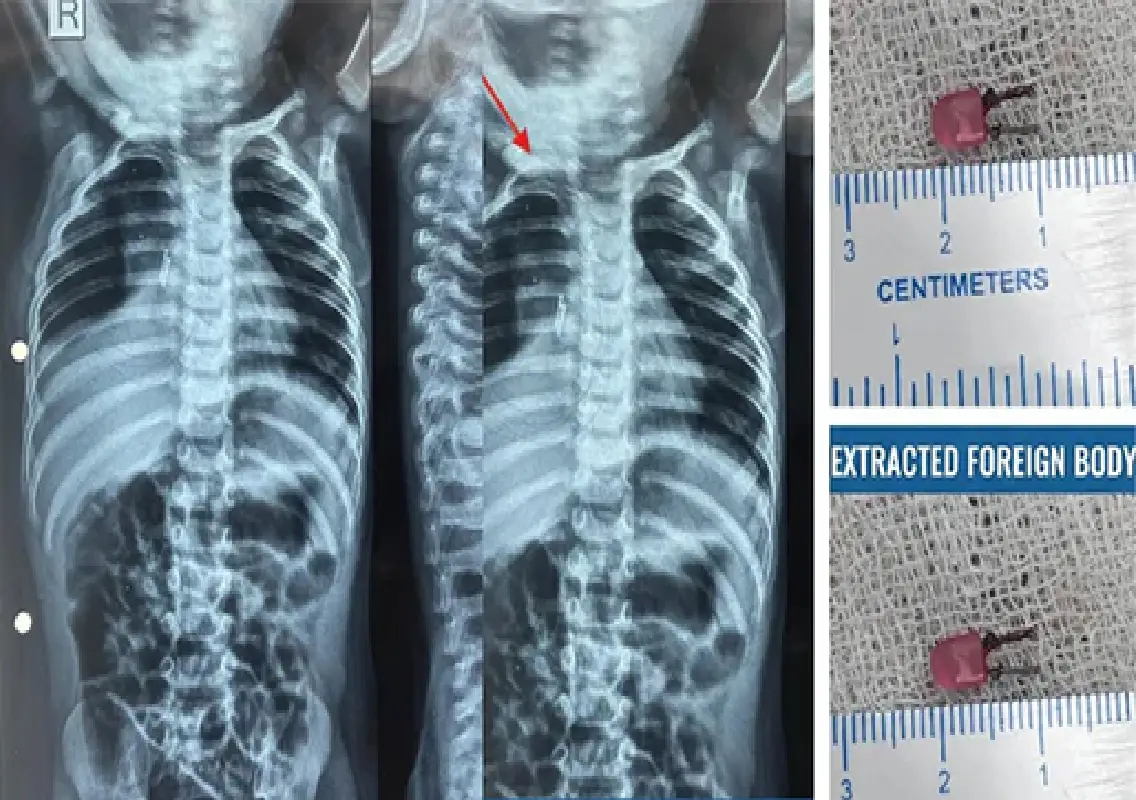
An X-ray indicated the possible presence of a foreign body in the windpipe. Based on this finding, the medical team planned an emergency bronchoscopy — a procedure in which a thin scope is inserted into the airway to directly view and remove obstructions.
Dr Hiren Soni, Head of the ENT Department at GMERS Hospital, Gotri, said the team proceeded with the endoscopic procedure after imaging raised suspicion.
“During the examination, it was found that there was an issue in the windpipe. An X-ray led us to suspect a foreign body was inside. During the operation, a bronchoscope was inserted, and we spotted a foreign object that looked like a piece of metal,” he said.
LED bulb found embedded in airway
During bronchoscopy, doctors located and removed a small LED bulb measuring about one centimetre that was lodged in the child’s windpipe. Due to the long duration it had remained inside, tissue had partially formed around it, making removal more delicate.
Dr Soni said the procedure required precision and modern endoscopic tools to avoid injury to the airway.
“Because he had been ill for a month and a half, skin had grown over it. With the help of our modern equipment, we were able to remove a bulb of just one centimetre. After removing it, we confirmed it was an LED bulb that had gone into the child’s mouth and got stuck in the windpipe,” he explained.
Doctors believe the child may have accidentally inhaled the tiny bulb while playing, a risk that is common among toddlers who tend to put small objects into their mouths.
Child recovers after procedure
Following removal of the bulb, the child’s symptoms subsided and his breathing improved. Doctors reported that he responded well after the procedure and was declared stable. He was scheduled for discharge after observation.
Medical staff said delayed detection could have led to serious complications, including severe infection, airway damage or life-threatening blockage.
Doctors warn parents about small objects
Doctors cautioned parents and caregivers to keep small objects, including decorative lights, batteries, bulbs and toy parts, out of reach of young children. They advised that persistent cough, wheezing or repeated chest infections that do not respond to treatment should be evaluated for possible foreign body aspiration.
They also emphasised the importance of early imaging and specialist referral when symptoms remain unexplained.
Conclusion
The case highlights how airway foreign bodies in children can mimic common respiratory illnesses and delay proper treatment. Prompt specialist evaluation and bronchoscopy helped resolve a potentially dangerous situation and ensured the child’s recovery.