







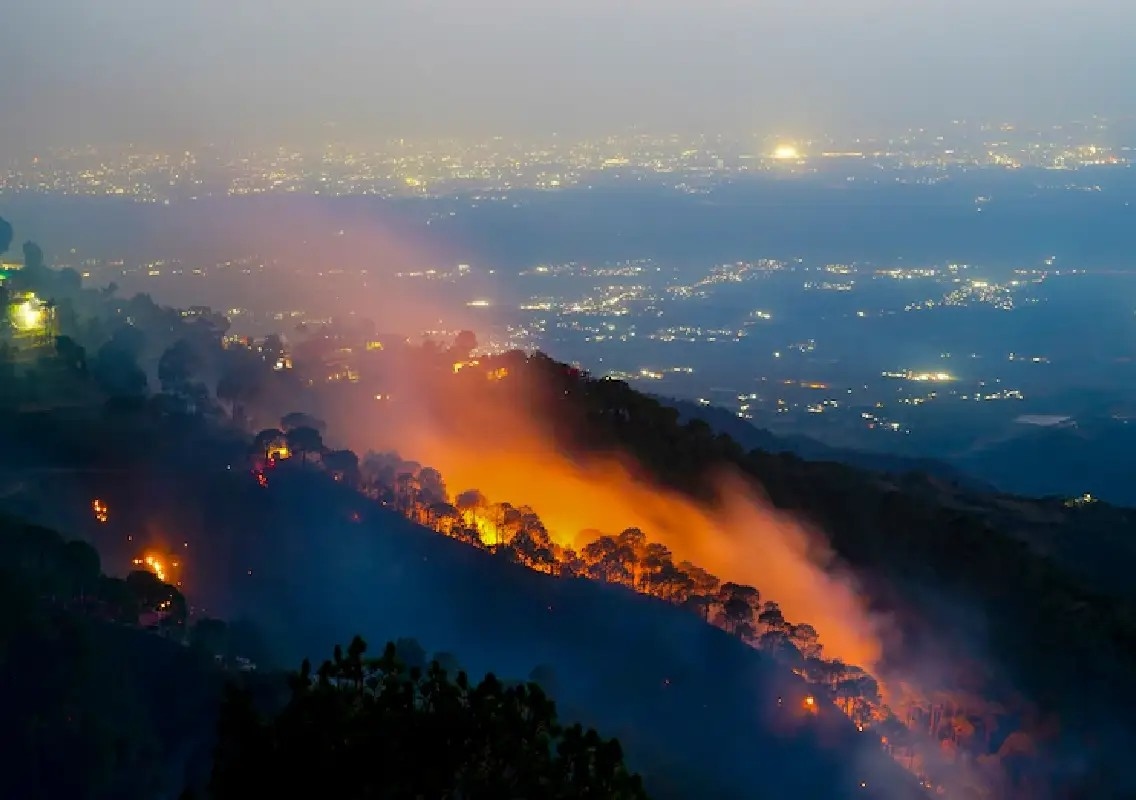


Kasauli: A massive forest fire that broke out in the pine-covered hills of Kasauli in Himachal Pradesh triggered a major emergency response this week, with the Indian Air Force, Army and firefighting teams working continuously for nearly 27 hours to bring the blaze under control.
The fire erupted on May 26 in the dry forest areas around Gilbert Trail and Upper Mall before rapidly spreading across steep and difficult terrain, threatening nearby homes and an Air Force station in the Solan district.
Authorities deployed helicopters and ground teams in a large-scale operation to prevent the fire from escalating into a bigger disaster. More than 62,000 litres of water were reportedly dropped from the air to contain the flames.
The incident has once again highlighted the growing threat of forest fires in Himachal Pradesh during the summer season amid rising temperatures, prolonged dry spells and increasing environmental stress.
Dry weather and pine needles fuelled blaze
Officials said the fire spread rapidly due to a combination of soaring temperatures, low humidity and strong winds linked to the ongoing heatwave conditions in the region.
Kasauli’s forests are dominated by pine trees, whose fallen needles contain highly flammable resin. During summer months, the dry needles form a thick layer on the forest floor, making the hills extremely vulnerable to fire.
Once ignited, the resin-rich needles burn quickly and allow flames to travel rapidly across large stretches of forest land.
Authorities noted that Himachal Pradesh experiences forest fires regularly during dry months, especially in areas where rainfall remains absent for long periods.
Human activity suspected behind fires
Officials stated that nearly 90 per cent of forest fires reported in Himachal Pradesh are believed to be caused by human activity.
Possible causes include unattended campfires, discarded cigarette butts, careless burning practices and deliberate acts of arson.
The Kasauli incident comes amid a wider pattern of increasing forest fires across the state this season. Reports indicate that over 200 forest fire incidents have already been recorded in Himachal Pradesh, damaging nearly 3,000 hectares of land.
Environmental experts believe climate change and prolonged dry weather conditions are worsening the frequency and intensity of such incidents across Himalayan regions.
Massive firefighting operation launched
As the blaze intensified and moved dangerously close to sensitive defence installations, multiple agencies launched a coordinated firefighting operation.
Ground teams from the Indian Army, local fire services and cantonment authorities worked continuously through dense smoke and difficult terrain to stop the spread of flames.
The Indian Air Force played a crucial role in containing the fire through repeated helicopter sorties.
Using specialised water buckets suspended beneath helicopters, Air Force personnel collected water from Sukhna Lake near Chandigarh, approximately 30 kilometres away, before carrying out precision drops over burning forest areas.
Officials initially confirmed that over 40,000 litres of water had been dropped on the affected zones. Later reports suggested the total quantity exceeded 62,500 litres during the full operation.
The aerial operation continued both during the day and night as teams battled to prevent the fire from spreading further toward residential areas and military facilities.
Fire brought under control
Head of Forest Force Sanjay Sood described the Kasauli fire as one of the most significant forest fires witnessed in Himachal Pradesh this season.
“The situation is now fully under control and there has not been any major damage,” Sood told ANI.
He added that the fire initially started near an Air Force base in the Solan region before spreading further into surrounding forest areas.
Authorities estimated the total loss caused by forest fires in the state this season at nearly Rs 67 lakh.
Fortunately, no loss of life or major property damage was reported in the Kasauli incident. Heritage locations, residential structures and defence installations were successfully protected through the coordinated response.
However, large sections of forest land were severely damaged and left charred after the blaze.
Growing concern over forest fire risks
The incident has renewed concerns regarding forest fire preparedness and environmental management in hill regions.
Experts have stressed the importance of preventive measures such as clearing dry forest debris, strengthening monitoring systems and increasing public awareness among residents and tourists.
Authorities are also expected to review fire prevention protocols in vulnerable forest zones as temperatures continue to rise and monsoon rainfall remains delayed.
Environmentalists warn that increasing heatwaves and shifting climate patterns may continue to intensify forest fire risks across Himalayan states in the coming years.
Kasauli returns to calm after tense hours
For now, Kasauli has returned to relative calm following the successful containment of the blaze.
The incident, however, serves as a reminder of how rapidly fragile hill ecosystems can transform from peaceful tourist destinations into zones of environmental emergency under extreme weather conditions.
Officials said monitoring teams remain deployed in the area to ensure there are no fresh flare-ups in the coming days.