


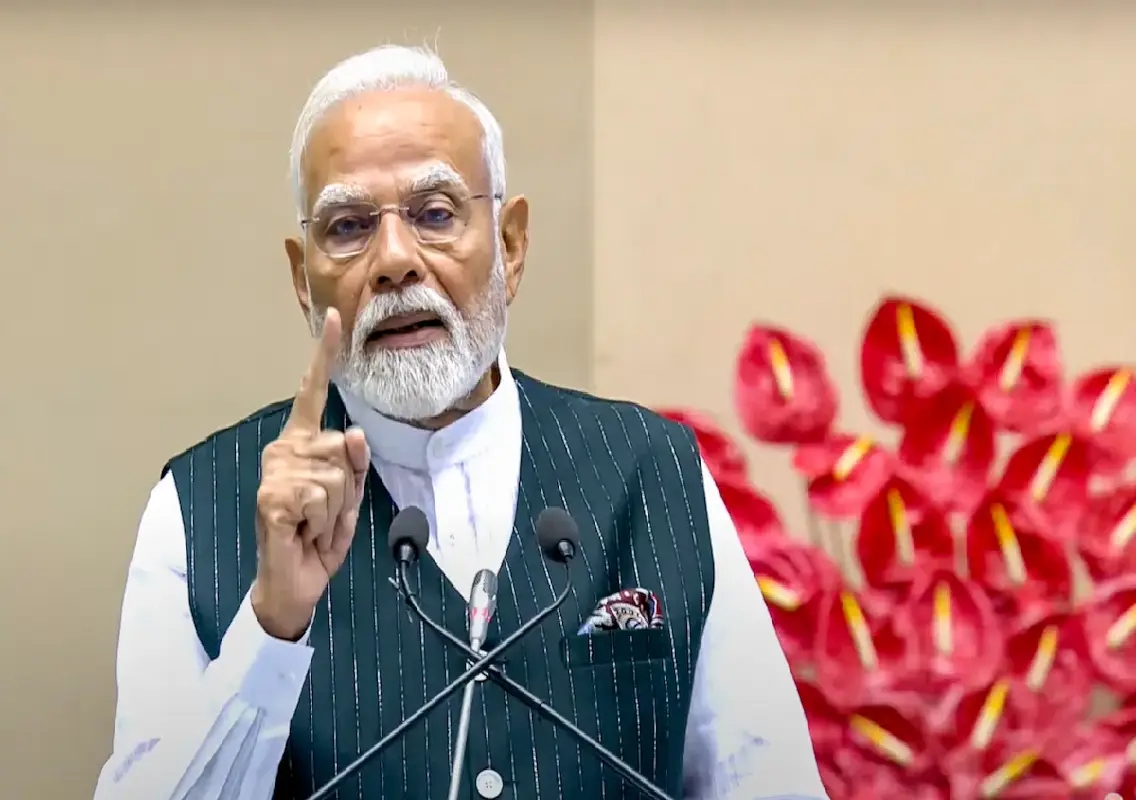


New Delhi: Prime Minister Narendra Modi on Wednesday sought to inject fresh energy into India’s development ambitions with a new slogan — “We will do it” — as he marked 25 years since he first took charge as the head of a government.
Addressing a large gathering at the Indira Gandhi Indoor Stadium in New Delhi, Modi called on citizens to embrace ambitious national goals and repeatedly led the crowd in the pledge, “We will do it.”
The event marked a significant milestone in Modi’s political journey. On October 7, 2001, he was sworn in as the Chief Minister of Gujarat, succeeding Keshubhai Patel. Twenty-five years later, Modi used the anniversary not merely to look back at his political career but to outline a fresh set of national aspirations.
“Today, at this stage of my journey, I respectfully salute every volunteer and every fellow worker. Friends, today is not just a day for memories. It is a day to fill our resolve with new energy,” Modi said.
He then repeated the phrase “We will do it” several times, setting the tone for the event.
Five targets for a developed India
Modi highlighted five major goals that he said should guide the country’s aspirations in the years ahead.
The targets are:
- Making India a developed nation by 2047
- Taking India into the world’s top three economies
- Building an Atmanirbhar Bharat
- Making India a global manufacturing hub
- Hosting the Olympic Games and achieving a major milestone in space, including a manned space mission
Modi called out each goal before the audience responded with “We will do it” in unison.
“This energy, this enthusiasm, this self-confidence is extraordinary,” Modi said.
The targets cover India’s economic ambitions as well as its aspirations in manufacturing, self-reliance, space technology and international sporting events.
Focus on India’s economic rise
Economic strength formed a central part of Modi’s vision. India has emerged as one of the world’s fastest-growing major economies, although its position in the global economic rankings has fluctuated.
Modi contrasted India’s current economic position with the situation when he became Prime Minister in 2014. His broader objective is to move India into the world’s top three economies as part of the country’s journey towards becoming a developed nation by 2047.
The target comes against a backdrop of significant global economic disruptions over the past several years. The Covid-19 pandemic, the Russia-Ukraine conflict and continuing instability in the Middle East have affected global supply chains, energy routes and international trade.
Modi argued that India has demonstrated greater resilience in dealing with these challenges.
“Whenever a crisis struck [in the past], India’s economy would be shaken. Today, when a crisis comes, India’s strength is discussed. India’s resilience is discussed,” he said.
Atmanirbhar Bharat and manufacturing
The goals of Atmanirbhar Bharat and becoming a global manufacturing hub are closely linked.
The government has sought to reduce dependence on imports while expanding India’s domestic manufacturing capacity. The Production Linked Incentive scheme, launched in 2020, has been a key part of this strategy, offering incentives to companies for increasing domestic production in selected sectors.
Modi said India’s economic ambitions should go beyond consumption and focus increasingly on production, exports and manufacturing capabilities.
“Today, we ourselves are the makers of our destiny. Therefore, it would be an injustice to Mother India if we were to pursue small goals,” he said.
He added that the country’s potential demanded ambitious objectives rather than easy ones.
The government’s emphasis on manufacturing is also aimed at strengthening India’s position in global supply chains while creating greater domestic capacity across strategic sectors.
Space ambitions and the Olympics
Two of Modi’s targets extend beyond conventional economic indicators — establishing India as a major spacefaring nation and hosting the Olympic Games.
India’s space programme has expanded considerably in recent years, with missions aimed at strengthening the country’s capabilities in areas including human spaceflight, lunar exploration and other advanced space technologies.
The ambition to host the Olympics similarly represents a push for India to organise one of the world’s largest sporting events.
Together, these goals reflect the broader message of Modi’s speech: that India should aspire to compete and lead on a global scale rather than limit itself to incremental achievements.
Modi highlights India’s resilience
Modi also used the occasion to compare the economic and policy environment of the present with that of the previous decade.
He referred to the criticism of “policy paralysis” associated with the UPA-II period between 2009 and 2014 and contrasted it with what he described as an era of accelerated reforms.
“Back then, there was talk of policy paralysis, and today there is talk of reforms express,” Modi said.
He also pointed to India’s export performance and efforts to strengthen domestic production.
The Prime Minister’s remarks come amid a period of political contestation, with the Opposition raising concerns over several government decisions and institutions. Protests and political confrontations have also intensified around issues including electoral-roll revision.
Against this backdrop, Wednesday’s event provided Modi and the BJP with an opportunity to shift the focus towards the government’s longer-term development agenda.
‘We will do it’ becomes the message
The five targets announced by Modi are intended to fit into the larger objective of transforming India into a developed country by 2047, the centenary of Independence.
The repeated “We will do it” slogan was designed to turn those objectives into a collective pledge rather than present them merely as government targets.
From economic expansion and manufacturing to self-reliance, space exploration and global sporting ambitions, the goals span several areas of national development.
Modi’s message was that India’s growing capabilities should be matched by equally ambitious expectations.
“Today, we ourselves are the makers of our destiny,” he said, urging the country to set goals that reflect its potential.
As Modi completes 25 years at the helm of a government — beginning with Gujarat in 2001 and continuing as Prime Minister since 2014 — the speech sought to turn a political milestone into a call for the next phase of India’s national journey.
The slogan “We will do it” was ultimately presented as a message of confidence: that the country should aim higher, pursue long-term ambitions and work collectively towards the goal of a developed India by 2047.