







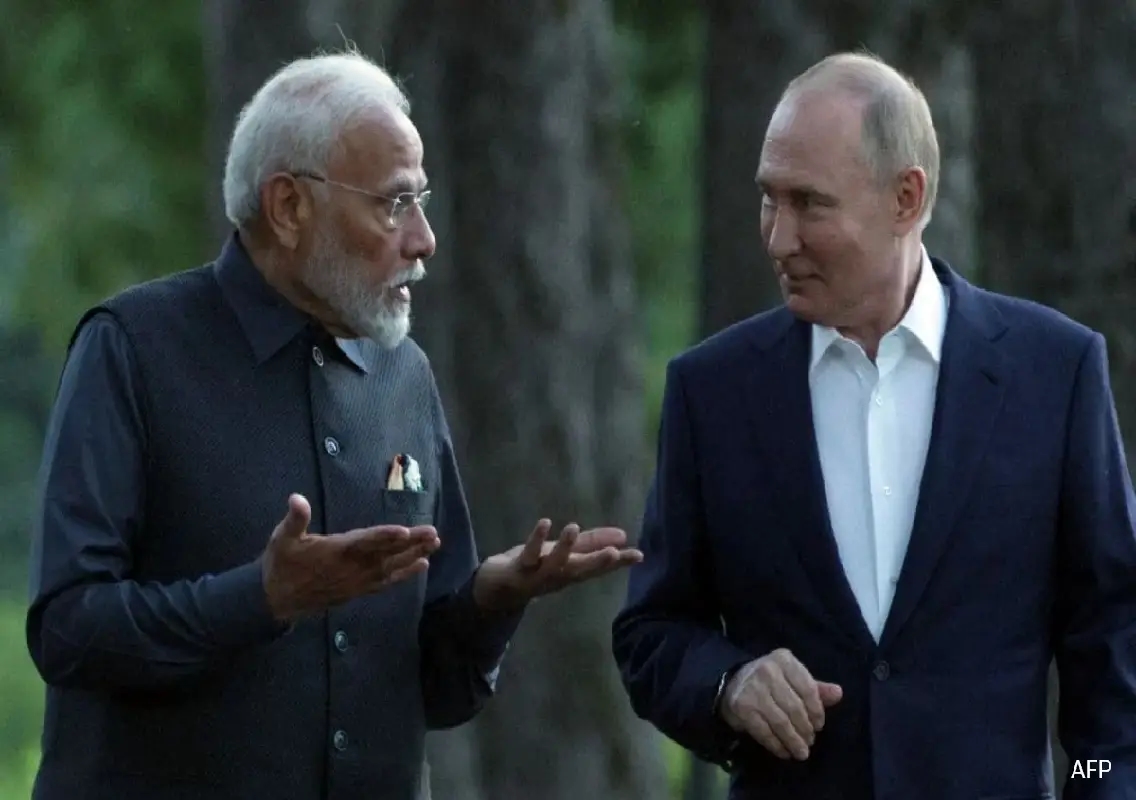


New Delhi: Prime Minister Narendra Modi on Tuesday expressed deep concern over reports that Ukraine had allegedly targeted the residence of Russian President Vladimir Putin, and urged both sides to remain focused on diplomacy to bring an end to the prolonged Russia–Ukraine war.
In a post on X, the Prime Minister stressed that dialogue remains the only viable path to peace. “Deeply concerned by reports of the targeting of the residence of the President of the Russian Federation. Ongoing diplomatic efforts offer the most viable path toward ending hostilities and achieving peace. We urge all concerned to remain focused on these efforts and to avoid any actions that could undermine them,” Modi wrote.
India has consistently called for restraint, dialogue and diplomacy since the conflict began in February 2022, positioning itself as a voice for peace while maintaining engagement with both Moscow and Kyiv.
Allegations of drone attack
The Prime Minister’s remarks came a day after Russian Foreign Minister Sergei Lavrov alleged that Ukraine had carried out a drone attack on President Putin’s residence located between Moscow and Saint Petersburg. According to Lavrov, as many as 91 drones were intercepted and brought down near Putin’s “official residence” in the Novgorod region.
Lavrov claimed that while there were no casualties or damage, the alleged incident marked a serious escalation. He further stated that Russia would “revise its negotiating position” in the ongoing peace talks aimed at ending Moscow’s invasion of Ukraine.
The Russian claim immediately drew international attention, as it suggested a direct threat to the Russian President’s residence at a time when fragile diplomatic efforts were underway.
Ukraine rejects Russian claims
Ukraine, however, strongly denied the allegations. President Volodymyr Zelensky dismissed Russia’s claims as fabricated and accused Moscow of using the incident to justify further attacks on Ukraine.
In a detailed post on X, Zelensky said the allegation was a “typical Russian lie” designed to undermine ongoing diplomatic initiatives. He also linked the claim to Russia’s attempts to derail peace efforts involving the United States.
“Russia is at it again, using dangerous statements to undermine all achievements of our shared diplomatic efforts with President Trump’s team,” Zelensky wrote. He asserted that Ukraine does not take steps that could weaken diplomacy and accused Russia of doing the opposite.
Zelensky also pointed out that Russia had previously targeted Kyiv, including government buildings, and warned the international community against remaining silent. “We cannot allow Russia to undermine the work on achieving a lasting peace,” he said.
Trump reacts strongly
The alleged attack also drew a sharp reaction from US President Donald Trump. Speaking after a conversation with President Putin and ahead of a meeting with Zelensky in the United States, Trump said he was “very angry” about the reports.
“I don’t like it. It’s not good. I learned about it from President Putin today. I was very angry about it. It’s a delicate period of time. This is not the right time,” Trump said, adding that attacking a leader’s residence crossed a line during sensitive negotiations.
Despite his anger, Trump said that a peace deal was “very close” following discussions with the Ukrainian leadership. Zelensky later announced that the US had promised security guarantees for Ukraine in a post-war settlement for 15 years, with the possibility of an extension.
Peace talks face fresh hurdles
Even as diplomatic efforts continue, several key issues remain unresolved. The future of territory occupied by Russia, particularly in eastern Ukraine, continues to be a major sticking point. President Putin has reiterated his demand for full control over Ukraine’s eastern Donetsk region, along with three other regions that Moscow claims as its own.
Another contentious issue is the fate of the Zaporizhzhia nuclear power plant in southern Ukraine, which remains under Russian control. These unresolved matters have complicated negotiations, even as international leaders push for a ceasefire.
The recent exchange of accusations, combined with Russia’s statement that it may revise its negotiating stance, has dealt a fresh blow to hopes of an early resolution to the conflict.
India’s consistent stand
India’s response, articulated by Prime Minister Modi, reflects New Delhi’s consistent position on the war. India has repeatedly emphasised that the current era is not one of war and that lasting peace can only be achieved through sustained dialogue and diplomacy.
By urging all sides to avoid actions that could undermine negotiations, India has once again called for restraint amid rising tensions. As global powers attempt to steer the conflict towards a settlement, Modi’s message underscores the importance of de-escalation at a time when the prospects for peace remain fragile.
Conclusion
With allegations, denials and strong reactions from world leaders, the Russia–Ukraine conflict has entered another tense phase. Prime Minister Modi’s call for diplomacy highlights the urgent need for restraint and dialogue, as any escalation risks further delaying peace in a war that has already lasted nearly four years.