







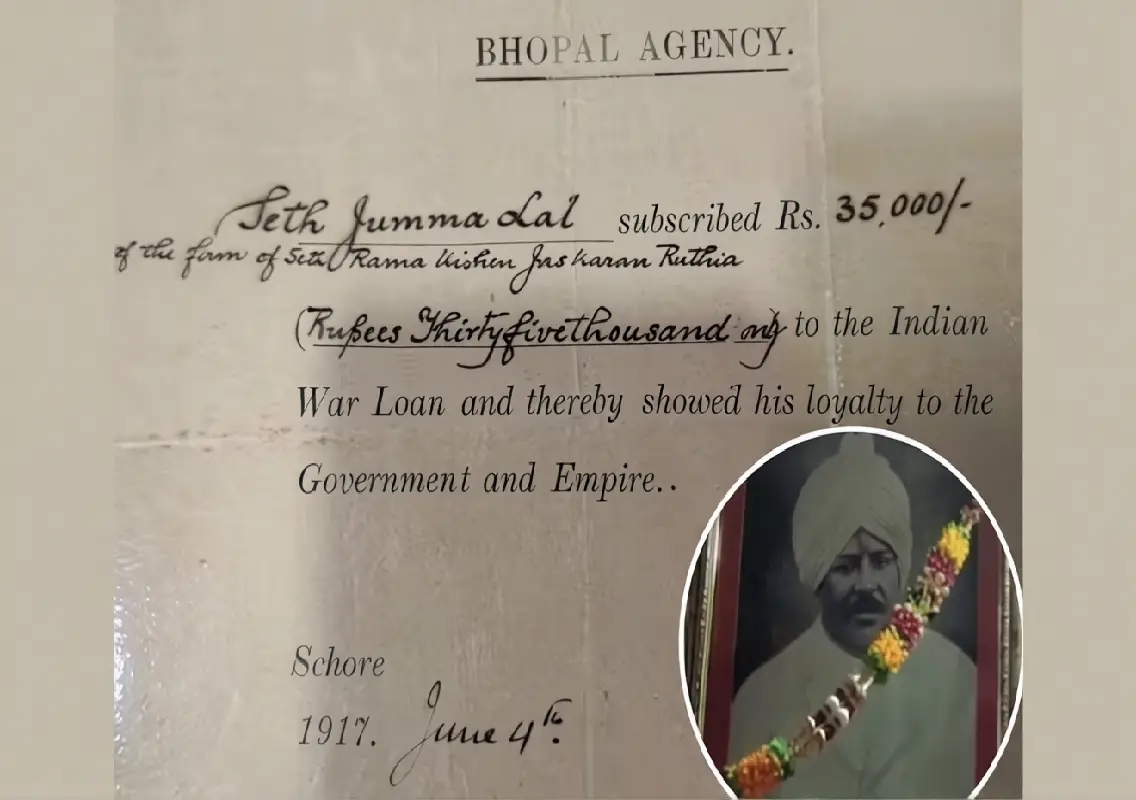


Sehore (Madhya Pradesh): An unusual financial claim dating back to the colonial era has surfaced in Sehore district, where a local business family alleges that the British government owes them money borrowed more than a century ago during the First World War.
The family of late businessman Seth Jumma Lal Ruthia claims that he lent ₹35,000 to the British administration in 1917 under what was then known as the Indian War Loan scheme. They argue that the amount was never repaid and, with accumulated interest over more than 100 years, would now run into several crores.
Loan during World War I
According to family members, Seth Jumma Lal Ruthia was a prominent trader dealing in cloth and grain in Sehore during British rule. During the First World War (1914–1918), the colonial administration was under severe financial strain and sought funds from Indian subjects to support the war effort.
The Indian War Loans were debt instruments floated by the British colonial government in 1917 and 1918 to finance the war. Historical records indicate that more than £70 million was raised from India through these schemes. Citizens were encouraged to invest in war bonds with the promise of attractive interest rates, and the campaign was often framed as a demonstration of loyalty to the Empire.
A document dated June 4, 1917, cited by the Ruthia family, reportedly states: “Seth Jumma Lal of the firm of Seth Rama Kishan Jaskaran Ruthia subscribed ₹35,000 (Rupees thirty five thousand only) to the Indian War Loan and thereby showed his loyalty to the Government and Empire.” The document is said to bear the signature of WS Davis, who was the Political Agent in Bhopal of the Bhopal Agency at the time.
In 1917, ₹35,000 was a substantial sum, equivalent to several lakhs in purchasing power at the time and potentially amounting to crores today if calculated with compound interest over more than a century.
Documents preserved within family
Seth Jumma Lal passed away in 1937, roughly two decades after extending the loan. According to his grandson Vivek Ruthia, the documents acknowledging the subscription were preserved by his son, Seth Manak Chand Ruthia, until his death in 2013.
Vivek Ruthia said that the existence of the loan resurfaced when old family papers and a will were examined during internal discussions. “The papers remained with us for over two decades. Only recently did we revisit them in detail and realise the significance of the claim,” he said.
The family maintains that there is no record of repayment having been made either before Independence in 1947 or thereafter.
Legal options under consideration
Vivek Ruthia has indicated that he is preparing to send a legal notice to the British government, citing principles of international law. He has also suggested that the matter could potentially be pursued in an international forum such as the International Court of Justice at The Hague, though legal experts note that such a route would be complex.
“This is not just about money, but about justice and history. ₹35,000 in 1917 would amount to crores in today’s currency, including interest,” Vivek said.
However, legal scholars point out that enforcing a century-old financial claim presents significant challenges. Questions would arise regarding limitation periods, sovereign immunity, jurisdiction, and the legal status of obligations undertaken by a colonial administration prior to Indian Independence.
Moreover, the Indian War Loans were structured as formal bond subscriptions, and historical records show that the United Kingdom government undertook various measures in later decades to redeem outstanding war debt instruments. For instance, the UK Treasury announced in 2014 that it would redeem certain outstanding war loans in 2015. Whether the Ruthia family’s document corresponds to a redeemable instrument and whether any redemption process applied to it would require detailed archival verification.
Historical and legal complexities
Experts say that while the discovery of such documents is historically significant, translating them into a legally enforceable financial claim is another matter. Establishing authenticity, proving non-payment, and identifying the appropriate legal successor to the colonial government’s liabilities would be central hurdles.
There is also the broader context of colonial-era financial arrangements, many of which were embedded within imperial administrative frameworks rather than bilateral agreements between sovereign states.
As of now, there has been no response from British authorities regarding the claim.
For the Ruthia family, the issue goes beyond monetary compensation. They view it as a matter of historical accountability. Whether the claim progresses beyond a legal notice remains to be seen, but it has certainly revived interest in the financial legacy of colonial-era war funding and the contributions made by Indian subjects during World War I.