







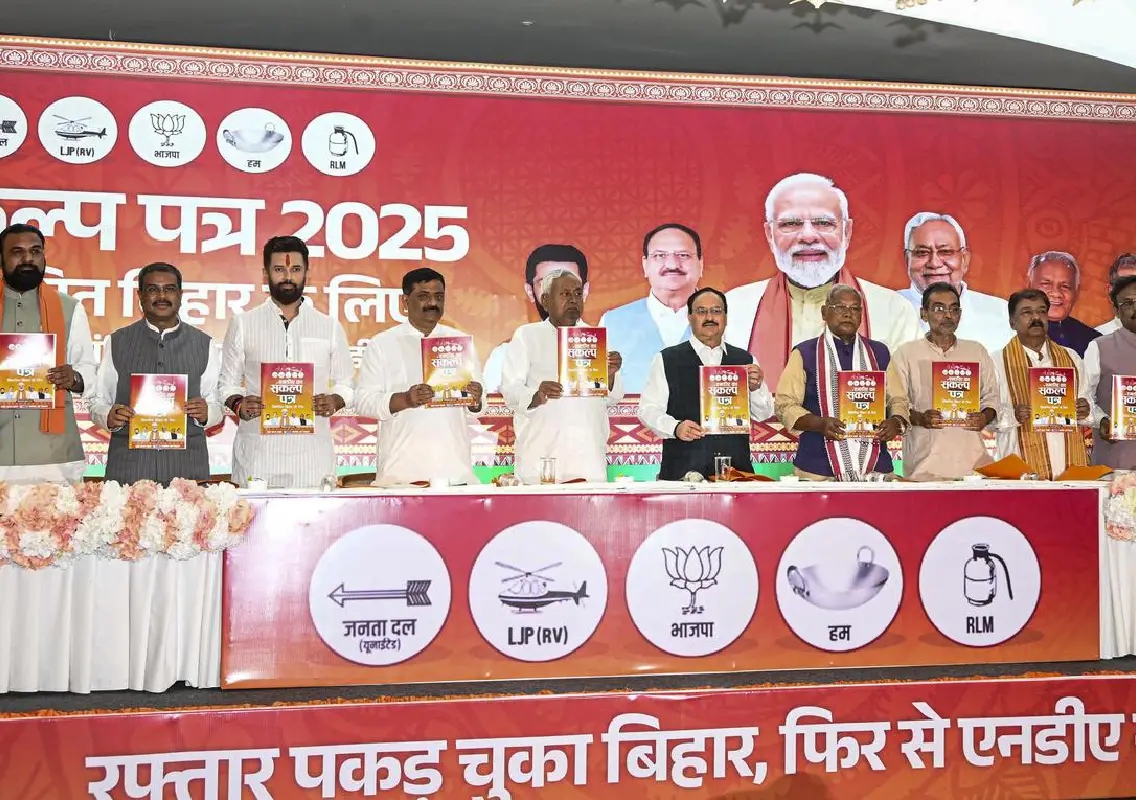


As Bihar gears up for the final phase of its Assembly elections on November 11, both the National Democratic Alliance (NDA) and the Mahagathbandhan (MGB) are battling to retain their strongholds and make fresh gains, with much depending on the performance of their smaller allies who have secured significant seat shares.
Smaller allies hold the key
Within the NDA, Union Minister Chirag Paswan’s Lok Janshakti Party (Ram Vilas) [LJP (RV)] is contesting 15 of its allotted 28 seats, while Jitan Ram Manjhi’s Hindustani Awam Morcha (Secular) [HAM(S)] is fielding candidates in all six of its constituencies. Both Paswan and Manjhi are regarded as key Dalit leaders within the alliance, and their success is expected to be crucial in reversing the NDA’s 2020 performance in the Magadh region, where the Rashtriya Janata Dal (RJD)-led MGB had won 20 of 26 seats.
The Rashtriya Lok Morcha (RLM), led by Upendra Kushwaha, also has much at stake, with his wife Snehlata Kushwaha contesting one of the four seats allotted to the party. The NDA hopes that the combined influence of its Dalit and Kushwaha leaders will translate into votes in the five key districts of Magadh.
While Chirag Paswan’s demand for a larger share of seats had earlier caused friction within the NDA, his strong claim of a “100% strike rate” in the Lok Sabha polls continues to bolster his bargaining position within the coalition.
Mahagathbandhan banks on allies
For the opposition MGB, Congress is contesting 37 of its 61 seats, and the Vikassheel Insaan Party (VIP) has fielded candidates in seven of its 12 constituencies. The alliance is relying heavily on Mukesh Sahani, the VIP chief, to mobilise Nishad (boatmen) community votes, which constitute about 2.6% of Bihar’s population.
Sahani, a former NDA ally, has been given significant importance in the alliance, with the MGB reportedly agreeing to name him as deputy chief minister if the coalition forms the government. The MGB is also working to erode the NDA’s dominance in Tirhut, where the ruling alliance currently holds 23 of the 30 seats going to polls in this phase, and in Mithilanchal, where NDA controls eight of ten seats in Madhubani district.
Seemanchal region in focus
The Seemanchal region, known for its high Muslim population, remains a politically sensitive and high-stakes battleground. The All India Majlis-e-Ittehadul Muslimeen (AIMIM), led by Asaduddin Owaisi, is contesting again after securing five of 24 seats in 2020. This time, Congress is contesting 12 seats and RJD is contesting nine in the region.
The NDA had bagged 12 seats in Seemanchal in the previous election, and its leaders believe that if AIMIM divides the Muslim vote, they could benefit from a consolidated Hindu vote. However, the MGB is confident that Muslims will vote en bloc for the opposition this time while also expecting to gain a share of the Hindu electorate.
High turnout adds intrigue
The record 65% turnout in the first phase of voting on November 6 has left both major alliances and new entrants like Prashant Kishor’s Jan Suraaj Party claiming momentum. A similarly high turnout in the second phase could add to the uncertainty over which side will benefit from the voter enthusiasm.
In this phase, the BJP will contest 53 seats compared to JD(U)’s 44, marking a reversal of the first phase where JD(U) led with 57 seats against BJP’s 48. On the MGB side, the RJD is contesting 71 seats, while CPI(ML) is fielding six candidates, with reports of friendly contests among allies in a few constituencies.
Outlook
As both alliances attempt to consolidate caste-based support and regional loyalties, the performance of their smaller partners could decisively tilt the scales. The results will reveal whether the NDA’s coalition arithmetic or the MGB’s social engineering yields greater dividends in the final phase of Bihar’s high-stakes election.