







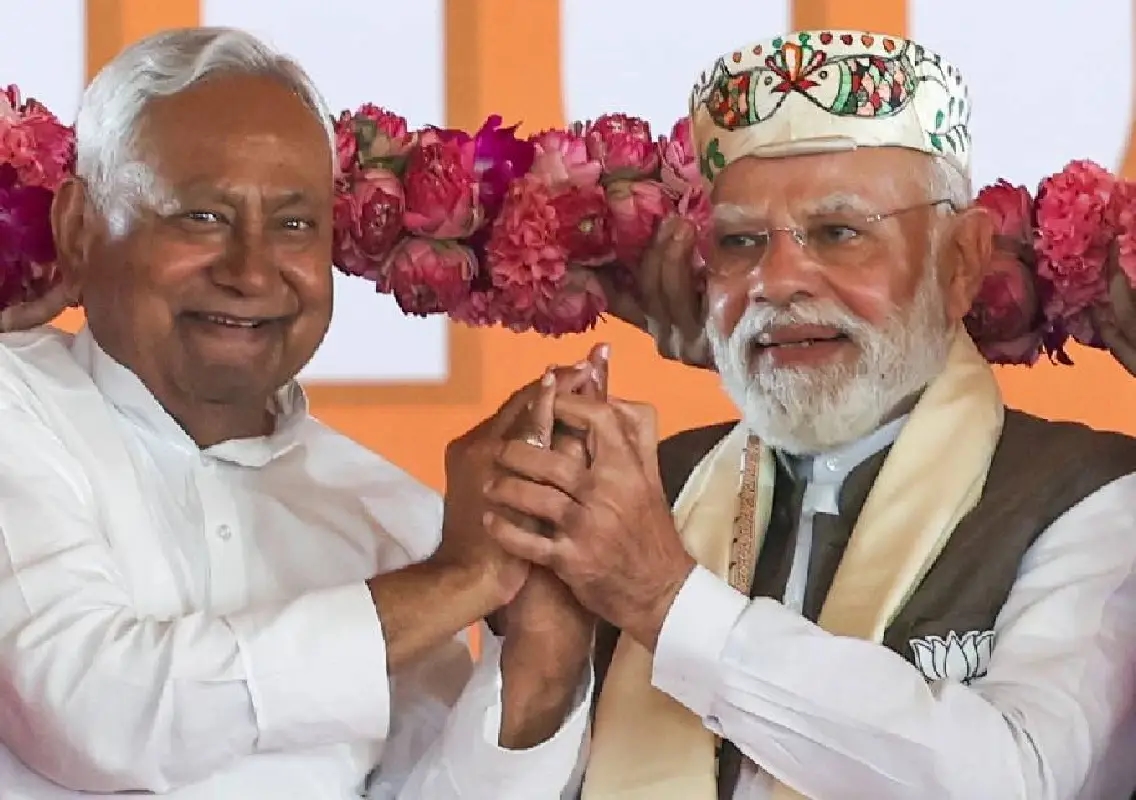


Bihar Chief Minister Nitish Kumar on Monday submitted the Cabinet’s formal recommendation to dissolve the current Assembly, setting in motion the final steps before the formation of a new National Democratic Alliance (NDA) government. The development marks a crucial transition period, coming just days after the NDA’s sweeping victory in the Assembly elections.
Cabinet recommends dissolution of Assembly
Earlier in the day, Nitish Kumar chaired the last Cabinet meeting of the outgoing government at 11:30 a.m. During the meeting, ministers unanimously decided to recommend dissolution of the present Assembly on November 19, marking the conclusion of the government’s tenure. Following the meeting, all ministers tendered their resignations, paving the way for reconstitution of the new NDA government.
Shortly after the meeting, Nitish Kumar reached Raj Bhavan to convey the Cabinet’s recommendation to Governor Arif Mohammad Khan. The Governor is expected to act on the advice as per constitutional procedure.
Senior JD(U) leader Vijay Kumar Choudhary later confirmed the decision, saying, “In the last Cabinet, it was decided to dissolve the current Assembly on November 19 and Nitishji has recommended this to the Governor.”
Nitish Kumar set for record 10th swearing-in
Once the Assembly is formally dissolved on November 19, Nitish Kumar will submit his resignation and is expected to be invited to form the next government as leader of the NDA. The oath-taking ceremony is scheduled for November 20 at the historic Gandhi Maidan in Patna, where thousands are likely to gather.
This will mark the tenth time Nitish Kumar takes oath as Chief Minister — a rare political milestone in Indian politics and a testament to his long-running influence in Bihar’s political landscape.
Prime Minister Narendra Modi, who campaigned extensively during the elections and addressed more than a dozen rallies, is expected to attend the swearing-in ceremony. During the campaign, he had promised to “return for the oath-taking of the new NDA government”.
NDA’s decisive mandate
The Bihar Assembly election results delivered a strong mandate to the ruling NDA, which secured 202 seats in the 243-member House — a comfortable and convincing majority. The BJP emerged as the single largest party with 89 seats, followed closely by the JD(U), which secured 85 seats.
Smaller allies also performed strongly:
- Chirag Paswan-led LJP(RV): 19 seats
- Hindustani Awam Morcha (HAM): part of the nine seats won by smaller partners
- Rashtriya Lok Morcha (RLM): also contributed to the tally of smaller alliance members
The opposition Mahagathbandhan, led by the Rashtriya Janata Dal (RJD), faced a crushing defeat, managing to secure only 35 seats. The RJD itself slipped to 25 seats, a sharp fall from its 2020 tally of 75.
Road ahead for the new government
With a strong majority in place, the NDA government is expected to focus on stability, welfare schemes, and continuity of developmental initiatives. However, internal discussions on Cabinet composition are likely to take centre stage in the coming days, as alliance partners negotiate representation based on their improved seat share.
JD(U) leaders have already indicated that the party will seek a greater number of ministerial berths in proportion to its electoral performance. The inclusion of new NDA partners such as LJP(RV) and RLM adds another layer of complexity to the power-sharing talks.
Conclusion
As Bihar moves toward the formation of a new government, the political momentum remains squarely with Nitish Kumar, who is set to begin yet another term backed by a strong NDA mandate. The dissolution of the Assembly and the upcoming oath ceremony mark a familiar but significant moment in the State’s political trajectory, underscoring both continuity and renewed mandate for governance.