







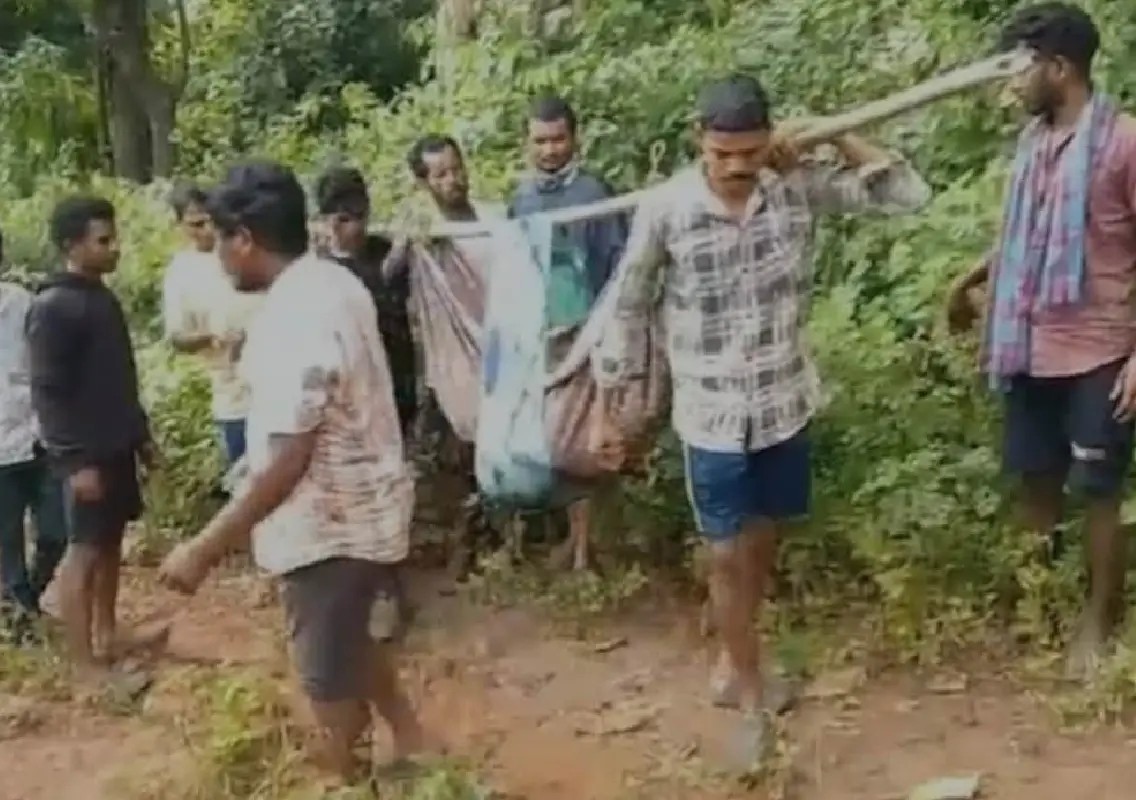


When Korrabu Padma fell seriously ill in her remote village in Andhra Pradesh, getting medical help became a race against distance. With an ambulance unable to reach the village, her family and neighbours had to carry her nearly 11 kilometres on a traditional doli before she could be taken to hospital.
Padma, from Marripakalu village in Koyyuru mandal of Alluri Sitharama Raju district, fell ill on Sunday and her condition worsened. Since vehicles could not reach the village, villagers carried her from Marripakalu to Palakajeedi, covering around 11 km.
An ambulance was waiting at Palakajeedi, from where she was taken to the Y Ramavaram Area Hospital for treatment.
A sick woman becomes a villagers’ responsibility
The incident has highlighted how difficult a medical emergency can become when an ambulance cannot reach a remote habitation.
Instead of being taken directly to a waiting emergency vehicle, Padma had to be physically carried over a rough route. Villagers said the road has rocks, potholes, muddy stretches, curves and uneven sections, making movement particularly difficult during the rainy season.
Residents said the problem has existed for decades and urged the government to build a proper tar road.
Government wants to reduce doli dependence
The incident comes as the Andhra Pradesh government is introducing measures aimed at improving emergency healthcare in tribal areas.
Chief Minister N Chandrababu Naidu has said feeder ambulances, 108 emergency services and 104 mobile medical units are being arranged so that patients do not have to depend on doli transport.
The government has also announced road projects covering 2,336 tribal habitations, with 905 km of roads laid under the ‘Adavi Talli Bata’ programme.
Drones bring another option
The state has also introduced drone-based medical transport in remote tribal areas. According to Health Minister Satya Kumar Yadav, four drones operating in Alluri Sitharama Raju district have completed more than 1,800 trips since the system began in January 2026.
The drones carry medicines, vaccines and medical samples, helping overcome difficult terrain.
But Padma’s 11-km journey underlines a basic need that remains unchanged: when a person falls critically ill, an ambulance must be able to reach them. Until roads and emergency access improve, villagers in remote areas may continue to become the first and only link between a sick person and life-saving medical care.