







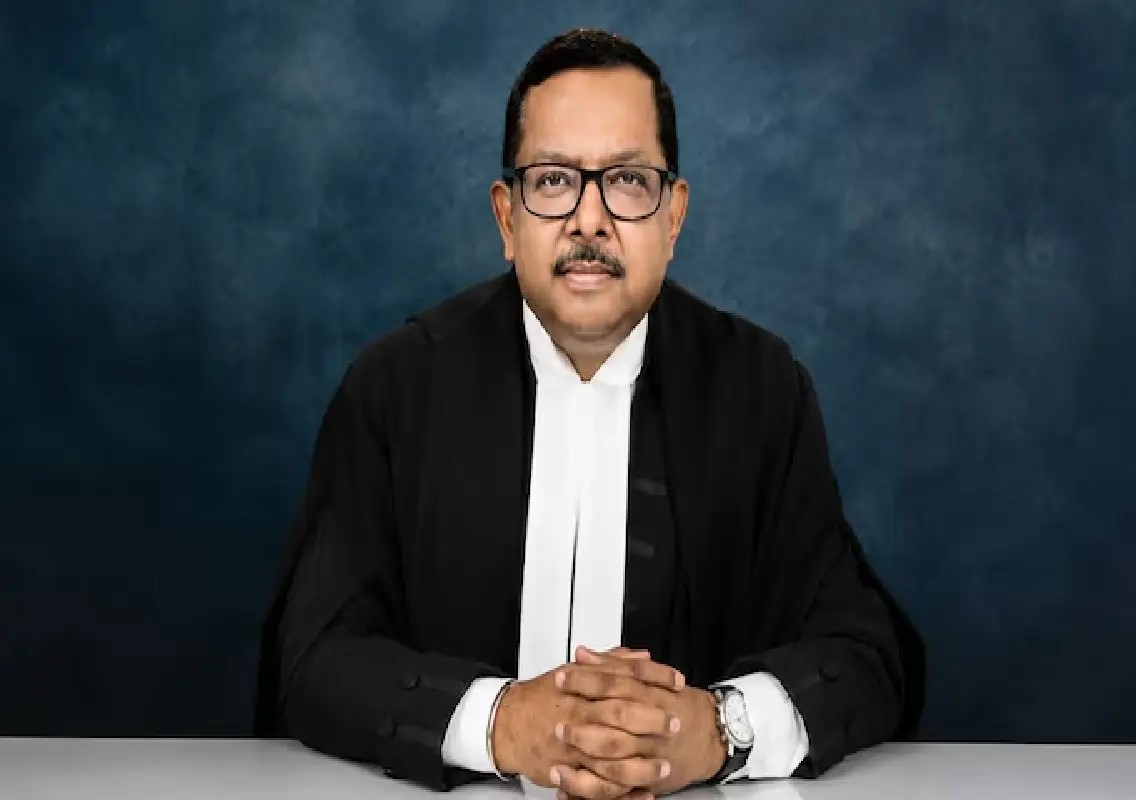


Bhopal: Supreme Court Judge Justice Ujjal Bhuyan has expressed concern over what he described as the growing criminalisation of peaceful dissent in the country, stating that ordinary acts of protest and expression are increasingly being treated as criminal offences. He made the remarks while delivering the 4th Memorial Lecture of Justice G P Singh at the National Law Institute University (NLIU) in Bhopal on Saturday.
During his address, Justice Bhuyan referred to several recent instances involving arrests, bail conditions and public protests, while underlining the importance of safeguarding constitutional freedoms.
Remarks on chicken biryani arrest
Referring to the arrest of youngsters who were allegedly detained for consuming chicken biryani while breaking their fast over the Ganga river, Justice Bhuyan questioned the basis of the action.
“There is no law prohibiting consumption of chicken over the Ganga river,” he said, adding that consuming chicken biryani could not be treated as an offence.
He observed that the individuals had reportedly remained in jail for three months despite the nature of the allegation.
Peaceful protest is central to democracy
Justice Bhuyan emphasised that the right to express one’s views and participate in peaceful demonstrations is protected under the Constitution.
He said debate and dissent are essential features of a democratic society and warned against treating routine acts of protest as criminal conduct.
According to him, people protesting environmental degradation or other public issues should not be viewed as criminals merely for voicing their concerns.
Concern over treatment of student protesters
The Supreme Court judge also referred to student demonstrations, saying that students participating in campus protests are sometimes arrested and remain in custody for extended periods before obtaining bail.
He further noted that some students also face suspension from educational institutions, requiring them to seek legal intervention before resuming their studies.
Justice Bhuyan said such developments raise important questions about the protection of constitutional rights.
Questions over restrictive bail conditions
Justice Bhuyan also expressed concern over restrictive conditions imposed while granting bail.
He observed that although courts eventually grant bail in many cases, delays in securing relief and stringent conditions attached to bail orders could discourage citizens from exercising their right to dissent.
He questioned whether such conditions indirectly discourage people from expressing opposing views.
The judge also referred to instances where individuals granted bail were allegedly barred from attending public meetings or posting on social media, stating that such restrictions could undermine personal liberty and fundamental freedoms.
References to earlier court rulings
Justice Bhuyan cited the Supreme Court’s 2024 judgment against punitive “bulldozer justice”, describing the ruling as welcome but observing that it had come after a considerable delay.
He also criticised a decision of the Bombay High Court that declined permission for a demonstration expressing solidarity with Palestine.
Recalling the observations made during the hearing, Justice Bhuyan said India has historically recognised Palestine and maintains diplomatic relations with it.
Post-retirement judicial appointments
The judge also commented on former members of the higher judiciary accepting political positions after retirement.
He questioned the reasoning behind such appointments, stating that the judiciary and the executive are constitutionally distinct institutions.
According to Justice Bhuyan, the idea of joining the legislature to bridge any perceived gap between the judiciary and the executive reflects a fundamental misunderstanding of their respective constitutional roles.
Encourages scrutiny of judicial decisions
Addressing law students, Justice Bhuyan stressed that judicial decisions should remain open to critical examination.
He said criticism of a court judgment should not be viewed as criticism of the judge delivering it and encouraged future lawyers to engage constructively with judicial decisions.
He added that the legitimacy of the judiciary ultimately depends on public confidence and expressed optimism about the commitment of the younger generation of lawyers and law students towards the Constitution and the rule of law.