







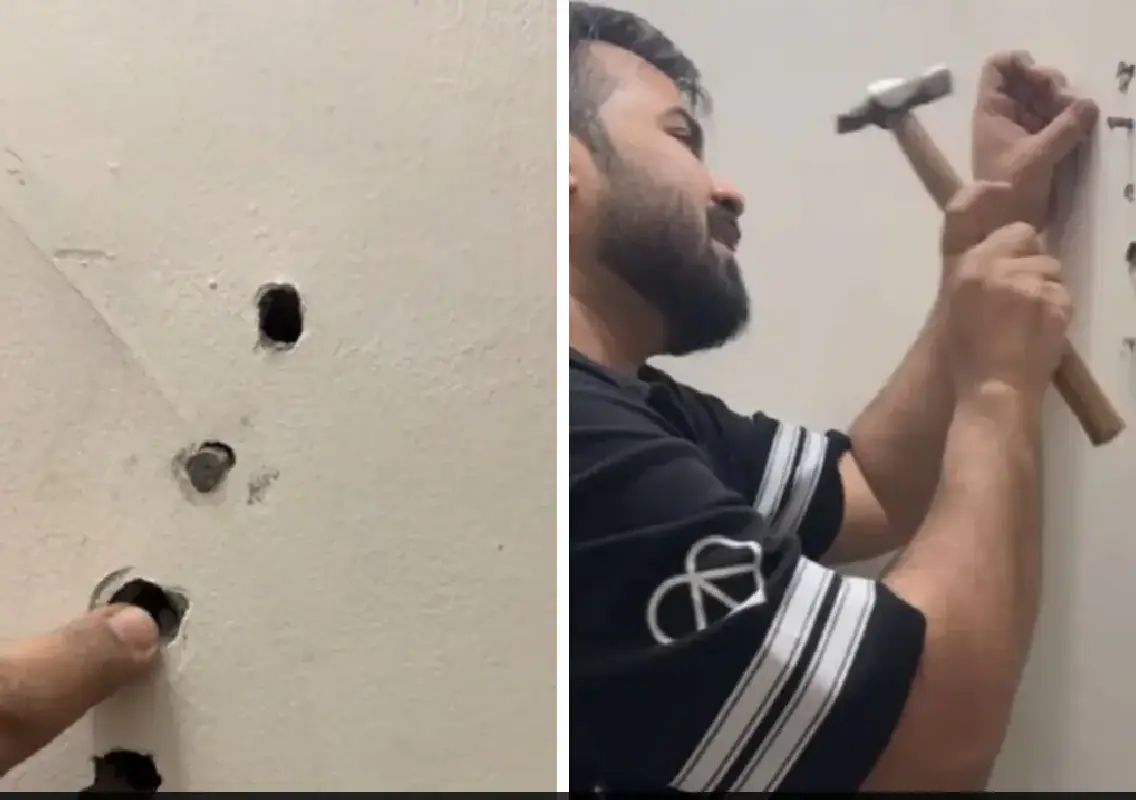


A Noida resident’s viral video showing him hammering a wooden pencil through the wall of his ₹1.5 crore apartment has ignited widespread concern over the quality of high-rise construction in the Delhi-NCR region.
The video, shared on Instagram by user @kabeer.unfiltered, shows the man driving a pencil into his apartment wall using a hammer — with the pencil sinking in effortlessly. The clip, which quickly went viral, prompted discussions about the structural integrity and material standards of luxury residential projects.
Resident questions construction quality
In the video, the resident explains his disbelief at the wall’s fragility.
“This hole in the wall was made using a pencil. I placed the pencil against the wall, hit it with a hammer, and it went right in,” he says. “When I first tried using a drill, it didn’t work well, but with the pencil, it went straight through. That’s how weak the wall is — you don’t even need a drill.”
The video, filmed inside a supposedly premium apartment, has since attracted lakhs of views and comments questioning how such a flaw could exist in a property priced over a crore.
Social media reacts with mixed opinions
While many viewers expressed anger and disappointment over the apparent poor construction quality, some users offered technical explanations.
Several commenters claimed that the walls shown in the video were non-structural AAC (Autoclaved Aerated Concrete) blocks, commonly used in modern high-rise buildings. These blocks are lightweight and not load-bearing, helping to reduce the building’s overall weight and improve earthquake resistance.
One user wrote, “How bad it feels to have been cheated, investing almost a crore in such poor infra.”
Another countered, “These are AAC blocks — they have air pockets to make them light, which is why drilling or hammering through them is easy. This doesn’t mean the building is unsafe.”
Authenticity yet to be verified
As of now, the authenticity of the video and the exact cause of the wall’s weakness remain unverified. Neither the developer nor local authorities have released an official statement on the issue.
However, the incident has reignited concerns about construction transparency in India’s booming real estate sector, where buyers often rely on branding and brochures rather than independent quality checks.
Experts note that while AAC blocks are widely accepted for partition walls, developers must ensure proper plastering and quality finishing to maintain durability and customer confidence.