







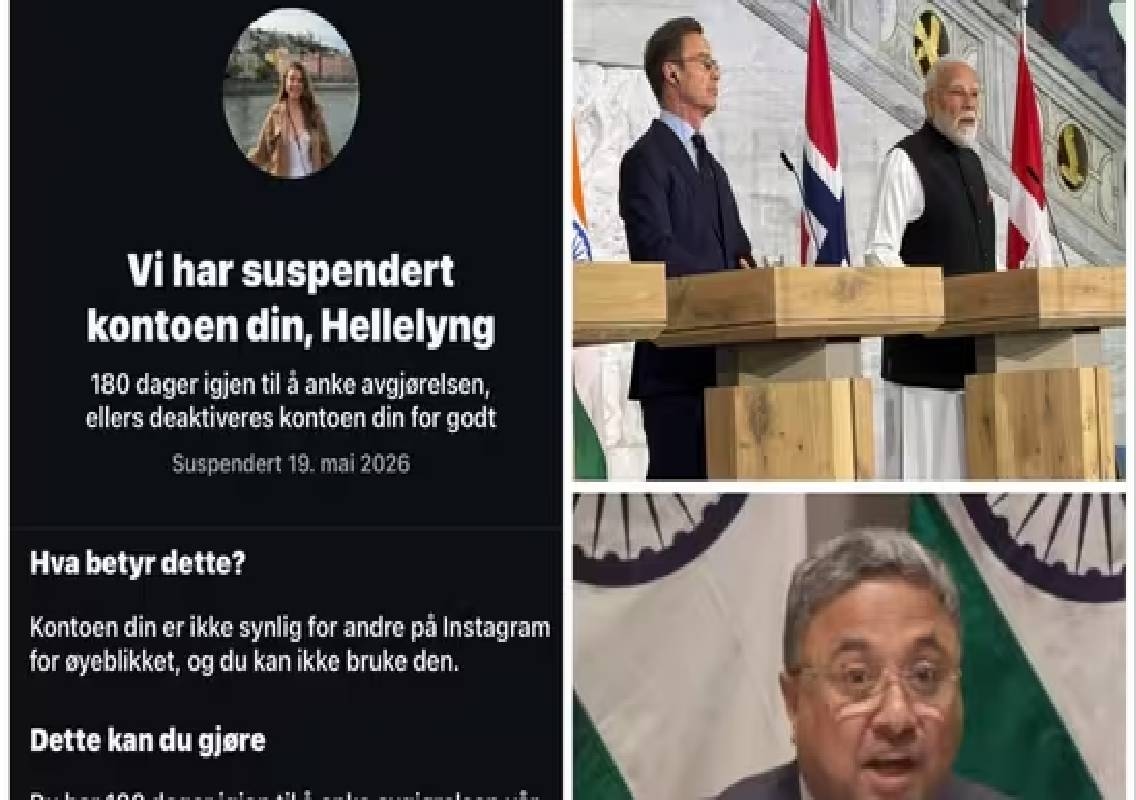


Oslo: Norwegian journalist Helle Lyng has claimed that her Instagram and Facebook accounts were suspended after her viral exchange involving Prime Minister Narendra Modi during his visit to Norway sparked widespread reactions online and drew attention during an official Ministry of External Affairs (MEA) briefing.
Lyng, who identifies herself as a journalist with Norwegian newspaper Dagsavisen, had posted a video from a joint media event in Oslo where she questioned PM Modi about not taking questions from what she described as the “freest press in the world”.
The incident quickly gained traction on social media and later became part of a tense exchange during an MEA press conference addressed by senior Indian diplomat Sibi George.
Viral video sparks online debate
The controversy began during a joint press statement event attended by PM Modi and Norwegian Prime Minister Jonas Gahr Støre in Oslo on Monday.
As PM Modi was leaving the event, Lyng was heard asking why he does not take questions from the press. In a video shared on social media platform X, she wrote that she did not expect the Indian prime minister to answer but believed it was important for journalists to question political leaders.
In her post, Lyng referred to Norway’s top ranking in the World Press Freedom Index and contrasted it with India’s ranking. The video rapidly circulated online, triggering political debate, media commentary and reactions from supporters and critics alike.
The clip also generated discussions regarding press freedom, media access and political communication during international visits.
Journalist claims Instagram and Facebook accounts suspended
A day after the video gained widespread attention, Lyng posted on X claiming that her Instagram and Facebook accounts had been suspended.
According to the journalist, she was unable to access both Meta-owned platforms and said the suspension affected her ability to respond to messages and comments from users.
“If you’re trying to reach me on Instagram or Facebook, I would like to let you know I have been suspended from both accounts,” she wrote on X.
Lyng further stated that she hoped the accounts would eventually be restored and added that she had never previously experienced such a suspension.
In another post, she described the development as “a small price to pay for press freedom”.
The exact reason behind the suspension of her Meta accounts remains unclear, and there has been no official public statement from Meta regarding the matter so far.
Screenshots shared by Lyng reportedly showed a notification stating that her Instagram account had been suspended on May 19, 2026, and that she had 180 days to appeal the decision before permanent deactivation.
Exchange continues during MEA briefing
The controversy extended beyond social media and entered an official MEA press briefing later during PM Modi’s Norway visit.
During the interaction, Lyng questioned Indian officials regarding human rights, democratic values and media freedom in India. She also asked why PM Modi does not take critical questions from Indian journalists.
Responding to her questions, MEA Secretary (West) Sibi George defended India’s democratic framework and constitutional system.
George spoke at length about India’s constitutional guarantees, judicial system and democratic institutions, stressing that citizens whose rights are violated have legal remedies available through the courts.
“We are proud to be a democracy,” he said while outlining India’s democratic structure and governance model.
The exchange between the journalist and Indian officials has since become widely discussed across television debates, online forums and political circles.
Lyng says journalism can be confrontational
Following criticism and online speculation, Lyng issued additional statements on social media clarifying that she is “not a spy” or acting on behalf of any foreign government.
She stated that her work is focused on journalism and defended her questioning style as part of normal journalistic practice.
According to Lyng, journalism often requires confrontation and persistence in seeking direct answers from those in positions of power.
“If any interview subject, especially with power, do not answer what I asked, I will try to interrupt and get a more focused response,” she wrote on X.
Her comments drew mixed reactions online, with some users supporting her stance on press accountability while others criticised her approach during the diplomatic event.
Debate over media freedom intensifies
The incident has reignited broader discussions surrounding media freedom, political communication and the relationship between governments and journalists during international engagements.
Critics of the Indian government have cited the episode while raising concerns regarding press access and questioning opportunities for journalists. Supporters of the government, meanwhile, argued that official diplomatic events are structured differently from open press conferences and accused the journalist of seeking confrontation.
The exchange also highlighted growing scrutiny surrounding global press freedom rankings and how they are interpreted in international political discourse.
As reactions continue online, the suspension of Lyng’s Meta accounts has added another layer to an already widely debated controversy involving international media, diplomacy and social media platforms.