







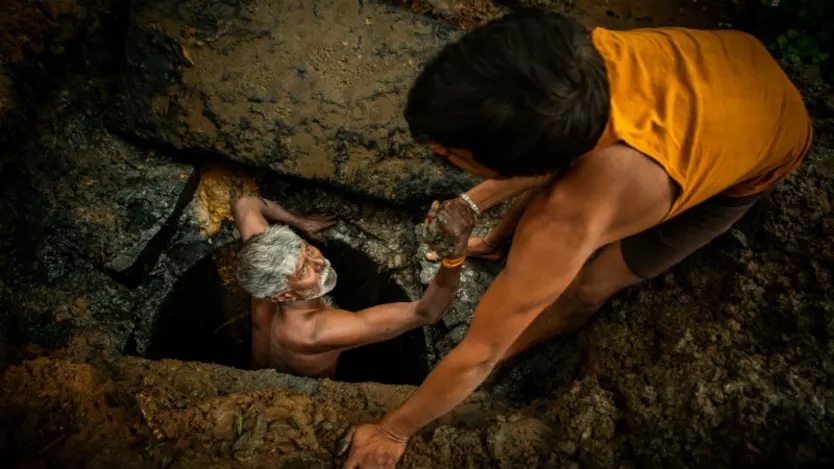


More than 470 sanitation workers have lost their lives while cleaning sewers and septic tanks across India between 2019 and October 2025, according to official data released by the Press Information Bureau (PIB).
The figures, shared on December 16, are based on data compiled by the Ministry of Social Justice and Empowerment and underline the continuing prevalence of hazardous manual cleaning, despite a legal ban and decades of sanitation programmes.
Deaths continue despite law and missions
India outlawed manual scavenging under the Prohibition of Employment as Manual Scavengers and their Rehabilitation Act, 2013. However, the deaths reveal a stark gap between law and implementation. On average, nearly 70 people die every year while cleaning septic tanks and sewer lines — work that is both dangerous and legally prohibited.
States reporting high numbers of such deaths include Delhi, Gujarat, Karnataka, Tamil Nadu, Maharashtra and Uttar Pradesh.
Several reports have repeatedly pointed out that workers are often sent into toxic environments without the protective gear mandated by law, largely due to poverty, caste-based exclusion and the continued reliance on informal labour.
Supreme Court flags violations
On September 19 this year, the Supreme Court of India imposed a fine of Rs 5 lakh on Delhi’s Public Works Department for allowing labourers, including a minor, to manually clean sewer drains near the Court premises.
Just a day earlier, a 40-year-old worker died and three others were critically injured while cleaning a manhole in Ashok Vihar, Delhi — an incident that highlighted how such violations occur even in the heart of the national capital.
Weak enforcement, limited accountability
Although offences under the 2013 Act are cognisable and non-bailable, activists and legal experts point out that convictions remain rare. The law currently prescribes a maximum penalty of one year in jail or a fine of Rs 50,000, raising questions about its deterrent value.
The National Commission for Safai Karamcharis is empowered to take suo motu action, but sustained rehabilitation of workers and their families remains limited.
Call for mechanisation and reform
Experts stress that with India’s advances in technology, sewer and septic tank cleaning can be fully mechanised. They also call for stricter punishment, mandatory FIRs in all deaths, proper safety equipment, and inclusive waste-management systems involving workers from all backgrounds.
Without urgent reform, they warn, sanitation workers will continue to pay with their lives for systemic apathy.