







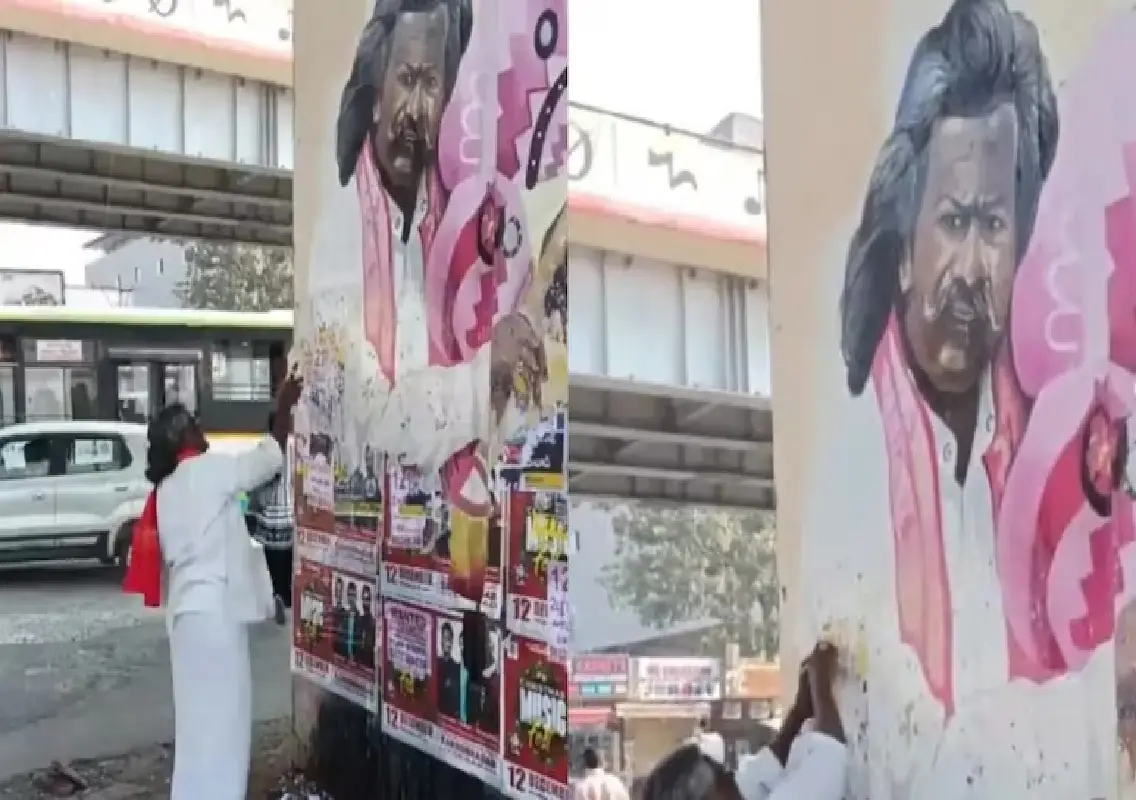


Hyderabad: A video of Padma Shri awardee Darshanam Mogilaiah, popularly known as Kinnera Mogilaiah, removing posters from a public pillar featuring his own portrait has gone viral on social media, triggering widespread debate on civic responsibility and enforcement of cleanliness rules in Hyderabad.
The footage shows the renowned folk musician personally cleaning a pillar near his image, applying whitener and scraping off posters that had been illegally pasted on the structure. The act, captured on camera by bystanders, has resonated strongly with citizens, many of whom have expressed admiration for the artiste’s humility while also criticising civic authorities for failing to curb defacement of public property.
Viral video sparks civic debate
The video, widely shared across social media platforms, has drawn attention to the persistent problem of posters, stickers and advertisements being pasted on public infrastructure such as electric poles, pillars, walls and flyovers across Hyderabad. What struck many viewers was that Mogilaiah, a nationally honoured cultural figure, felt compelled to address the issue himself rather than wait for municipal action.
Social media users have been tagging the Greater Hyderabad Municipal Corporation (GHMC), urging it to take strict action against individuals and organisations that paste posters on public property. Several residents pointed out that posters often carry phone numbers, addresses and organisational details, making it easy to identify offenders if enforcement mechanisms are applied seriously.
Who is Darshanam Mogilaiah?
Darshanam Mogilaiah is a distinguished folk musician from Telangana who has dedicated his life to preserving and promoting the rare tribal string instrument known as the kinnera. The instrument, believed to have origins dating back several centuries, is traditionally played by members of specific tribal communities and is deeply rooted in oral storytelling and folk traditions.
Mogilaiah is credited with reviving interest in the kinnera at a time when the art form was on the verge of extinction. His mastery of the instrument and commitment to passing on the tradition to younger generations earned him national recognition. In 2022, he was conferred the Padma Shri for his contribution to Indian folk music and cultural heritage.
For many, the sight of such an accomplished artiste cleaning a public pillar himself was both moving and troubling.
Public reactions and demands for action
Residents and social media users reacted strongly to the video, expressing disappointment that a respected cultural icon had to personally intervene to protect public property. Many described the incident as a reflection of civic apathy and weak enforcement of existing rules.
One user urged authorities to impose penalties on those who illegally paste posters, noting that the identification details printed on most posters make it easy to trace violators. Another questioned the effectiveness of GHMC’s monitoring mechanisms, arguing that occasional drives or the presence of a single official are insufficient to tackle a city-wide problem.
Several comments highlighted the irony of Mogilaiah’s portrait itself being defaced, calling it a sign of deep-rooted disregard for public spaces and cultural respect. A user described the situation as “painful and embarrassing,” adding that such negligence reflects a regressive mindset and a state of learned helplessness among citizens who have come to accept defacement as normal.
Rules exist, enforcement questioned
Hyderabad, like many major Indian cities, has regulations prohibiting the defacement of public property. Pasting posters, banners and stickers without permission is technically an offence, and violators can be fined. However, citizens frequently complain that enforcement is sporadic and penalties are rarely imposed in a consistent manner.
Political posters, event advertisements, coaching centre promotions and real estate flyers are commonly seen on public structures across the city. While civic bodies occasionally conduct cleanliness drives or remove posters, residents argue that the lack of sustained action encourages repeat violations.
The viral video has once again brought these concerns to the fore, with many calling for GHMC to strengthen monitoring, impose higher fines and ensure accountability.
Symbolism beyond the act
Beyond the immediate issue of posters, many observers viewed Mogilaiah’s act as symbolic. A Padma Shri awardee, honoured for preserving cultural heritage, taking it upon himself to clean a public space was seen as a reminder of individual responsibility as well as institutional failure.
Cultural activists noted that Mogilaiah’s humility and respect for public spaces stand in contrast to the casual manner in which walls and pillars are defaced across cities. They argued that such behaviour not only damages infrastructure but also erodes the aesthetic and cultural fabric of urban spaces.
Conclusion
The sight of Darshanam Mogilaiah cleaning a pillar bearing his own image has struck a chord with Hyderabad’s residents, turning a simple act into a powerful statement on civic sense and governance. While the video has earned praise for the folk musician’s dignity and responsibility, it has also raised uncomfortable questions about why such actions are necessary in the first place.
As public pressure mounts, citizens hope the incident will prompt GHMC and other authorities to take stricter, more consistent action against defacement of public property. Whether this moment translates into lasting change remains to be seen, but for now, Mogilaiah’s gesture has reminded the city that respect for public spaces begins with collective accountability.