







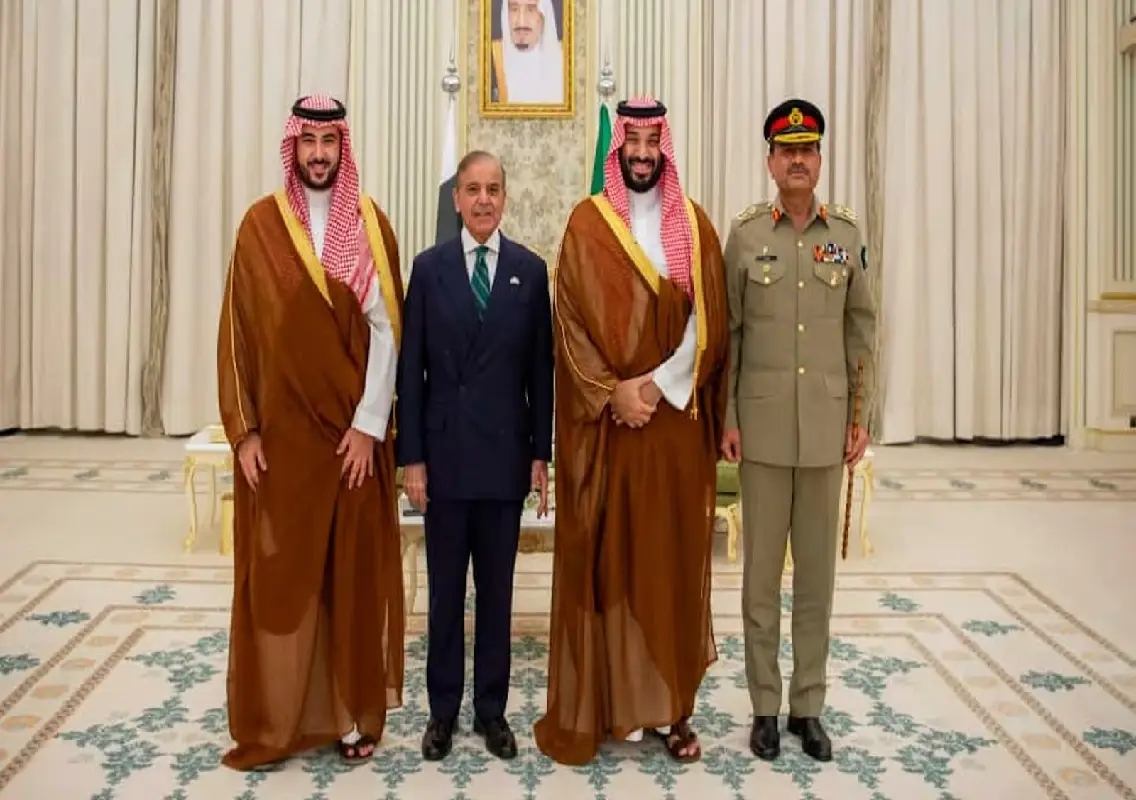


New Delhi (India): Pakistan and Saudi Arabia have signed a historic Strategic Mutual Defence Agreement, pledging that an attack on either nation will be treated as an aggression against both. The move, announced during Pakistan Prime Minister Shehbaz Sharif’s visit to Riyadh at the invitation of Saudi Crown Prince Mohammed bin Salman (MBS), is being seen as one of Islamabad’s most consequential military pacts in decades.
India reacted cautiously on Thursday, with the Ministry of External Affairs (MEA) stating that New Delhi will take “all steps necessary to protect national interests and ensure comprehensive security across all domains.”
Key features of the pact
The pact, signed in Riyadh, was finalised in the presence of Pakistan Army chief Field Marshal Asim Munir, foreign minister Ishaq Dar, and defence minister Khawaja Asif. According to a joint statement, the agreement lays out the following commitments:
- Collective defence: Any aggression against either country will be considered an aggression against both.
- Security cooperation: The two sides pledged to deepen defence ties, enhance intelligence-sharing, and strengthen joint deterrence.
- Institutional framework: The pact formalises what had long been an informal arrangement between Pakistan and Saudi Arabia, institutionalising Islamabad’s role in West Asia’s security architecture.
Pakistani officials described the agreement as “unprecedented in scope,” signalling a deepening of military and strategic trust between the two Muslim-majority nations.
Regional context and timing
The defence pact comes in the aftermath of an Israeli airstrike on Doha, which targeted Hamas operatives and rattled Gulf countries heavily reliant on the US for security guarantees. The attack prompted Qatar to host an emergency summit of nearly 60 Arab League and Organisation of Islamic Cooperation (OIC) member states, where the growing regional instability was widely discussed.
Observers say the pact is partly a response to that instability, aimed at presenting a united Muslim front against potential external aggression. It also signals Riyadh’s willingness to hedge its security bets beyond Washington.
Implications for India-Saudi ties
The agreement is expected to cast a shadow over India–Saudi Arabia relations, which have grown significantly in recent years through energy cooperation, infrastructure investment, and counter-terrorism collaboration.
MEA spokesperson Randhir Jaiswal said New Delhi was aware of talks between Riyadh and Islamabad over such a pact and would “study its implications carefully.” Analysts suggest India will tread cautiously to balance its deepening partnership with Saudi Arabia while safeguarding its security concerns vis-à-vis Pakistan.
A consequential shift
Strategic experts view this as Pakistan’s most consequential defence partnership since its alignment with the United States during the Cold War. The formalisation of a mutual defence pact with Saudi Arabia could significantly reshape West Asia’s security architecture, with ripple effects felt across South Asia.
For Riyadh, the agreement provides an additional layer of security assurance amid regional volatility, while for Islamabad, it marks a rare diplomatic and military win at a time of economic fragility and domestic challenges.
Pakistan and Saudi Arabia signed a defence pact pledging joint response to aggression. India said it will safeguard national interests and study its impact.