







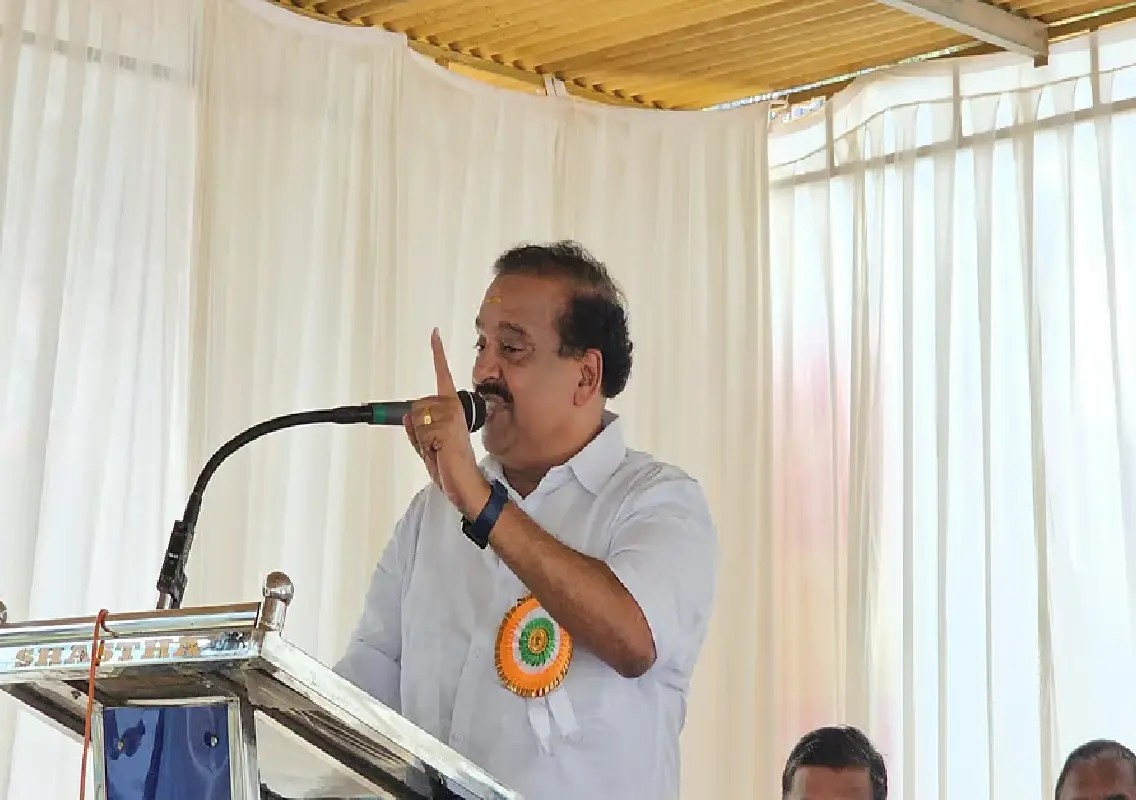


Thiruvananthapuram: Senior BJP leader P K Krishnadas on Sunday defended the Railway Board’s decision to bifurcate the Palakkad railway division and transfer stations including Mangaluru to the Mysuru division, saying the move would ultimately support development in Kerala.
Krishnadas, who has served as chairman of the Passenger Amenities Committee, an advisory body under Indian Railways, said there was no reason for people in Kerala to be concerned about the restructuring.
He was responding to questions from reporters regarding concerns over the impact of the bifurcation on the Palakkad division, particularly its revenue, passenger facilities and development allocations.
Krishnadas defends railway restructuring
Krishnadas said Indian Railways operates with a single financial account and argued that revenue generated by railway stations and operations would ultimately remain part of the national railway system even if the administrative division changes.
He said any reduction in revenue attributed to the Palakkad division following the bifurcation would correspondingly appear as an increase in revenue for the Mysuru division.
“Is the Mysuru division a part of America? Isn’t it part of the Indian Railways? If there is a loss here, it will increase on the other side. All of this is income for the Indian Railways,” he said.
His comments came amid criticism of the decision to reorganise the railway divisions and move stations such as Mangaluru from Palakkad to Mysuru.
According to Krishnadas, the administrative restructuring should not be viewed as a loss to Kerala merely because certain stations will fall under a different railway division.
Passengers will get better facilities, he says
One of the main concerns surrounding the bifurcation has been whether passengers in Kerala would lose access to facilities or face reduced railway investment following the reorganisation.
Krishnadas dismissed these concerns and said passengers would not be deprived of facilities.
“We are telling you—not only will passengers not be deprived of facilities, but within the next three years, they will get facilities many times better than what they have now,” he said.
He maintained that railway infrastructure and passenger amenities would continue to be developed based on requirements rather than simply on the revenue generated by a particular administrative division.
The BJP leader said people should therefore focus on the potential improvements in railway infrastructure instead of viewing the bifurcation purely from the perspective of the Palakkad division’s existing revenue.
Comparison with Salem division
Krishnadas was also asked about the BJP’s statewide hartal in 2007 when the Palakkad division was bifurcated to create the Salem division during the Congress-led UPA government at the Centre.
He said the circumstances surrounding the earlier bifurcation were different from the present situation.
According to Krishnadas, the creation of the Salem division had substantially reduced the revenue attributed to the Palakkad division.
He claimed that the reduction in revenue had an impact on the funds allocated to Kerala because revenue was used as a criterion by the UPA government at the time.
He argued that the same situation does not apply under the present BJP-led government.
BJP government follows different allocation approach
Krishnadas said railway funding under the BJP-led government was not determined solely by the revenue attributed to an individual railway division.
“Today, that is not the case. Whatever each division needs is allocated. Whatever passengers need in each state, whatever is required for development, is provided,” he said.
He contrasted this approach with the railway development policy followed by the previous Congress-led government.
According to Krishnadas, the BJP-led government under Prime Minister Narendra Modi follows a different concept of development, with funding and facilities being provided according to requirements.
He argued that the reorganisation of railway divisions should therefore not automatically be interpreted as a reduction in investment or passenger amenities for Kerala.
Mangaluru’s transfer remains a key issue
The transfer of stations such as Mangaluru from the Palakkad division to the Mysuru division has been a major point of discussion surrounding the Railway Board’s decision.
Mangaluru and other stations currently associated with the Palakkad division have historically been linked to railway operations in the coastal region. The proposed administrative changes have consequently triggered concerns among various stakeholders about the future of railway development and revenue generated by the region.
Krishnadas, however, said the administrative jurisdiction of a railway station should not be confused with the overall financial resources of Indian Railways.
He maintained that money generated through railway operations remains part of the national railway system and can be allocated for development wherever required.
His defence of the decision comes amid political debate in Kerala over the restructuring and its potential consequences for the state.
Development remains the focus, says Krishnadas
Krishnadas reiterated that Kerala need not be worried about the bifurcation and said the key issue should be the quality of railway facilities available to passengers.
He maintained that the government would continue to provide resources for passenger requirements and infrastructure development.
The BJP leader’s comments also sought to distinguish the current railway administration from the situation in 2007, when the creation of the Salem division became a major political issue in Kerala.
He argued that the present system of allocating resources according to the requirements of divisions, passengers and states means that the bifurcation should not result in reduced railway development in Kerala.
The Railway Board’s decision remains politically significant because of the changes to the administrative jurisdiction of important stations, including Mangaluru.
While opponents have raised concerns about the potential loss of revenue and influence for the Palakkad division, Krishnadas has argued that railway revenue should be viewed at the national level and that passengers’ needs should remain the priority.
He said the restructuring could ultimately be accompanied by improved facilities and infrastructure and reiterated his claim that passengers in the affected areas could see significantly better amenities over the next three years.