




New Delhi: The Press Council of India (PCI) has issued detailed guidelines for journalists covering protests and demonstrations, emphasising press identification, personal safety, impartial reporting and coordination with newsrooms and law enforcement agencies. The guidelines were issued on October 15, days after journalists were detained or allegedly manhandled while covering protests in Delhi on October 10.
The advisory aims to help media personnel discharge their professional responsibilities while reducing risks in volatile situations. It also stresses the importance of verifying information, distinguishing facts from allegations and avoiding the publication of sensitive operational details that could compromise safety.
According to the guidelines, journalists should visibly display a valid press identity card issued by their media organisation, a Press Information Bureau (PIB) accreditation card or a State government Directorate of Information and Publicity accreditation card, as applicable.
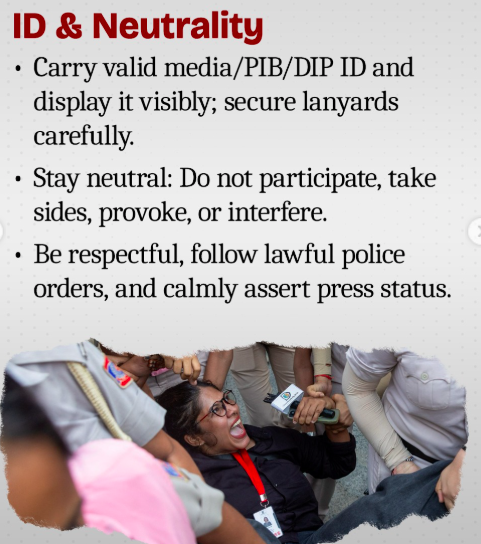
The PCI has also called on journalists to maintain professional neutrality, avoid participating in demonstrations and keep a safe distance from confrontations. Newsrooms have been advised to maintain contact with reporters in the field, while freelancers should ensure that a trusted editor or contact knows their location and assignment details.
Why has the PCI issued the guidelines?
The guidelines come amid concerns over the safety of journalists covering demonstrations in the national capital.
On October 10, large protests took place in Delhi over demands for Chief Election Commissioner Gyanesh Kumar’s resignation and opposition to the Special Intensive Revision (SIR) of electoral rolls. The demonstrations were accompanied by extensive security arrangements, detentions and restrictions in parts of the city.
Journalists covering the events were among those affected. Reports said several media personnel were detained despite identifying themselves as journalists, while some reported being manhandled or having their equipment seized. The incidents prompted renewed discussion about the ability of reporters to cover public demonstrations safely.
Against this backdrop, the PCI said its guidelines were intended to facilitate orderly and effective media coverage while promoting the safety of journalists, responsible reporting and better coordination between media organisations and law enforcement authorities.
The advisory addresses both the physical risks of reporting from crowded or tense locations and the professional responsibilities involved in covering protests.
Journalists advised to display valid press identification
One of the key recommendations concerns the identification of media personnel at protest sites.
The PCI has advised journalists to carry valid identity cards issued by their respective media organisations. Where applicable, they may carry PIB accreditation or accreditation issued by a State government’s Directorate of Information and Publicity.
The identity card should remain clearly visible while journalists are covering demonstrations. The Council has also advised reporters to secure their cards and lanyards properly to prevent them from becoming entangled during crowd movement or confrontations.
Clear identification can help distinguish journalists from other people present at a demonstration. However, the guidelines also emphasise that reporters should remain calm and assert their professional status when necessary.
Journalists have been advised to follow lawful instructions issued for immediate safety while continuing to maintain their professional responsibilities.
The recommendations do not suggest that carrying a press card eliminates every risk or guarantees unrestricted access to a protest site. Instead, they form part of a broader set of measures intended to improve safety and facilitate the discharge of journalistic duties.
Maintain neutrality and avoid joining demonstrations
The PCI has reiterated that journalists covering protests must maintain professional neutrality and should not participate in the demonstrations they are reporting on.
Reporters have been advised not to take sides, provoke confrontations or interfere with protesters, counter-protesters or police personnel.
The guidelines stress that journalists should remain observers rather than become participants in the events they are covering. Maintaining this distinction is important for preserving the credibility of reporting and ensuring that coverage reflects the developments on the ground rather than the personal views of individual reporters.
The Council has also emphasised the need to remain respectful while interacting with authorities and people at the protest site.
These recommendations are particularly relevant when tensions escalate and the possibility of police action or clashes increases. In such circumstances, journalists must balance their responsibility to document events with the need to avoid actions that could aggravate a volatile situation.
The advisory also recommends that journalists assess the situation continuously instead of assuming that a location will remain safe throughout an assignment.
Keep a safe distance and plan escape routes
The guidelines place considerable emphasis on situational awareness and physical safety.
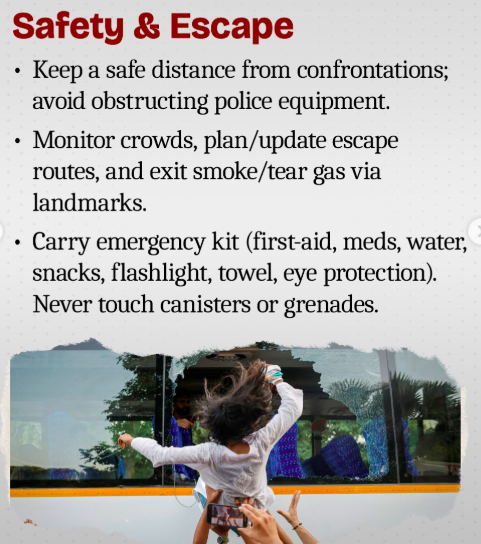
Journalists have been advised to maintain a reasonable distance from confrontations, particularly when tensions rise or police action appears likely. They should monitor changes in crowd behaviour and identify nearby exits, open streets and safe locations before conditions deteriorate.
The Council has recommended that reporters plan escape routes in advance and revise them as circumstances change.
In areas affected by smoke or tear gas, journalists should use visible landmarks and safe routes to leave the area rather than moving deeper into a crowd. The guidance also warns against touching or attempting to move tear-gas canisters, flash-bang devices or smoke grenades.
Journalists have additionally been advised not to attach cameras or other recording equipment to police barricades, vehicles or equipment in ways that could obstruct movement or cause damage.
Depending on the assessed threat, reporters may consider using suitable protective headgear and body armour.
The recommendations recognise that protest sites can change rapidly, with crowd movements, barricades and police action creating new hazards. Continuous assessment of the surroundings is therefore an important part of safe reporting.
Emergency kits and first-aid preparedness
The PCI has recommended that journalists covering demonstrations carry an emergency kit containing basic supplies that may prove useful during prolonged assignments or unexpected incidents.
The suggested items include:
- A basic first-aid kit.
- Essential personal medication.
- Drinking water and high-protein snacks.
- A flashlight.
- A washcloth or hand towel.
- Eye protection or goggles.
The recommendation reflects the practical challenges of covering demonstrations, where reporters may spend long periods outdoors and may not have immediate access to medical assistance or essential supplies.
Basic first-aid preparedness can also help journalists respond to minor injuries while waiting for professional medical assistance. The advisory does not replace medical training or emergency services, but it encourages reporters to prepare for foreseeable risks before arriving at a protest site.
The Council has also highlighted the importance of identifying safe locations and exit routes in advance, particularly where tear gas, smoke or sudden crowd movement may make it difficult to leave an area quickly.
Newsrooms asked to monitor journalists in the field
The PCI has called for better coordination between field reporters and their newsrooms.
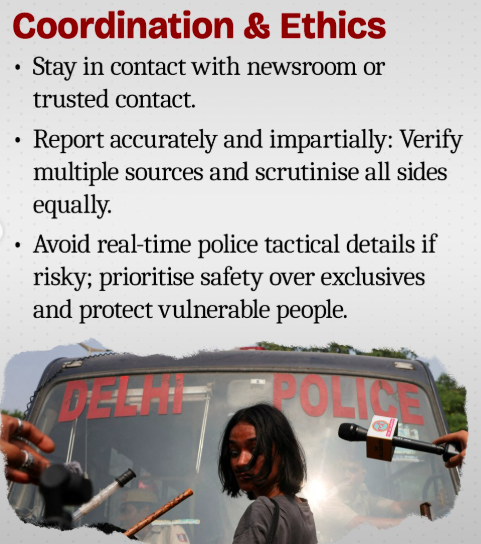
Media organisations have been advised to designate a contact person responsible for monitoring journalists’ locations and responding to emergencies. Such coordination can help newsrooms establish whether reporters have reached their assignments safely and provide assistance if communication is interrupted.
Freelance journalists have been advised to ensure that a trusted editor or contact knows their location, assignment plan and expected return time.
This recommendation is particularly significant for journalists working independently or without the support of a large reporting team. Sharing assignment details with a reliable contact can make it easier to respond if a reporter is injured, detained or unable to communicate.
The guidelines also underline the need for journalists to keep assessing their safety throughout an assignment rather than relying solely on arrangements made before reaching the protest site.
The Council’s emphasis on newsroom coordination places responsibility not only on individual reporters but also on media organisations to maintain systems that support journalists working in potentially dangerous environments.
Verify claims and protect vulnerable people
Alongside physical safety, the guidelines emphasise the need for accurate, objective and impartial reporting.
Journalists have been advised to verify information through multiple sources wherever possible and distinguish confirmed facts from allegations, opinions and unverified claims.
The Council has called for claims made by protesters, organisers, police and government authorities to be scrutinised fairly. This approach is intended to reduce the risk of misinformation and ensure that reporting reflects the available evidence rather than relying on statements from a single side.
The advisory also addresses the handling of sensitive information during live coverage. Journalists have been asked not to broadcast or publish real-time police positions, tactical movements or escape routes if doing so could compromise operational security or safety.
In addition, the guidelines stress the importance of protecting the privacy of minors, injured people and other vulnerable individuals.
These recommendations are intended to balance the public interest in documenting protests with the responsibility to avoid exposing people to unnecessary risks or publishing information that could cause harm.
PCI reiterates professional responsibility
The Press Council of India is a statutory, quasi-judicial body established under the Press Council Act, 1978, to preserve the freedom of the press and maintain and improve the standards of newspapers and news agencies. Its jurisdiction under the Act primarily covers print media.
The latest guidelines bring together recommendations on identification, crowd safety, newsroom communication and journalistic ethics for reporters covering demonstrations.
Their issuance follows a period of heightened concern over the treatment of journalists during protests in Delhi. While the advisory sets out practices intended to improve safety and professional conduct, its recommendations should not be confused with a guarantee that journalists will never face detention, obstruction or injury while reporting.
The central message is that journalists should be able to document public events responsibly while taking precautions to protect themselves and the people around them.
As demonstrations continue to be an important part of public and political life, the PCI’s guidelines highlight the need for preparation, impartiality and coordination between reporters, their newsrooms and authorities. Their effectiveness will depend on how consistently these recommendations are followed and whether journalists can carry out their work safely and professionally in the field.