







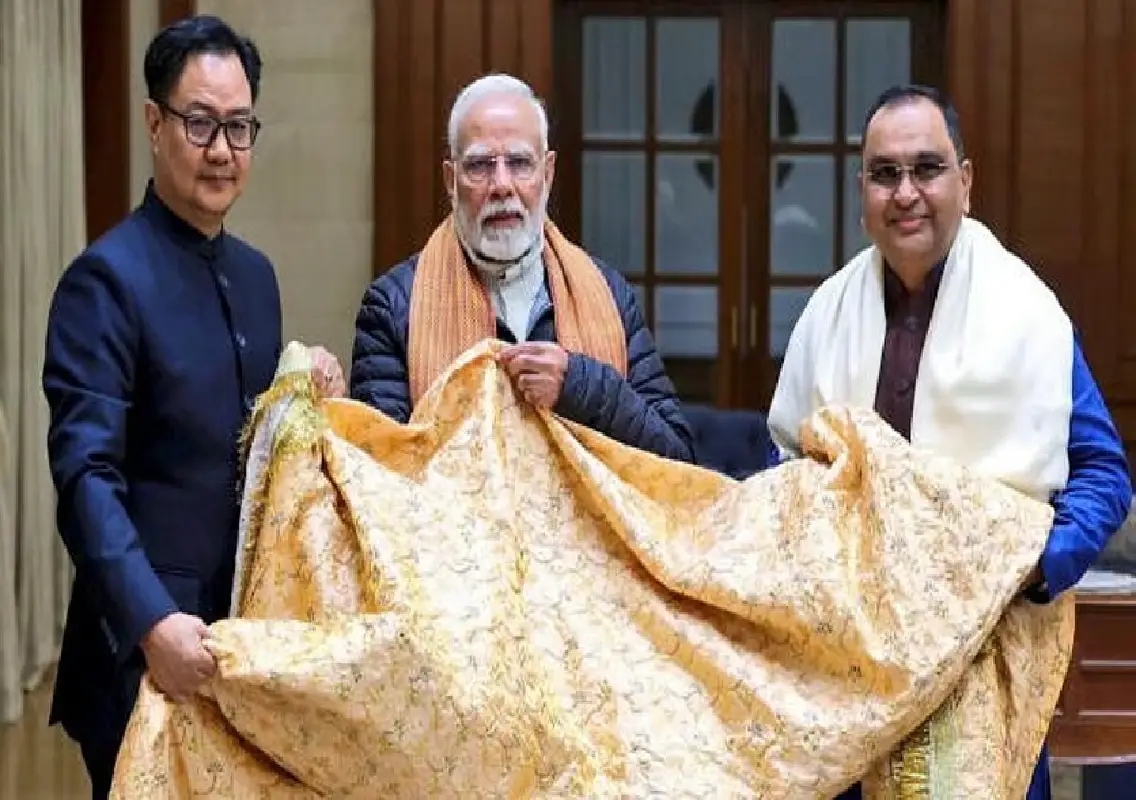


New Delhi: A petition has been filed in the Supreme Court seeking directions to restrain Prime Minister Narendra Modi from offering a ceremonial chadar at the Ajmer Sharif Dargah, arguing that the long-standing practice has no legal or constitutional basis. The matter was briefly mentioned before a vacation bench comprising Chief Justice of India Surya Kant and Justice Joymalya Bagchi on Monday.
The bench, however, did not agree to list the matter for hearing immediately. “No listing today,” the Chief Justice said, while asking advocate Barun Sinha, appearing on behalf of the petitioners, to approach the Supreme Court Registry in accordance with procedure.
Petition challenges long-standing practice
The plea has been filed by Jitender Singh and other petitioners, who have questioned the constitutional propriety of the Prime Minister of India offering a chadar at the Ajmer Sharif Dargah of Sufi saint Khwaja Moinuddin Chishti. According to the petition, the practice was initiated by the country’s first Prime Minister, Pandit Jawaharlal Nehru, in 1947 and has continued ever since through successive governments.
The petitioners contended that while the tradition has been followed for decades, it lacks any statutory or constitutional backing. They argued that the office of the Prime Minister, being a constitutional authority, should not be associated with religious practices that are not expressly mandated or permitted under the Constitution.
Allegations cited in the plea
In its submissions, the plea made controversial historical claims regarding Khwaja Moinuddin Chishti. It stated that historical records allegedly associate Moinuddin Chishti with foreign invasions that led to the conquest of Delhi and Ajmer, and resulted in mass subjugation and religious conversions of the local population.
The petition asserted that such historical associations, if considered, are fundamentally contrary to India’s sovereignty, dignity, and civilisational ethos. On this basis, the petitioners argued that state endorsement, even symbolic, of practices connected to such figures is inappropriate in a secular constitutional framework.
The plea maintained that allowing a sitting Prime Minister to participate in such rituals could be seen as state patronage of a particular religious tradition, potentially violating the principle of secularism enshrined in the Constitution.
Secularism and constitutional office
The petitioners have relied heavily on the constitutional principle of secularism, arguing that holders of high constitutional offices must maintain strict neutrality in matters of religion. They claimed that the act of offering a chadar in an official capacity blurs the line between personal faith and constitutional responsibility.
According to the plea, while individuals, including political leaders, are free to practise their personal faith, actions undertaken in an official capacity as Prime Minister carry symbolic and institutional weight. Such acts, the petition argued, should therefore be subject to constitutional scrutiny.
Court’s initial response
During the brief mention of the matter, the vacation bench refrained from making any observations on the merits of the plea. The bench’s direction to approach the Registry indicates that the petitioners will need to follow procedural requirements before the case can be considered for listing.
Legal observers noted that mentioning matters during court vacations is generally reserved for urgent issues, and the bench’s response suggests that the court did not view the plea as requiring immediate intervention.
Practice followed by successive governments
The offering of a chadar at the Ajmer Sharif Dargah by the Prime Minister has been a symbolic practice followed by several Prime Ministers over the years. The ritual is often performed through a representative, especially during the annual Urs festival, and is seen by many as a gesture of goodwill and respect towards India’s pluralistic traditions.
Supporters of the practice argue that it reflects India’s syncretic culture and does not amount to religious endorsement, but rather represents respect for a historic spiritual institution visited by people of multiple faiths.
Likely legal and political implications
If the plea is admitted and taken up for detailed hearing, it could raise broader questions about the role of constitutional functionaries in religious and cultural practices. Legal experts believe the case may touch upon the delicate balance between personal faith, cultural tradition, and constitutional secularism.
At the same time, the petition is expected to spark political and social debate, given the sensitive nature of religious practices and their historical context.
Conclusion
While the Supreme Court has not yet agreed to hear the plea, the petition has brought renewed attention to the constitutional boundaries governing the conduct of high public officials. The next course of action will depend on whether the Registry processes the plea for listing and whether the court decides to examine the broader constitutional questions it raises. Until then, the long-standing tradition of Prime Ministers offering a chadar at the Ajmer Sharif Dargah remains unchanged.