







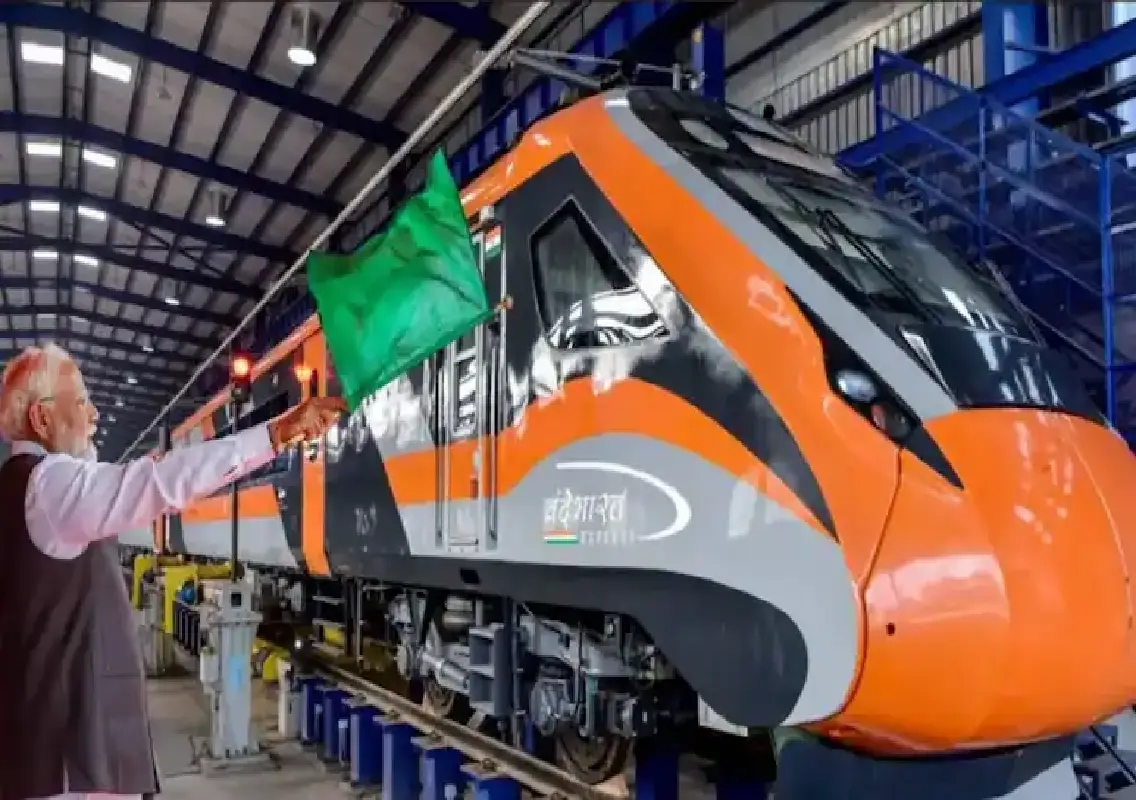


Malda: Prime Minister Narendra Modi on Saturday flagged off India’s first Vande Bharat sleeper train, marking a major milestone in the country’s rail modernisation drive. The state-of-the-art overnight train service will connect Howrah, near Kolkata, with Kamakhya Junction in Guwahati, providing a high-speed rail link between West Bengal and Assam.
The Prime Minister flagged off the inaugural Howrah–Kamakhya Vande Bharat Sleeper train from Malda Town in West Bengal. He also virtually flagged off the return Guwahati–Howrah Vande Bharat sleeper service on the same occasion. The launch assumes political significance as both West Bengal and Assam are heading into Assembly elections in the coming months.
According to the Prime Minister’s Office (PMO), the new service has been designed to meet the growing transportation needs of modern India and to offer passengers a faster, safer and more comfortable long-distance travel option.
First overnight Vande Bharat service
Unlike the existing Vande Bharat Express trains, which are primarily day-time intercity services with seating arrangements, the newly launched Vande Bharat sleeper train has been specifically designed for overnight long-distance travel. It is fully air-conditioned and equipped with sleeping berths, enabling passengers to travel comfortably during night hours.
The Howrah–Kamakhya route is a crucial rail corridor connecting eastern India with the North-East. The introduction of a high-speed sleeper train on this sector is expected to significantly reduce travel time by around 2.5 hours compared to existing premium trains.
In a statement, the PMO said the train would “offer an airline-like travel experience at economical fares” and would make long-distance journeys more convenient, particularly for families, elderly passengers and pilgrims.
Boost to connectivity and tourism
The Prime Minister said the new Vande Bharat sleeper service would give a major boost to connectivity between West Bengal and Assam, while also promoting religious travel and tourism. Kamakhya Temple in Guwahati is one of the most important Shakti Peethas in the country and attracts lakhs of devotees every year.
Improved overnight connectivity is expected to benefit pilgrims, tourists, business travellers and students, while also strengthening economic and cultural ties between eastern India and the North-East.
Railway officials said the service would also reduce congestion on existing trains on the busy Howrah–Guwahati corridor and provide passengers with a premium yet affordable alternative.
Speed and performance
The Vande Bharat sleeper train has been built with advanced technology and is capable of achieving a top speed of 180 kmph. However, officials clarified that its operational speed on the Howrah–Kamakhya route is expected to be around 120–130 kmph, depending on track conditions and signalling systems.
Despite this, the train is expected to substantially cut travel time due to faster acceleration, reduced halts and modern train control systems.
The train’s design incorporates an advanced suspension system that ensures stability at high speeds, making overnight travel smoother and quieter compared to conventional long-distance trains.
Focus on comfort and hygiene
Passenger comfort has been a key focus in the design of India’s first Vande Bharat sleeper train. The berths feature ergonomic designs aimed at providing better support and restful sleep during long journeys. The suspension system has been described as “world-class”, reducing vibrations and jerks even at higher speeds.
Hygiene standards have also been significantly upgraded. The train uses advanced disinfectant technology capable of killing up to 99 per cent of germs. Clean and updated linens, blankets and towels will be provided to all passengers, aligning the service with international travel standards.
Railway officials said these features were introduced keeping in mind post-pandemic expectations of cleanliness and safety among travellers.
Advanced safety and automation
Safety has been given top priority in the Vande Bharat sleeper train. The indigenous Kavach automatic train protection system has been installed to prevent collisions and overspeeding. In addition, comprehensive onboard surveillance systems have been deployed to enhance passenger security.
The train also features a high level of automation. Automatic sliding doors are programmed to remain closed throughout the journey and will open only when the train arrives at designated stations. This is expected to improve safety and maintain cabin temperature and cleanliness.
Emergency communication systems and modern fire detection and suppression mechanisms are also part of the train’s safety architecture.
Local cuisine on board
In a departure from traditional railway catering, the Vande Bharat sleeper train will offer curated local cuisine to passengers, similar to premium airline services. Catering is included in the ticket price and focuses on regional flavours.
Passengers travelling from Kamakhya to Howrah will be served Assamese cuisine, while those on the return journey from Howrah to Kamakhya will be offered Bengali dishes. Railway officials said the initiative was aimed at enhancing the travel experience and promoting regional food traditions.
Fare structure
The train offers three classes of travel—3AC, 2AC and 1AC—catering to different passenger segments. The expected one-way fares are as follows:
- 3AC: Approximately ₹2,300
- 2AC: Around ₹3,000
- 1AC: Roughly ₹3,600
Officials said the pricing has been kept competitive to ensure affordability while delivering a premium travel experience.
Conclusion
The launch of India’s first Vande Bharat sleeper train marks a significant step in the evolution of Indian Railways, combining speed, safety, comfort and modern amenities in a single service. By connecting Howrah and Kamakhya with an overnight high-speed train, the project is expected to transform long-distance rail travel in eastern and north-eastern India.
As Indian Railways continues to expand the Vande Bharat network, the sleeper variant is likely to play a crucial role in redefining overnight travel, bridging regions more efficiently and offering passengers a new benchmark in rail journeys.