


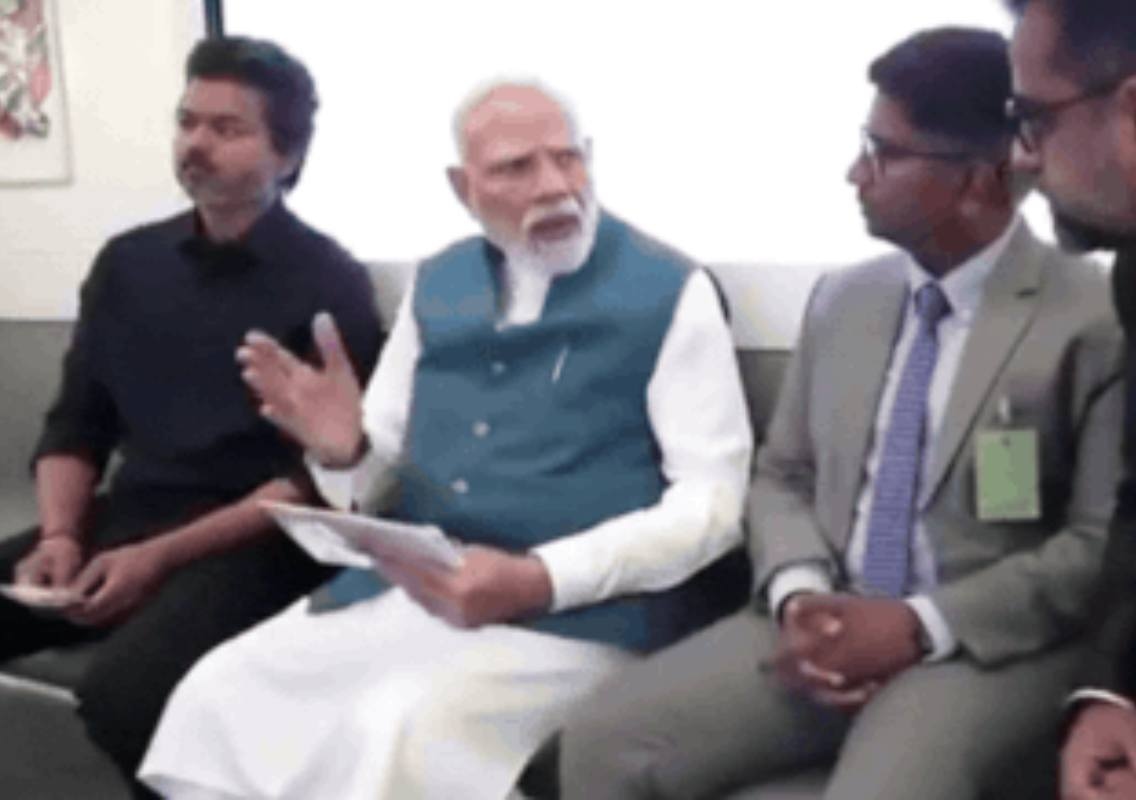


Chennai: Prime Minister Narendra Modi on Sunday inaugurated the Poonamallee–Vadapalani stretch of Phase II of the Chennai Metro Rail Project, developed at an estimated cost of Rs 4,900 crore. The Prime Minister also took a ride on the newly inaugurated stretch with Tamil Nadu Chief Minister C Joseph Vijay, marking the launch of another section of the city’s expanding urban rail network.
Modi and Vijay jointly flagged off the new Metro services in the presence of Tamil Nadu Governor Rajendra Vishwanath Arlekar. The Prime Minister also purchased a ticket at the station and briefly interacted with an employee at the ticket counter.
The newly opened section forms part of Corridor 4 of Chennai Metro Phase II. Covering approximately 15 km, it includes 11 elevated stations and is expected to improve connectivity between the western suburbs and central parts of Chennai.
The corridor features a 3.7-km double-decker structure and advanced signalling technology designed to support driverless train operations. The expansion is expected to reduce travel times for commuters and improve access to residential and commercial areas along the route.
Chennai Metro Phase II: Route and stations
The Poonamallee–Vadapalani stretch is an important addition to Corridor 4, which is part of Chennai Metro’s wider Phase II expansion programme.
The newly inaugurated section covers around 15 km and has 11 elevated stations. The stations are:
- Poonamallee Bypass
- Poonamallee Bus Stand
- Poonamallee Government Hospital
- Karayanchavadi
- Kumananchavadi
- Kattupakkam
- Iyappanthangal
- Thelliyaragaram
- Porur Bypass
- Porur Junction
- Vadapalani
The new connection is expected to make daily travel easier for residents of Chennai’s western suburbs, including people commuting for work, education and healthcare.
The double-decker structure is another notable feature of the corridor. Such infrastructure can accommodate different transport requirements within a limited space, helping address the challenges of building major transport links in a growing urban area.
The advanced signalling system is designed to support driverless operations, reflecting Chennai Metro’s move towards technology-led urban transport infrastructure.
Chennai Metro service timings and operations
According to Chennai Metro Rail, regular passenger services on the newly inaugurated stretch were scheduled to begin at 4 pm on Sunday and operate in both directions until 9 pm.
From October 12, services are scheduled to run daily from 7 am to 9 pm.
The last train is scheduled to depart at 9 pm from both terminals: Poonamallee Bypass Metro and Vadapalani Metro on Corridor 4.
The initial operating schedule provides a limited service window on the inauguration day, followed by regular daily operations from October 12. Commuters travelling on the new route are advised to check Chennai Metro Rail’s official updates for any changes to timings or service arrangements.
The addition of the stretch is expected to provide an alternative to road travel for passengers moving between the western suburbs and other parts of the city. As passenger services expand, the corridor could also help ease pressure on busy roads by giving commuters another public transport option.
PM Modi offers prayers and visits IIT Madras centre
Before the Metro inauguration, Modi offered prayers at the Sri Jalakanteswara Swamy Temple in Tamil Nadu. He later visited the Sudha Gopalakrishnan Brain Centre at IIT Madras.
The Prime Minister was also scheduled to dedicate the centre to the nation. The facility is part of a scientific initiative to map more than 100 human brains into three-dimensional atlases at cellular resolution.
The research project covers different stages of life, from the foetal stage to old age, and is intended to help scientists study the human brain in greater detail.
Modi was also scheduled to release C-STROKE, a human ischaemic stroke atlas featuring more than 1,000 annotated microscopic sections from stroke-affected brain tissue. The atlas is expected to support research into stroke and help scientists identify potential targets for treatment.
Later in the day, the Prime Minister was scheduled to attend the golden jubilee celebrations of Jaigopal Garodia Hindu Vidyalaya Matriculation Higher Secondary School.
The programme combined infrastructure inaugurations with visits to scientific and educational institutions, reflecting the range of projects and events on the Prime Minister’s Tamil Nadu itinerary.
National Highway projects worth Rs 3,700 crore
Modi’s visit also includes the inauguration and foundation-stone laying for National Highway projects worth around Rs 3,700 crore in Tamil Nadu.
The projects include the four-laning of the 36-km Vadugapatti–Therkuvenganallur section of NH-744A and the 30-km Madurai Ring Road section of NH-744A.
Another key project is the four-lane Thiruvarur Bypass on the Nagapattinam–Thanjavur section of NH-83.
The highway works are intended to improve road connectivity and facilitate smoother movement of people and goods. Upgraded roads and bypasses can help reduce congestion in urban areas, improve links between districts and support transport-dependent economic activity.
The projects form part of a wider infrastructure programme that includes road, rail, Metro, port and industrial investments.
Five Amrit stations to be inaugurated
The Prime Minister will also inaugurate five railway stations developed under the Amrit Bharat Station Scheme.
The stations are Palani, Vellore Cantonment, Ambasamudram, Paramakkudi and Namakkal.
The scheme focuses on upgrading railway stations through improved passenger amenities, better circulation areas, accessibility improvements and modernised station facilities.
Station redevelopment is intended to make railway travel more convenient while improving the infrastructure available to passengers. The five inaugurations add a railway component to the broader infrastructure programme planned during Modi’s visit.
Alongside the Chennai Metro expansion and highway works, the station upgrades are aimed at strengthening transport links across Tamil Nadu.
Port projects to improve cargo handling and logistics
Several port-related projects at Chennai Port, Kamarajar Port and V O Chidambaranar Port are also on the agenda.
The projects aim to strengthen maritime infrastructure, expand cargo-handling capacity and improve logistics efficiency. Ports play a significant role in supporting trade by connecting manufacturers, exporters and importers to domestic and international supply chains.
Improved port infrastructure can help streamline the movement of goods, reduce delays and support industrial activity in surrounding regions.
The projects at the three ports are part of the wider effort to develop transport infrastructure across different modes. Better integration between ports, highways and railways can help improve the movement of cargo from production centres to shipping terminals.
CPCL to develop Rs 1,620-crore lube oil project
Modi will also lay the foundation stone for a Group II/III Lube Oil Base Stocks project at the existing Manali Refinery of Chennai Petroleum Corporation Limited (CPCL).
The project is estimated to cost around Rs 1,620 crore and will have a production capacity of 270,000 metric tonnes per annum.
It is intended to manufacture Group II and Group III lube oil base stocks, which are used to produce premium-quality lubricants. Developing domestic production capacity could help strengthen India’s supply of these materials and support the lubricant manufacturing industry.
The project adds an industrial component to the infrastructure programme, alongside transport projects covering Metro rail, highways, railway stations and ports.
Its planned capacity and focus on higher-grade base stocks reflect the importance of developing facilities that can serve the requirements of modern lubricant formulations.
Chennai Metro expansion adds to Tamil Nadu infrastructure push
The inauguration of the Poonamallee–Vadapalani stretch marks a further step in Chennai Metro’s Phase II development. The 15-km section, with 11 elevated stations, is expected to improve connectivity across the city’s western suburbs and provide commuters with another public transport option.
The project’s double-decker structure and signalling technology are among its notable engineering features, while the planned service timings establish the initial operating schedule for passengers.
Modi’s wider Tamil Nadu programme also includes National Highway projects, five Amrit railway stations, port-related developments and the foundation stone for CPCL’s lube oil base stocks facility.
Together, the projects cover several areas of infrastructure development, from urban mobility and road connectivity to maritime logistics and industrial manufacturing. The impact of the Chennai Metro extension will ultimately depend on passenger uptake, service reliability and how effectively it connects with other modes of transport as the wider network expands.