







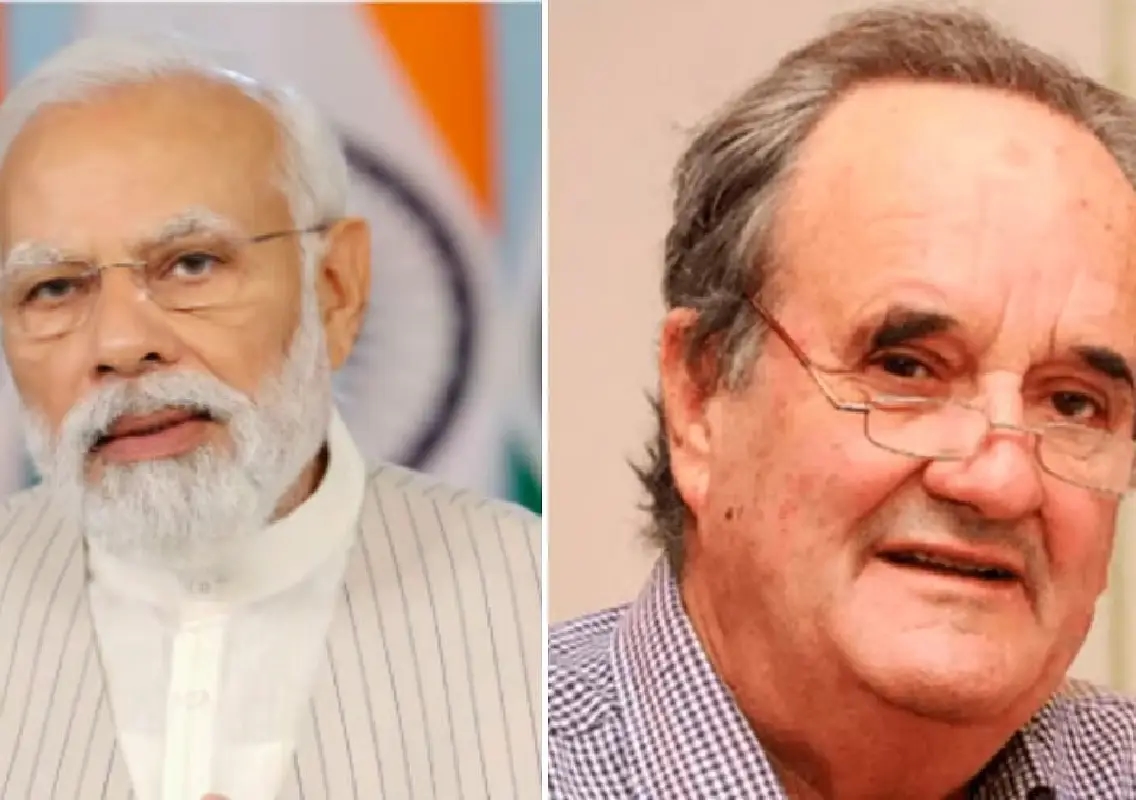


Prime Minister Narendra Modi on Sunday expressed deep grief over the passing of veteran journalist and author Mark Tully, remembering him as a “towering voice of journalism” whose work reflected a profound connection with India and its people.
PM recalls Tully’s lasting impact
In a post on X, the Prime Minister said Tully’s reporting and insights had left an enduring mark on public discourse in India. He extended condolences to Tully’s family, friends and admirers, noting that his understanding of the country went far beyond headlines and statistics, capturing the spirit of its people.
Death confirmed by close associate
Mark Tully passed away at the age of 90 at Max Hospital on Sunday afternoon. The news was confirmed by his close friend and fellow journalist Satish Jacob. Hospital authorities said Tully had been admitted on January 21 under the nephrology department and died at 2.35 pm due to multi-organ failure following a stroke.
A life deeply intertwined with India
Born on October 24, 1935, in Kolkata, Tully spent his early years in India before travelling to England for education. He returned to India in 1964 as a correspondent for the BBC and later served as its New Delhi bureau chief for 22 years. During this period, he emerged as one of the most influential chroniclers of post-Independence India.
Over a career spanning more than five decades, Tully reported on pivotal events including the 1971 Bangladesh war, the Emergency, Operation Blue Star, the assassinations of Indira and Rajiv Gandhi, and the Babri Masjid demolition.
Author, broadcaster and honoured voice
An acclaimed author, Tully wrote 10 books, among them No Full Stops in India, India in Slow Motion and The Heart of India. He was knighted in 2002 and received the Padma Bhushan in 2005.
Colleagues and readers across generations remembered him as a journalist of rare empathy and credibility, whose voice helped the world understand India with honesty and depth.