







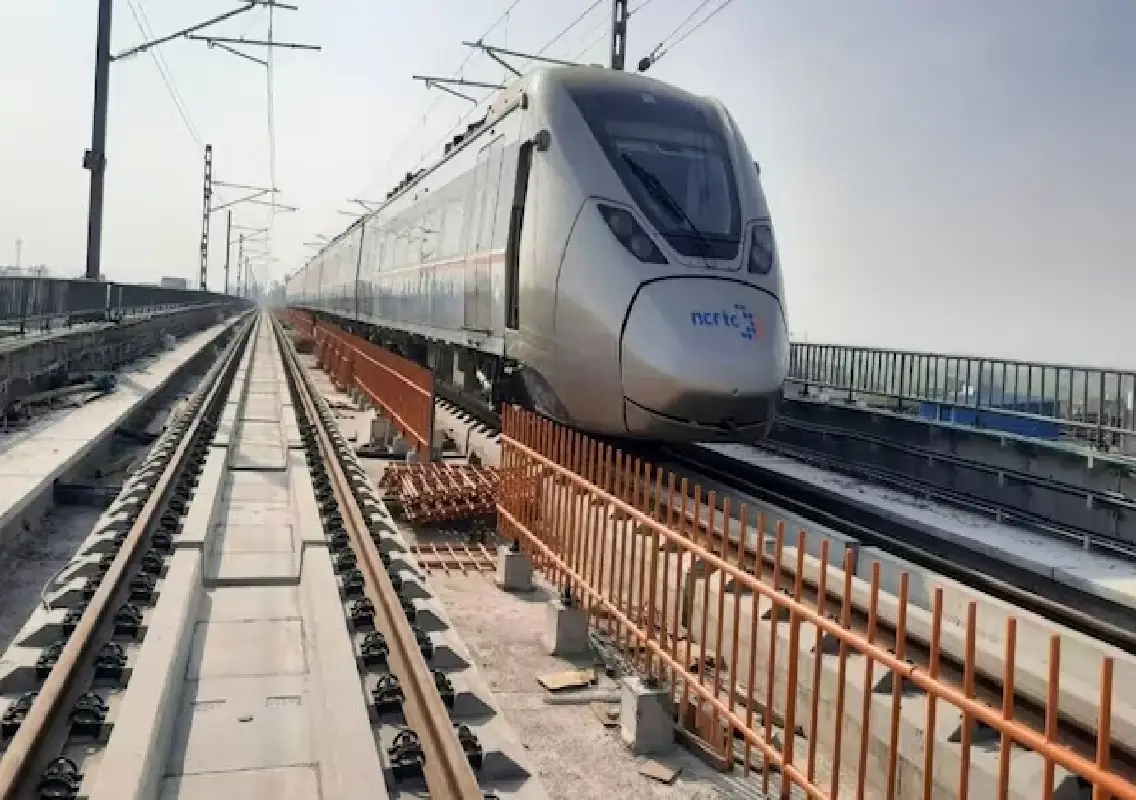


New Delhi: Prime Minister Narendra Modi will dedicate the entire 82-km Delhi–Meerut Namo Bharat Corridor to the nation, marking the full commissioning of India’s first Regional Rapid Transit System (RRTS). With this, high-speed regional rail connectivity between the national capital and western Uttar Pradesh will become fully operational.
The inauguration includes the remaining sections of the corridor — a 5-km stretch between Sarai Kale Khan and New Ashok Nagar in Delhi, and a 21-km stretch between Meerut South and Modipuram in Uttar Pradesh. The completion of these sections enables seamless travel across the entire corridor at a design speed of 180 kmph.
The Namo Bharat RRTS is aimed at transforming regional connectivity across the National Capital Region (NCR), significantly reducing travel time between Delhi and Meerut while offering a modern, sustainable alternative to road transport.
Faster regional connectivity across NCR
The corridor connects major urban centres including Sahibabad, Ghaziabad, Modinagar and Meerut with Delhi. Once fully operational, commuters will be able to travel between Delhi and Meerut in under an hour, a journey that often takes over two hours by road during peak traffic.
Designed with advanced signalling systems, modern stations and high-speed rolling stock, the Namo Bharat trains represent a new category of rail service — positioned between conventional suburban rail and long-distance intercity trains.
Officials say the project is expected to ease congestion on key highways such as NH-9 and reduce vehicular emissions in one of India’s most densely populated regions.
Sarai Kale Khan to emerge as multi-modal hub
Sarai Kale Khan, the originating station of the corridor, is among the four Namo Bharat stations being commissioned during the inauguration. It has been developed as a major multi-modal transport hub to facilitate seamless connectivity across various modes of public transport.
The station integrates with:
- Hazrat Nizamuddin Railway Station
- Delhi Metro’s Pink Line
- Veer Haqeeqat Rai ISBT
- Ring Road
Urban planners describe Sarai Kale Khan as a critical interchange that will allow passengers to switch between regional rail, metro, bus and Indian Railways services within a compact transport zone.
The other three stations being commissioned — Shatabdi Nagar, Begumpul and Modipuram — are located in Meerut and are expected to strengthen both regional and intra-city mobility in the city.
Meerut Metro: India’s fastest metro system
In addition to the RRTS corridor, the Prime Minister will also inaugurate the Meerut Metro services between Meerut South and Modipuram. In a first-of-its-kind initiative in India, Meerut Metro and Namo Bharat trains will operate on the same infrastructure, representing a unique integration of urban and regional transit systems.
With a maximum operational speed of around 120 kmph, Meerut Metro is set to become India’s fastest metro system. The metro is expected to cover the entire stretch in approximately 30 minutes, including all scheduled stoppages.
Transport experts say the shared infrastructure model optimises costs, reduces land acquisition challenges and ensures efficient utilisation of rail corridors. The move is being seen as a benchmark for future transit projects in rapidly urbanising regions.
Boost to sustainable urban mobility
The Delhi–Meerut Namo Bharat Corridor is being positioned as a model for integrated urban and regional transport planning. By offering high-frequency, high-speed services, authorities aim to shift a significant portion of daily commuters from private vehicles to public transport.
Officials estimate that the project will help decongest major arterial roads and reduce carbon dioxide emissions by cutting dependence on fossil fuel-powered vehicles. The corridor is also expected to support economic growth by enhancing access between Delhi and satellite cities in western Uttar Pradesh.
The RRTS project aligns with the government’s broader push for sustainable infrastructure, smart mobility solutions and improved ease of living in metropolitan regions.
Transforming regional transport landscape
The full commissioning of the 82-km corridor marks a major milestone in India’s rail infrastructure development. As India continues to expand metro networks and invest in semi-high-speed rail systems, the Namo Bharat corridor introduces a new category of transit designed specifically for intercity commuting within large urban clusters.
With integrated stations, high-speed operations and shared infrastructure with the Meerut Metro, the project sets a precedent for future RRTS corridors planned across the NCR.
The inauguration signals a significant step towards reshaping daily commuting patterns in the region and reflects the Centre’s emphasis on modern, efficient and environmentally sustainable public transport systems.