







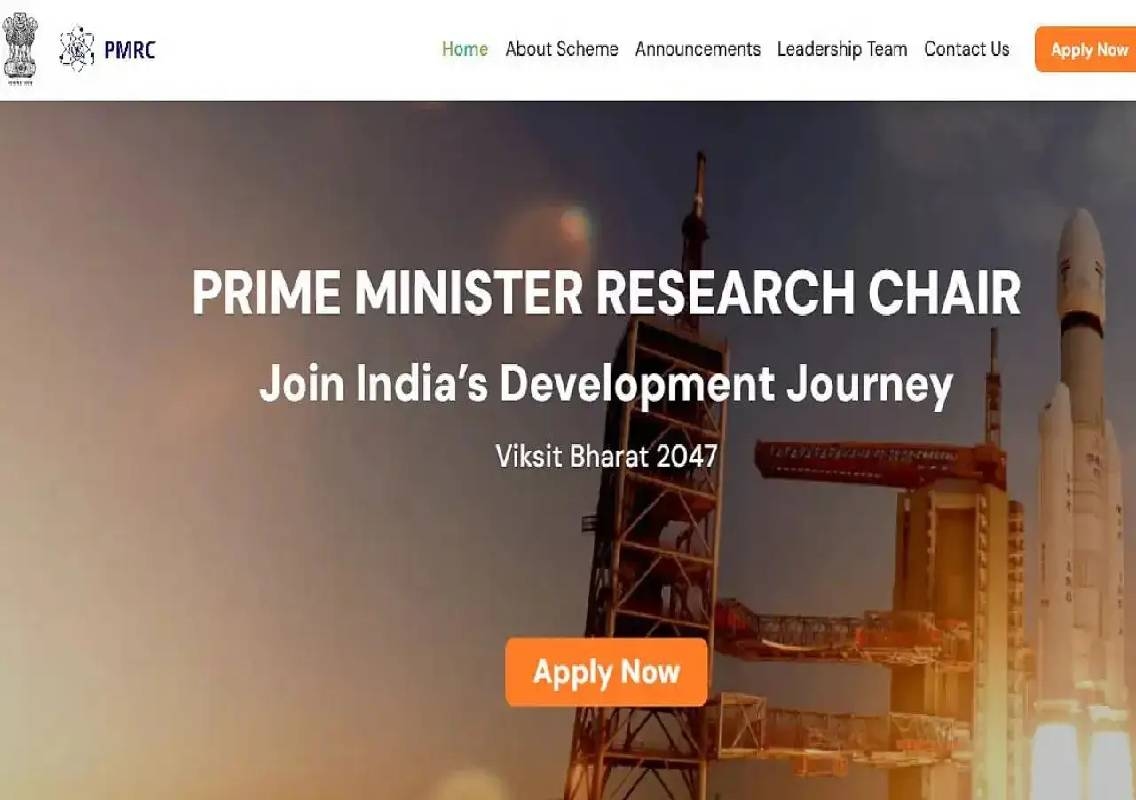


New Delhi: The Ministry of Education has invited applications for the Prime Minister Research Chair (PMRC) Scheme 2026, a major initiative aimed at attracting Indian-origin researchers, scientists and professionals working abroad to contribute to India’s research and innovation ecosystem. The scheme seeks to place distinguished researchers at premier higher education institutions and national research laboratories across the country to lead cutting-edge projects in strategically important sectors.
The Department of Higher Education officially opened applications for both researchers and host institutions on June 1 through the PMRC portal. The initiative is expected to strengthen India’s research capabilities by encouraging global Indian talent to return and collaborate with leading academic and scientific institutions.
Scheme aims to bring global Indian talent to India
The PMRC Scheme has been designed to create opportunities for highly accomplished Indian-origin researchers working overseas to undertake advanced research in India. Selected candidates will be hosted by some of the country’s top institutions and laboratories, where they will be expected to contribute to innovation, knowledge creation and technological advancement.
Among the institutions identified as potential hosts are Indian Institute of Technology Bombay, Indian Institute of Technology Delhi, Indian Institute of Technology Madras, Indian Institute of Technology Kanpur, Indian Institute of Technology Hyderabad, Indian Institute of Technology (Indian School of Mines) Dhanbad and Indian Institute of Science Bengaluru.
Apart from these institutions, eligible host organisations include government higher education institutions ranked among the top performers in the National Institutional Ranking Framework (NIRF) and national research laboratories operating under major scientific departments and councils.
Eligibility criteria for host institutions
The Ministry has specified that the following institutions can host PMRC fellows and research chairs:
- Government higher education institutions ranked among the Top 100 in the NIRF Overall category.
- Government engineering institutions ranked among the Top 100 in the NIRF Engineering category.
- Government institutions ranked among the Top 50 in the NIRF Research category.
- National laboratories and research institutions functioning under agencies such as the Department of Biotechnology (DBT), Department of Science and Technology (DST), Council of Scientific and Industrial Research (CSIR), Indian Council of Medical Research (ICMR) and other eligible national research organisations.
The objective is to ensure that researchers joining under the scheme have access to world-class infrastructure, academic support and collaborative opportunities.
Focus on 13 priority sectors
The PMRC programme will support research across 13 strategic sectors identified as critical for India’s future growth and technological leadership.
These sectors include:
- Artificial Intelligence (AI)
- Quantum Computing
- Semiconductors
- Cybersecurity
- Healthcare
- Biotechnology
- Space and Defence Technologies
- Advanced Materials
- Climate Change Research
- Next-Generation Communications
- Manufacturing Technologies
- Agricultural Technologies
- Blue Economy and Atomic Energy
The government believes these areas will play a significant role in shaping India’s economic and scientific progress in the coming decades.
Three categories of researchers
The PMRC Scheme offers three levels of engagement depending on the applicant’s experience and research profile.
Young Research Fellows (YRF)
This category is intended for early-career researchers with less than five years of post-PhD experience. The programme aims to encourage promising young scientists to establish research careers in India.
Senior Fellows (SF)
Researchers with five to less than ten years of post-doctoral experience will be eligible under the Senior Fellows category. These candidates are expected to bring substantial expertise and contribute to research leadership.
Research Chairs (RC)
The highest category is reserved for eminent researchers with ten years or more of post-PhD experience and a proven record of research excellence and leadership.
Financial support under the scheme
The PMRC Scheme offers a comprehensive funding package covering fellowships, research grants, relocation expenses and institutional support.
Young Research Fellows
- Annual fellowship: ₹0.15 crore to ₹0.20 crore
- Research grant: ₹1 crore to ₹1.50 crore
- Annual residential and medical allowance: ₹0.05 crore
- One-time relocation support: ₹0.30 crore
- Annual operational cost and institute overheads: ₹0.20 crore
Senior Fellows
- Annual fellowship: ₹0.20 crore to ₹0.40 crore
- Research grant: ₹1.50 crore to ₹2.50 crore
- Annual residential and medical allowance: ₹0.09 crore
- One-time relocation support: ₹0.40 crore
- Annual operational cost and institute overheads: ₹0.30 crore
Research Chairs
- Annual fellowship: ₹0.40 crore to ₹0.60 crore
- Research grant: ₹3 crore to ₹5 crore
- Annual residential and medical allowance: ₹0.15 crore
- One-time relocation support: ₹0.50 crore
- Annual operational cost and institute overheads: ₹1 crore
The funding support is expected to help researchers establish laboratories, recruit teams and undertake long-term projects with significant national impact.
Strengthening India’s research ecosystem
The PMRC Scheme reflects the government’s broader effort to transform India into a global research and innovation hub. By encouraging accomplished Indian-origin scientists and researchers abroad to work with leading institutions in India, the initiative aims to enhance knowledge transfer, foster international collaborations and accelerate scientific breakthroughs.
Officials believe the programme will not only strengthen academic and research institutions but also support India’s ambitions in emerging technologies and strategic sectors.
Applications from eligible researchers and host institutions are currently being accepted through the PMRC portal.