







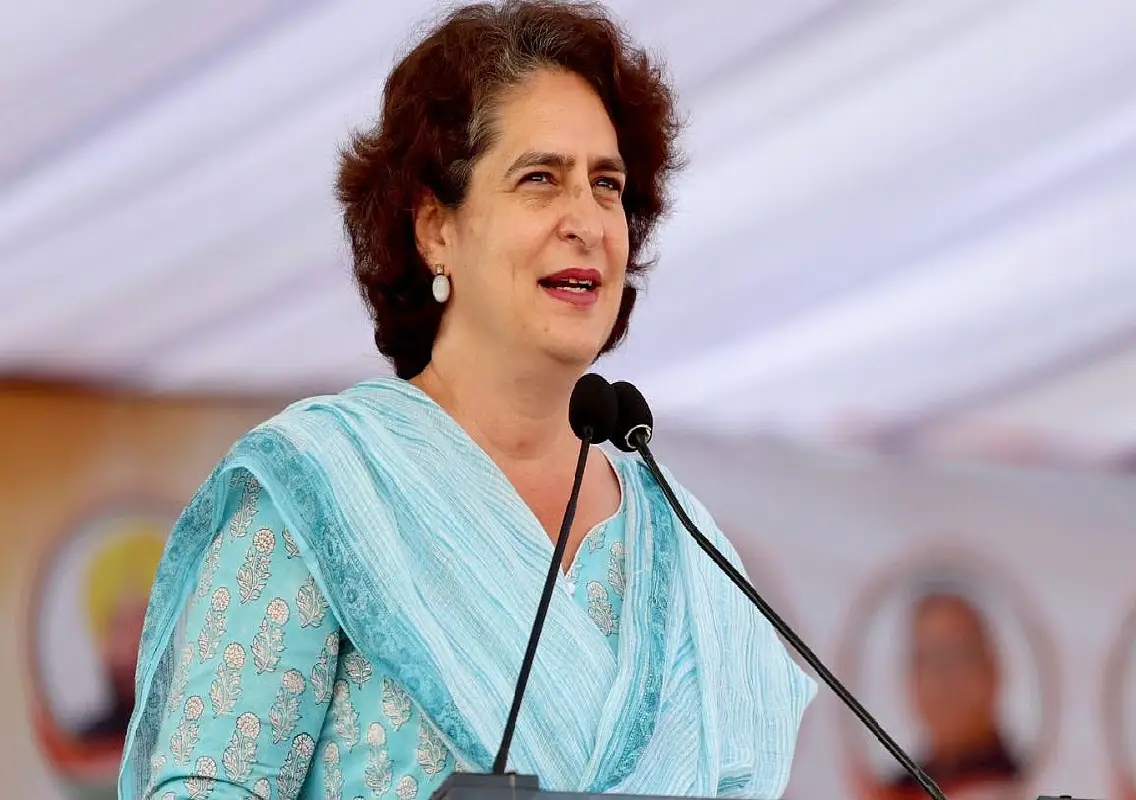


New Delhi: Congress MP Priyanka Gandhi Vadra on Saturday questioned the Centre’s reported decision to rename the Mahatma Gandhi National Rural Employment Guarantee Act (MGNREGA), arguing that such a move would lead to avoidable expenditure of public funds without offering any real benefit to rural households.
Her remarks came a day after media reports suggested that the Union Cabinet had approved a Bill proposing a new name for the flagship rural employment scheme, along with an increase in the number of guaranteed workdays. According to these reports, MGNREGA is proposed to be renamed as the Poojya Bapu Grameen Rozgar Yojna, while the annual guaranteed employment would be enhanced from the existing 100 days to 125 days.
‘Unnecessary exercise that costs money’
Speaking to reporters, Priyanka Gandhi said she could not understand the rationale behind changing the name of a welfare scheme that has been in existence since 2005 and has become deeply embedded in rural livelihoods across the country.
“I can’t understand what mentality is behind this. First of all, this is Mahatma Gandhi’s name, and secondly, when the name is changed, the government’s resources are spent again on it, as everything needs to be renamed. This is a big process that also costs money. So what’s the use of doing all this unnecessarily?” she said.
She stressed that renaming a nationwide programme involves significant administrative expenditure, including changes to official records, signboards, documents, digital portals and awareness material. According to her, such resources would be better utilised to strengthen implementation, ensure timely wage payments and expand employment opportunities under the scheme.
Long-standing role of MGNREGA
MGNREGA, enacted in 2005, guarantees at least 100 days of wage employment in a financial year to rural households whose adult members volunteer to do unskilled manual work. The scheme has been widely regarded as a key social security measure, particularly during periods of agrarian distress, droughts and economic slowdowns.
Under the Act, any Indian citizen aged 18 years or above and residing in a rural area is eligible to apply for work. Employment is required to be provided within 15 days of demand, failing which the applicant is entitled to an unemployment allowance. Wages are credited directly into bank or post office accounts, ensuring transparency, with equal remuneration mandated for men and women. The programme is implemented across the country, except in fully urban districts.
Over the years, MGNREGA has played a crucial role in creating rural assets such as ponds, roads and irrigation structures, while also acting as a safety net for millions of migrant workers.
Congress voices support for Priyanka Gandhi
Congress MP Rajeev Shukla echoed Priyanka Gandhi’s concerns and described the proposed renaming as unnecessary. Speaking to IANS, Shukla said the issue raised questions about why Mahatma Gandhi’s name was being altered in the title of a scheme that already honours him.
“I saw Priyanka Gandhi raising the issue about why Mahatma Gandhi’s name is being removed. Many people in Gujarat have the name ‘Bapu’. This step seems unnecessary, but still it is being brought up,” Shukla said.
He added that instead of focusing on symbolic changes, the government should prioritise strengthening welfare schemes and addressing issues such as delays in wage payments and rising demand for work in rural areas.
BJP hits back at Congress criticism
The criticism from the Congress, however, drew a sharp response from the BJP. BJP MP Brij Lal defended the reported decision and argued that the renaming was intended to honour Mahatma Gandhi rather than dilute his legacy.
“MGNREGA has been renamed after Bapu, and since he is revered as our Rashtrapita, this should be supported — even by Priyanka Gandhi. However, she has a problem with MGNREGA because she is a fake Gandhi; she has a problem with why the word ‘Gandhi’ has been removed,” Brij Lal told IANS.
He claimed that the proposed name continued to reflect respect for Mahatma Gandhi and accused the Congress of politicising the issue for electoral reasons.
Proposed increase in workdays draws attention
Apart from the controversy over the name, reports of an increase in guaranteed employment days from 100 to 125 have also drawn attention. While opposition leaders have not opposed the idea of increasing workdays in principle, they have demanded clarity on funding, implementation and whether adequate budgetary support would be provided to states.
Experts note that any increase in guaranteed days would require substantial additional allocation from the Centre, as states often struggle to meet existing demand due to fund constraints and delayed reimbursements.
Political and policy implications
The reported move has once again brought welfare politics to the centre of the national debate. MGNREGA has long been a politically sensitive programme, often cited by the Congress as a landmark achievement of the UPA era, while the BJP has focused on reforms, technology-driven monitoring and asset creation under the scheme.
Political analysts say that renaming a programme so closely associated with Mahatma Gandhi and rural employment is likely to trigger strong reactions, particularly if it is perceived as symbolic rather than substantive.
Conclusion
As discussions around the reported Bill continue, Priyanka Gandhi’s remarks have added momentum to the debate on whether renaming long-standing welfare schemes serves any practical purpose. While the government maintains that the proposed changes honour Mahatma Gandhi and expand employment opportunities, the opposition insists that public resources should be directed towards improving delivery rather than rebranding. The issue is expected to be debated further both inside and outside Parliament in the coming days.