


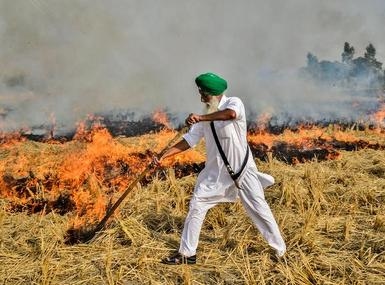


Amritsar: The Commission for Air Quality Management (CAQM) has intensified its efforts to curb paddy stubble burning in Punjab after the state recorded 542 farm fires between September 15 and October 23, 2026. A high-level team led by CAQM chairperson Rajesh Verma reviewed measures in Amritsar and Tarn Taran on Saturday and directed district administrations to strengthen enforcement and improve access to residue-management facilities.
The commission expressed concern over the rising number of farm fires and called for coordinated action to prevent further incidents. It also stressed that paddy residue should be treated as a resource that can be put to productive use rather than burned in fields.
Official data showed that Tarn Taran accounted for 257 incidents during the period, while Amritsar recorded 142. Together, the two districts reported 399 farm fires, accounting for nearly three-quarters of Punjab’s total.
The review focused on the availability of machinery, the movement of paddy residue from farms to processing facilities, and the use of stubble as fuel in thermal power plants, brick kilns and industries.
Tarn Taran and Amritsar account for major share of fires
Punjab recorded 542 farm fires between September 15 and October 23, according to the official figures cited in the report. Tarn Taran emerged as the district with the highest number of incidents among the two areas reviewed, with 257 cases reported by Friday.
Amritsar recorded 142 incidents over the same period. The combined total of 399 cases highlights the scale of the challenge facing the administrations in these districts.
The rise in incidents prompted the CAQM team to ask local officials to intensify preventive action and ensure that available stubble-management measures reach farmers in time.
The commission’s review covered both the arrangements for managing residue within agricultural fields and the infrastructure needed to transport it to facilities where it can be processed or used.
Officials were asked to improve coordination among district administrations, farmers, Custom Hiring Centres, machinery providers and other stakeholders so that farmers can access suitable equipment without unnecessary delays.
CAQM calls for stronger field-level monitoring
During its meeting with deputy commissioners and other officials from Amritsar and Tarn Taran, the CAQM team reviewed the measures being taken to manage paddy residue and prevent field burning.
The commission directed officers to visit villages and interact with farmers regularly. It emphasised that awareness campaigns alone would not be sufficient unless farmers could also obtain the machinery and practical assistance required to manage their crop residue.
The instructions included ensuring that farmers were informed about available facilities and that equipment could be arranged promptly during the crucial post-harvest period.
District administrations were also asked to strengthen coordination between farmers and Custom Hiring Centres, which provide agricultural machinery for use by farmers who may not own the equipment themselves.
The commission stressed that delays in access to machinery and residue-management services could undermine efforts to prevent stubble burning. Officials were therefore directed to ensure that available solutions were accessible when farmers needed them.
Industries asked to increase use of paddy residue
A key part of the CAQM’s strategy is to expand the productive use of paddy stubble. The commission said residue should be directed towards thermal power plants, brick kilns and industries that can use it as fuel, wherever technically and operationally feasible.
It instructed authorities to appoint officers responsible for monitoring specific industrial sectors and ensuring that participating units use paddy residue as required.
The designated officers were also asked to submit regular compliance reports, allowing the administration to monitor whether industries were making effective use of the available material.
Converting agricultural residue into fuel can provide an alternative to open-field burning while creating a use for material that would otherwise require disposal. However, the effectiveness of this approach depends on sufficient processing capacity, transport arrangements and demand from industrial users.
The commission’s instructions therefore covered both the supply side — collecting and transporting residue from farms — and the demand side, where industries can use processed paddy stubble as fuel.
Industrial boiler in Amritsar inspected
During the visit, the CAQM team inspected a facility in Amritsar where paddy residue is used as fuel. The inspection included an industrial boiler at a local industrial complex that operates using pellets made from paddy stubble.
Pelletisation involves processing agricultural residue into a more compact fuel form that can be handled and transported more conveniently than loose stubble.
The visit allowed the team to examine how processed paddy residue is being used in an industrial setting and consider the scope for expanding similar arrangements.
The commission has emphasised that stubble management should not be limited to removing residue from fields. It should also encourage its productive use wherever suitable infrastructure and demand exist.
Such arrangements require coordination between farmers, residue collection and processing facilities, transport operators and industrial consumers. Reliable demand from fuel users can help make residue collection more viable and provide farmers with additional options for managing crop waste.
Tarn Taran administration told to prioritise prevention
With Tarn Taran reporting 257 farm fires, the district administration was specifically directed to intensify its field-level efforts.
The deputy commissioner was asked to prioritise the issue, strengthen monitoring and ensure that preventive measures were implemented effectively. The CAQM warned that laxity or failure to take meaningful action would invite strict action and accountability.
The direction places responsibility on district officials to move beyond general instructions and ensure that preventive measures are implemented at the village level.
Regular visits, timely access to machinery and better coordination with residue-management facilities are intended to reduce the likelihood of farmers resorting to burning.
The commission also called for continued engagement with farmers so they understand the options available and can obtain the support needed to use them.
Why stubble burning remains an air-quality concern
Paddy stubble burning is a seasonal source of air pollution in parts of northern India. After harvesting, farmers have a limited window to clear fields and prepare for the next crop. Burning residue can be a quick method of clearing fields, but it releases smoke and particulate matter into the atmosphere.
The resulting emissions can contribute to poor air quality, particularly when combined with other pollution sources and weather conditions that limit the dispersion of pollutants.
Preventing these fires requires more than enforcement alone. Farmers need practical alternatives, including access to machinery, collection and transport services, and viable markets for agricultural residue.
The CAQM’s latest directions reflect this combination of enforcement and resource management. By strengthening field monitoring while encouraging industries to use processed paddy residue, the commission is seeking to reduce burning and increase the amount of stubble directed towards productive uses.
Coordinated action needed to reduce farm fires
The CAQM has asked district administrations and other stakeholders to make effective use of existing residue-management solutions and improve coordination throughout the process.
The figures for Amritsar and Tarn Taran underline the need for sustained action, particularly in districts reporting a large number of incidents. Authorities have been directed to ensure that farmers receive timely assistance and that industrial users are monitored for compliance.
With Punjab reporting 542 farm fires between September 15 and October 23, the commission’s focus is now on stronger field-level implementation, better access to machinery and wider use of paddy residue as fuel.
The effectiveness of these measures will depend on how consistently they are implemented during the remainder of the harvest season and whether farmers can access practical alternatives to burning when they need them.