







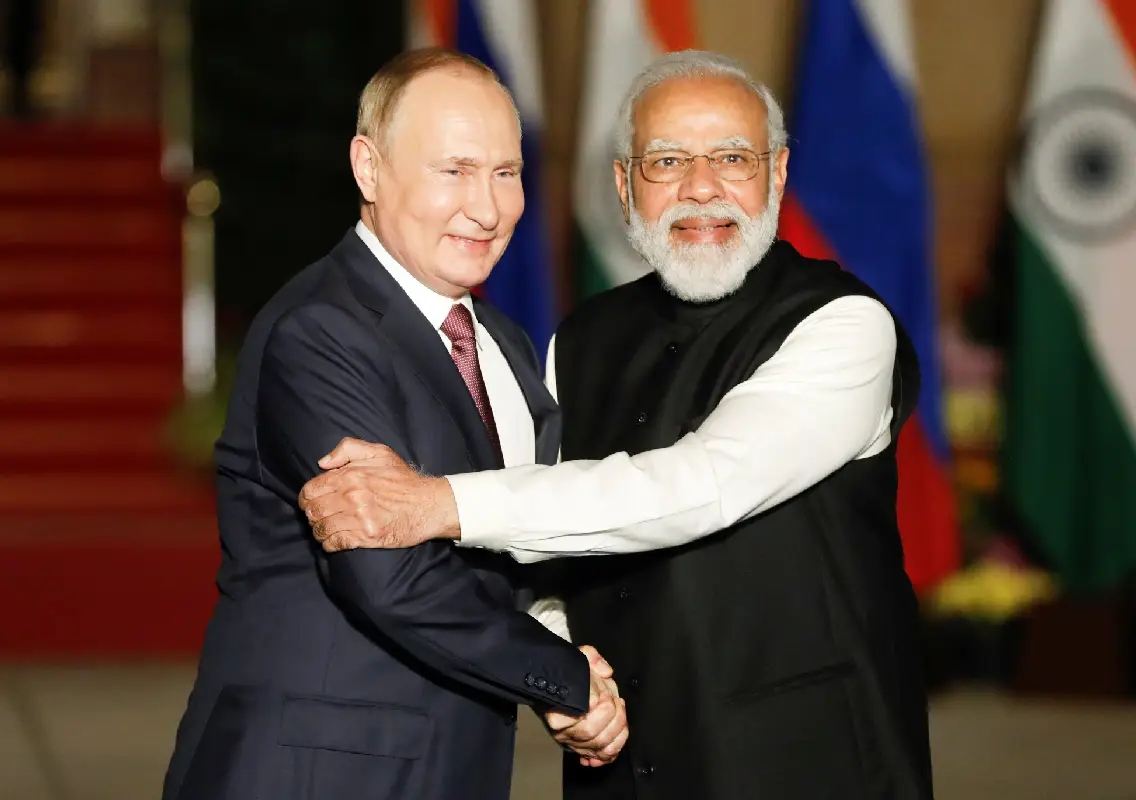


New Delhi: Russian President Vladimir Putin is expected to travel to India around 5 December for the annual bilateral summit with Prime Minister Narendra Modi, officials familiar with the matter said on Wednesday. The high-profile visit, which may last either one or two days, is likely to produce significant outcomes aimed at further strengthening the “Special and Privileged Strategic Partnership” between the two countries.
Preparations for the visit
While dates have not been officially announced, preparations are underway in both New Delhi and Moscow to finalise the agenda. Ahead of Mr. Putin’s trip, Russian Foreign Minister Sergey Lavrov will visit India next month to hold preparatory discussions with his Indian counterpart.
The Russian President last visited New Delhi in 2021, while Prime Minister Modi travelled to Moscow in July 2024 for the previous edition of the summit. The annual mechanism has seen 22 such summit meetings so far, alternating between the two countries, and serves as the highest-level institutional platform for reviewing the full spectrum of bilateral relations.
Defence and energy ties on agenda
According to officials, talks between Mr. Modi and Mr. Putin are expected to focus heavily on defence cooperation, trade and energy security. Defence ties remain a central pillar of the partnership, with India likely to explore the procurement of additional S-400 air defence missile systems from Russia.
India had signed a $5 billion deal in 2018 to acquire five units of the S-400 system, despite warnings of possible sanctions from the Trump administration. Russia has delivered three of the regiments so far, with the remaining two expected in 2026, after delays caused by the ongoing war in Ukraine.
The systems played a crucial role during Operation Sindoor, enhancing India’s air defence capabilities, prompting New Delhi to consider further acquisitions.
Strategic partnership under strain
The summit comes at a time when India-Russia ties are being closely watched in the context of shifting global alignments. Despite growing pressure from the West, New Delhi has continued to maintain strong economic and defence relations with Moscow, particularly in the energy sector.
India has defended its purchase of discounted Russian crude oil, stating that energy procurement is dictated by national interest and market dynamics. This position has at times placed India at odds with Washington, which recently doubled tariffs on Indian goods to 50%, partly in response to India’s continued oil imports from Russia.
Russian Foreign Minister Lavrov recently made it clear that India-U.S. relations are not a determinant of Delhi-Moscow ties, stressing that the strategic partnership stands independently.
Ukraine conflict to feature in talks
The Ukraine war, now in its fourth year, is also expected to figure prominently in the summit. India has consistently called for dialogue and diplomacy, avoiding alignment with Western sanctions while maintaining humanitarian assistance for Ukraine.
Observers expect the Modi-Putin talks to explore avenues for peace initiatives and to discuss the broader implications of the conflict on global stability and energy security.
Political optics and symbolism
The upcoming visit will carry significant symbolic weight. In his remarks during the Shanghai Cooperation Organisation (SCO) summit in Tianjin last month, Prime Minister Modi said that “140 crore Indians are eagerly waiting to welcome” President Putin in December. He added that close cooperation between India and Russia is vital not only for both nations but also for global peace, stability and prosperity.
President Trump, meanwhile, described India and Russia as drifting towards what he called “the darkest China,” underscoring how U.S. domestic politics continues to shape narratives about Delhi-Moscow ties.
Conclusion
As Mr. Putin prepares to arrive in New Delhi for the 23rd annual summit, both sides are expected to reaffirm their time-tested relationship while navigating the challenges of a complex geopolitical environment. With defence, energy, and strategic security at the forefront, the Modi-Putin meeting could mark another significant chapter in a partnership that has remained resilient through decades of global change.