







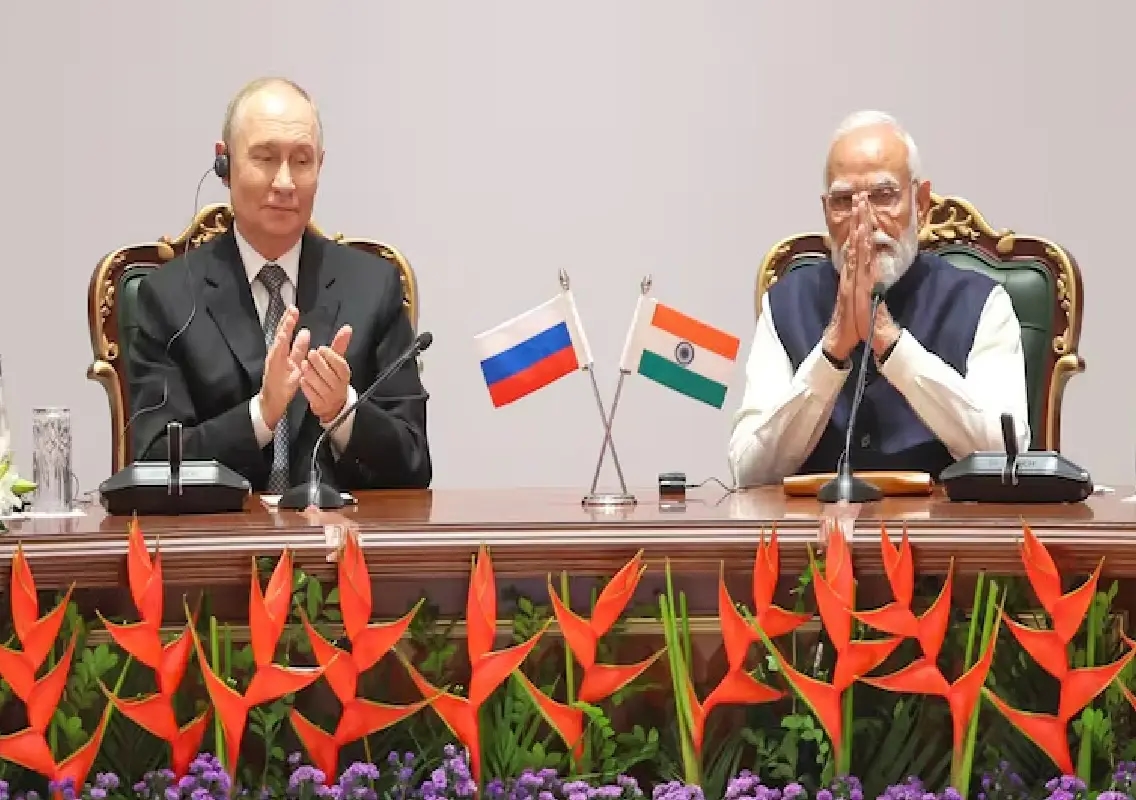


New Delhi: Russian President Vladimir Putin on Friday assured India of uninterrupted fuel supplies, even as New Delhi comes under mounting pressure from the United States to scale down its oil imports from Moscow. The statement came during a high-profile summit in New Delhi, where Prime Minister Narendra Modi hosted Putin for talks heavily centred on energy, defence cooperation and trade expansion.
Putin’s visit — his first to India since the start of the Ukraine conflict — featured a ceremonial welcome, including an honour guard and a 21-gun salute, symbolising the continued strategic closeness between the two nations.
Russia reiterates commitment to India’s energy needs
Addressing a joint statement after talks, Putin emphasised Russia’s role as a dependable energy partner.
“Russia is a reliable supplier of oil, gas, coal, and everything required for the development of India’s energy,” he said, noting that Moscow is ready to ensure continuous and stable shipments to support India’s rapidly expanding economy.
Prime Minister Modi thanked Putin for his “unwavering commitment” to India, reiterating that energy security remains a strong pillar of the India–Russia relationship. While he spoke about cooperation in nuclear energy, he avoided direct reference to oil — a sensitive topic amid pressure from Washington.
US tariffs intensify India’s geopolitical balancing act
India’s energy strategy has been under scrutiny since the Ukraine war began, with New Delhi emerging as one of the largest buyers of discounted Russian crude. In 2024, Russia supplied 36% of India’s total crude imports, averaging 1.8 million barrels per day.
But the geopolitical landscape tightened after US President Donald Trump imposed 50% tariffs on most Indian products in August, explicitly criticising India’s continued reliance on Russian oil. The move has significantly impacted Indian exporters and complicated ongoing trade negotiations with Washington.
New Delhi has, in recent months, reduced Russian crude imports, though it continues to defend its energy decisions as being based on national interest.
Former Indian Ambassador to Russia, Pankaj Saran, described the moment as another test of India’s ability to manage competing strategic alignments. “Balancing acts are second nature to Indian foreign policy making,” he wrote in an editorial.
Ukraine conflict discussed during bilateral meeting
Putin said he had briefed Modi extensively on the situation in Ukraine, including diplomatic efforts involving “some partners, including the United States,” toward a potential peace settlement. Modi reiterated India’s long-standing position of advocating peace and dialogue, avoiding any explicit criticism of Russia.
India has consistently called for diplomacy and de-escalation, maintaining its neutral stance despite Western pressure.
Deepening economic cooperation despite trade imbalance
The two leaders announced an economic cooperation programme until 2030, aimed at strengthening trade, investment and market access. Indian officials described it as a critical step toward reducing vulnerabilities and expanding opportunities in sectors such as shipping, chemicals, healthcare, and job creation.
Bilateral trade touched $68.7 billion in 2024–25, nearly six times the pre-pandemic level. However, Indian exports to Russia totalled only $4.88 billion, highlighting a persistent trade imbalance that New Delhi is keen to address.
According to Ashok Malik of The Asia Group, the visit aligns with India’s broader strategy to diversify economic linkages amid disruptive US tariffs and global supply chain shifts.
Defence ties strong but evolving
Russia has historically been India’s primary defence supplier, accounting for the bulk of India’s weapon imports for decades. However, the share of Russian-origin defence equipment has fallen sharply — from 76% during 2009–13 to 36% in 2019–23, according to the Stockholm International Peace Research Institute.
While top-level defence discussions took place during the summit — covering fighter jets, air defence systems and nuclear submarines — no new major deals were finalised. Indian officials stressed that while defence cooperation remains important, New Delhi continues to pursue diversification and domestic manufacturing under its Atmanirbhar Bharat programme.
Conclusion
Putin’s assurance of reliable fuel supplies comes at a pivotal moment for India, which is seeking to protect its energy security while navigating a landscape shaped by Western sanctions, US tariffs and shifting global alliances. As India balances its long-standing strategic partnership with Russia against growing engagement with the United States, the latest summit demonstrates New Delhi’s determination to maintain strategic autonomy in pursuit of national interests.