


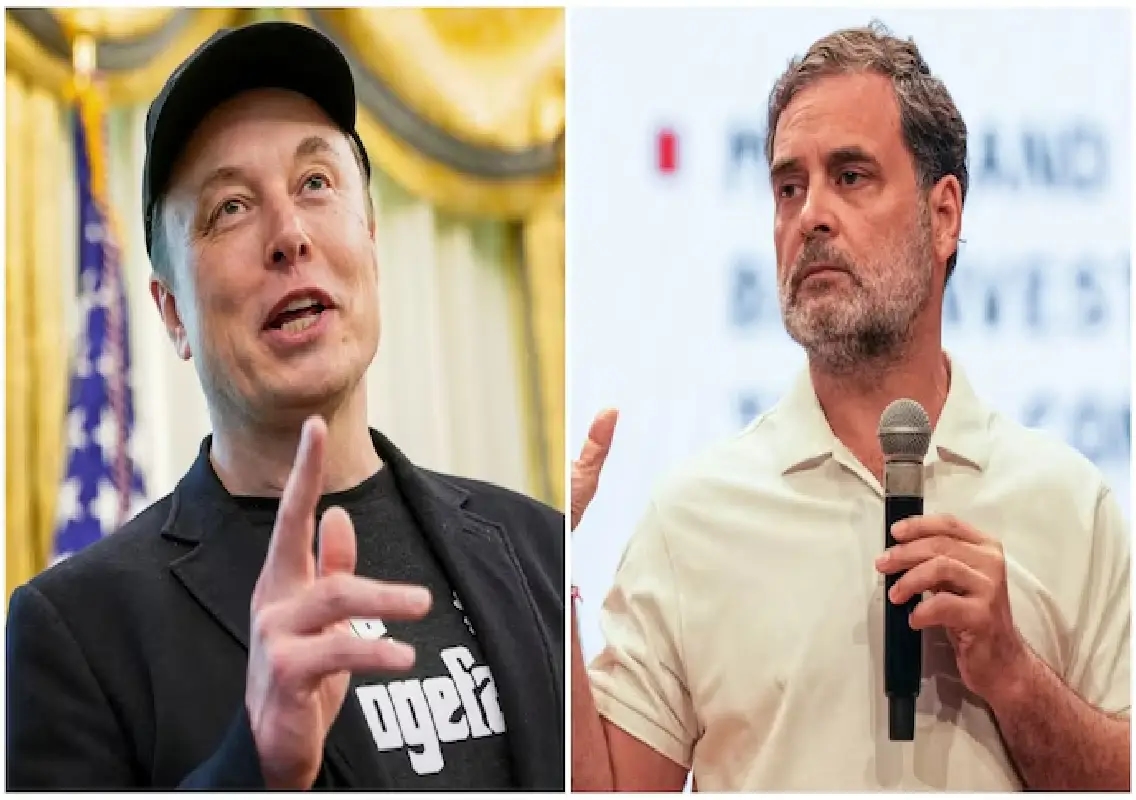


New Delhi: Congress leader Rahul Gandhi has joined the public exchange between Elon Musk and Mukesh Ambani over the delayed launch of Starlink satellite internet services in India, telling the American billionaire to “wait till you discover the other guy” in an apparent reference to industrialist Gautam Adani.
Gandhi’s remark came after Musk intensified his criticism of India’s regulatory process, questioning whether Reliance Industries chairman Mukesh Ambani was the “real boss of India” because Starlink was still awaiting the necessary approvals to begin commercial operations.
Responding to Musk’s post on X, the Leader of the Opposition in the Lok Sabha wrote, “Welcome to India, Elon. Wait till you discover the other guy”.
Although Gandhi did not name Adani in his X post, he appeared to sharpen the political message through a subsequent Instagram post. The post featured a carousel of images, including one showing Adani alongside Prime Minister Narendra Modi aboard a jet. The image appeared to be several years old.
The exchange has brought India’s satellite internet approval process into the political spotlight, with questions about corporate influence, competition and regulatory requirements dominating the discussion.
Rahul Gandhi’s remark draws Adani into the debate
Gandhi’s response appeared to extend Musk’s criticism of India’s business environment by drawing attention to the Congress party’s longstanding allegations concerning the relationship between the Adani Group and the BJP-led government.
The Congress has repeatedly accused the government of favouring Adani’s business interests, allegations that have been disputed by the BJP and the industrial group.
By telling Musk to “wait till you discover the other guy”, Gandhi appeared to suggest that the issues facing Starlink could not be understood solely through the company’s dispute with Ambani.
The reference also added a political dimension to Musk’s complaint, which had initially focused on the delay in obtaining regulatory approvals for his satellite internet venture.
Within an hour of Gandhi’s post, Musk responded on X, writing, “Thank you, Rahul. This is indeed troubling”.
Musk’s reply indicated that he was receptive to Gandhi’s intervention, although neither post established that any particular business group had influenced the regulatory decisions affecting Starlink.
The exchange quickly became a talking point because it brought together one of the world’s most prominent technology entrepreneurs and India’s leading opposition politician in a debate involving some of the country’s largest corporate groups.
Musk questions Mukesh Ambani over Starlink delay
Musk’s latest comments followed a series of posts alleging that powerful business interests were preventing Starlink from entering the Indian market.
In one post, he accused “certain oligarchs” of using their influence to preserve their position in the country’s telecommunications sector.
“Unfortunately, we are being blocked by certain oligarchs in order to maintain their monopolistic chokehold on the Indian people. You can guess who they are. This is a crime against the people of India!” Musk wrote.
He subsequently directly named Ambani while questioning why Starlink had not received all the approvals required to launch its commercial services in India.
“Starlink is licenced in over 165 countries and has spent five years complying with every single law and requirement of the government of India, so why still no licence? Is Ambani the real boss of India?” Musk posted on X.
He made the remarks while sharing a social media post alleging that the government was more interested in protecting powerful business groups than serving consumers.
Musk has argued that Starlink could introduce greater competition into India’s internet market and provide connectivity to communities that remain poorly served by existing networks.
However, his allegations concerning corporate influence have not been substantiated by the information provided in the government’s public response.
Government rejects allegations of preferential treatment
The Indian government rejected Musk’s suggestion that the country’s regulatory framework was unfair or designed to prevent Starlink from entering the market.
The Ministry of Communications described the allegation that the framework, or its application, was discriminatory as “baseless and misconceived”.
According to the government, three satellite communications operators have received licences: Elon Musk’s Starlink, Reliance Jio’s satellite venture Jio Satcom and Bharti-backed Eutelsat OneWeb.
However, the licences do not mean that the companies can immediately begin commercial operations. They must complete the required security assessments and obtain the other applicable approvals, including those relating to spectrum.
The ministry stated that security assessments were under way for all three licensees.
Minister of State for Communications Chandra Sekhar Pemmasani also said the outstanding approvals were not an issue affecting Starlink alone. He explained that the Department of Telecommunications had issued licences and provisional spectrum to satellite communications companies, while security clearance remained pending with the Ministry of Home Affairs.
The government’s position is that the approval process applies to the operators concerned, rather than being directed at a single company.
This explanation directly counters Musk’s allegation that Starlink is being deliberately kept out of India to protect a rival’s market position.
Jio and OneWeb also await regulatory clearance
The involvement of Reliance Jio and Eutelsat OneWeb is central to the debate because both are pursuing satellite communications services in the same market.
Reliance Jio, part of Mukesh Ambani’s business group, is developing its satellite communications capabilities. Bharti-backed OneWeb is also working towards commercial operations in India.
Representatives of the companies have indicated that their ventures are awaiting regulatory approvals, supporting the government’s assertion that the process extends beyond Starlink.
The development of satellite internet services could introduce additional options for Indian consumers, particularly in remote areas where conventional broadband infrastructure is difficult to establish.
Traditional internet connectivity generally relies on fibre-optic cables, mobile towers and other ground-based infrastructure. Satellite services can connect users through equipment communicating with satellites in orbit, potentially extending internet access to locations where terrestrial networks are limited.
Musk has repeatedly highlighted this potential benefit, arguing that Starlink could help people living in villages and isolated areas with poor or no internet coverage.
However, commercial availability will depend on the completion of regulatory requirements, as well as factors such as service pricing, equipment costs and network capacity.
A regulatory dispute turns into a political exchange
The latest exchange illustrates how the debate over satellite internet licensing has expanded beyond a technical regulatory issue into a wider argument about corporate competition and political influence.
Musk has publicly questioned the delay affecting Starlink and directly challenged Ambani, while Gandhi has used the controversy to revive the Congress party’s criticism of the Adani Group’s relationship with the government.
The government, meanwhile, has maintained that all three satellite operators must complete the required security assessments and other formalities before launching commercial services.
Gandhi’s reference to Adani and Musk’s response have intensified the public debate, but the social media exchange itself does not establish that either Ambani or Adani has influenced the regulatory process.
The immediate question remains when Starlink, Jio Satcom and Eutelsat OneWeb will complete the necessary approvals and begin commercial operations in India.
Until then, the dispute is likely to remain a focal point in discussions about satellite connectivity, competition in the telecommunications sector and the relationship between major businesses and government policy.