







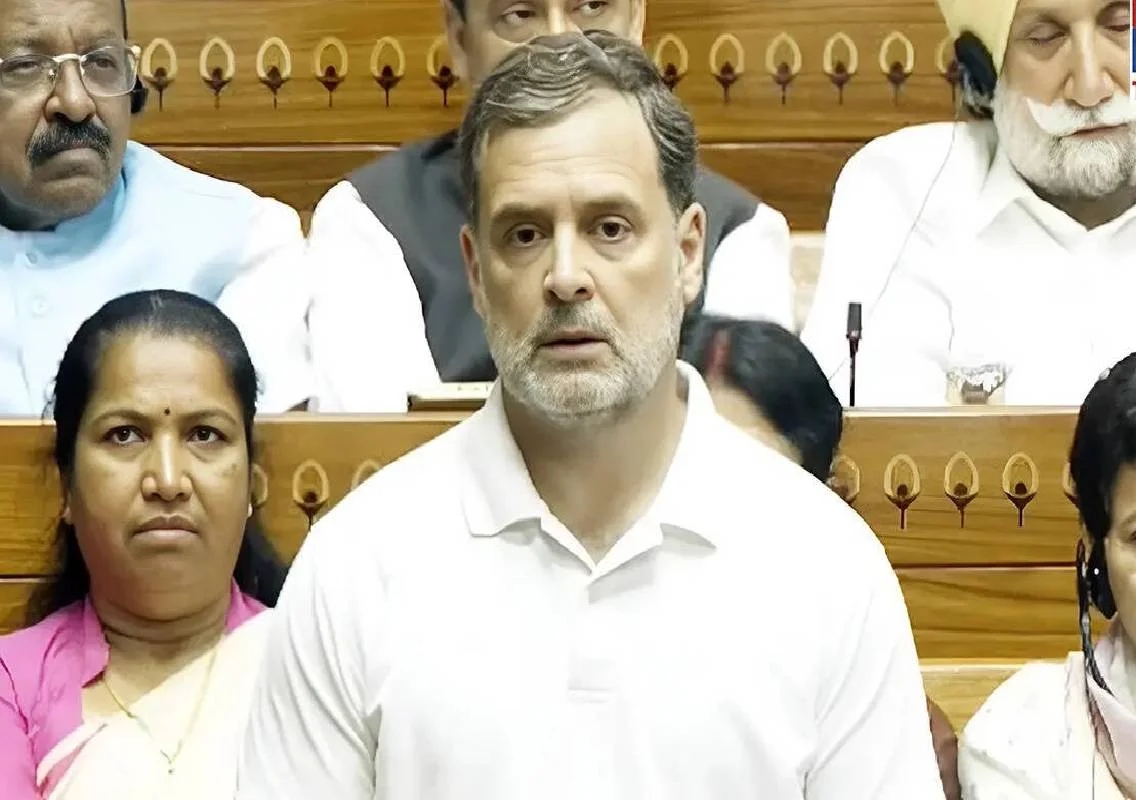


New Delhi: A heated confrontation broke out in the Lok Sabha after Leader of Opposition Rahul Gandhi launched a sharp attack on the Centre over the Women’s Reservation Bill and the proposed delimitation exercise. His remarks triggered strong protests from the ruling Bharatiya Janata Party (BJP), escalating into a political and personal war of words inside the House.
The controversy intensified after Rahul Gandhi repeatedly used the term “magician (jaadugar)” in an apparent jibe at Prime Minister Narendra Modi. Referring to past national security narratives, he alleged that political messaging was being used to divert attention from structural changes in the electoral system.
Uproar in House over remarks
Gandhi’s comments drew immediate objections from Treasury benches, leading to disruptions during the session. Defence Minister Rajnath Singh strongly condemned the remarks, calling them “unacceptable” and demanding an apology from the Congress leader.
He also went a step further by urging that strict action, including possible expulsion, be considered for what he termed an unparliamentary and personal attack.
Speaker Om Birla intervened during the exchange, cautioning members and stating that such language was not appropriate for parliamentary proceedings.
‘Not a women’s bill’: Rahul Gandhi’s critique
Beyond the controversy, Rahul Gandhi mounted a broader critique of the Women’s Reservation Bill. He argued that the legislation was not genuinely aimed at empowering women but was instead linked to political calculations.
“This is not a women’s bill. It has nothing to do with empowerment,” he said, alleging that it was part of an attempt to reshape India’s electoral landscape.
He claimed that the bill, when combined with delimitation, could lead to significant changes in representation that may benefit certain regions over others.
Delimitation debate turns contentious
The issue of delimitation redrawing parliamentary constituencies based on population became a central point of disagreement. Gandhi alleged that the proposed exercise could disadvantage southern, northeastern and smaller states.
According to him, population-based redistribution might reduce representation for states that have successfully controlled population growth, thereby altering the political balance.
Opposition parties have echoed similar concerns, warning that such changes could shift political weight towards northern states.
BJP counters allegations
The BJP strongly rejected Gandhi’s claims, maintaining that the government is committed to fairness and transparency in the delimitation process. The ruling party reiterated assurances made earlier by Prime Minister Narendra Modi that no region would face injustice.
Government leaders also criticised Gandhi’s remarks as misleading and politically motivated, accusing the Opposition of creating unnecessary fear around the issue.
Caste census and representation concerns
Gandhi also raised the issue of a caste census, arguing that it should directly influence political representation. He questioned whether the government intends to use such data to ensure equitable participation for Other Backward Classes (OBCs) in Parliament and state assemblies.
The Congress leader accused the Centre of avoiding the core issue and attempting to delay meaningful reforms related to social representation.
Timing and political significance
The debate comes at a crucial time, as the Women’s Reservation Bill passed earlier is yet to be implemented. Its rollout is tied to the completion of a Census and a subsequent delimitation exercise, which is expected after 2026.
This linkage has fuelled suspicion among Opposition parties that electoral boundaries may be redrawn in a manner that impacts political representation across regions.
Conclusion
The sharp exchange between Rahul Gandhi and the BJP underscores the growing political tensions surrounding delimitation and women’s reservation. While the government maintains that the process will be fair, the Opposition continues to question its intent and implications. As Parliament moves forward with these key reforms, the debate is likely to remain a major flashpoint in national politics.