


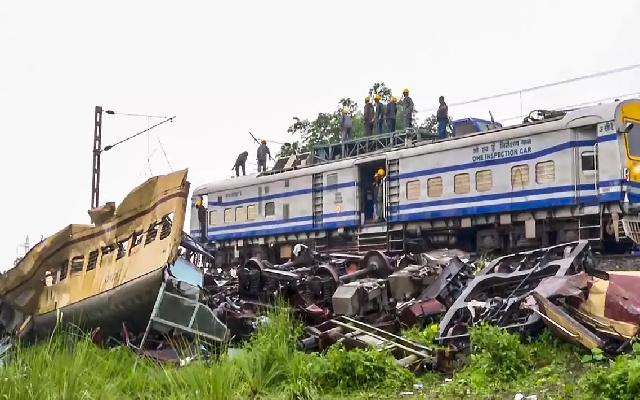


In an unexpected turn of events for the newly sworn-in union government, Darjeeling—a renowned hill station in West Bengal—witnessed a devastating train collision that has shocked the nation. Sources close to the matter have revealed to Frontline that the tragic incident involving the Kolkata-bound Kanchanjunga Express and a freight train loaded with containers was not merely an isolated case of human or mechanical error, but a culmination of systemic failures within the Railways hierarchy.
The collision occurred at 8:55 am on June 17, claiming the lives of 10 individuals, severely injuring nine others, and causing injuries to 32 more. Railway experts analyzing the incident have pointed to a breakdown in adherence to safety protocols across multiple levels of the organization.
The root cause, as uncovered, relates to a failure in the track circuits due to thunderstorms earlier that morning. This resulted in automatic signal failures between Rangapani and Chatterhat at 5:50 am, a critical issue governed by Railway General & Subsidiary Rules (G&SR). These rules stipulate that in the event of signal failure, trains must proceed cautiously under modified operational procedures, including reduced speeds and mandatory stops at each signal.
Shockingly, despite the known signal malfunction, multiple trains were authorized to proceed along the same stretch of track, contrary to established safety norms. The freight train involved in the collision departed with clearance that should have been exclusive to another train already on the track. This oversight highlights significant procedural lapses and a lack of adherence to safety protocols by station masters, train personnel, and supervisory staff at various levels of the Railways administration.
Furthermore, it has been reported that the freight train was traveling at a speed far exceeding the permissible limit of 10 km per hour in such signal failure scenarios, compounding the negligence observed during the tragic sequence of events.
As investigations continue into the Darjeeling train collision, questions loom over the efficacy of existing safety mechanisms within the Railways network and the accountability of those responsible for ensuring adherence to established protocols. The incident serves as a grim reminder of the urgent need for comprehensive reforms to prevent such tragedies from recurring on India’s extensive railway network.