







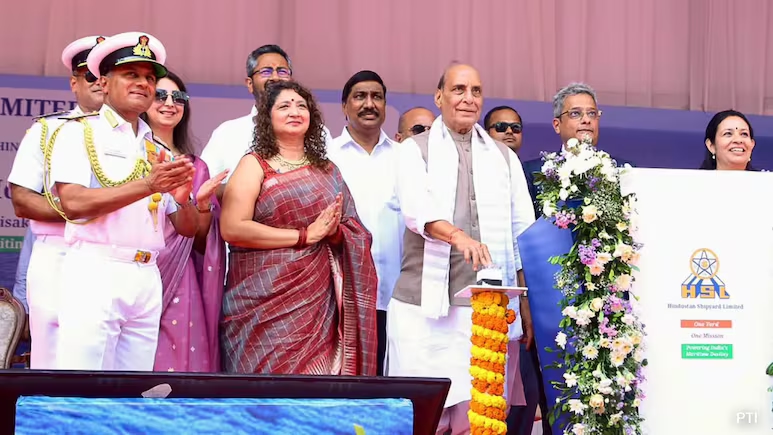


Visakhapatnam: Defence Minister Rajnath Singh on Tuesday launched the Indian Navy’s first indigenous Fleet Support Ship, FSS-1, named Surya, at Hindustan Shipyard Limited (HSL) in Visakhapatnam, marking a major step in India’s naval logistics and domestic shipbuilding capabilities.
Singh also laid the keel of the fifth vessel in the Fleet Support Ship programme, FSS-5, and inaugurated the upgraded Slipway-4 and a new 300-tonne Goliath Crane at the public sector shipyard.
The three developments are aimed at expanding HSL’s ability to build larger and more complex vessels. The upgraded slipway and crane will allow the shipyard to build and launch ships of up to 45,000 deadweight tonnes (DWT).
FSS-1 entered the waters of the Bay of Bengal just 18 months after the first steel was cut. The 43,500-tonne Fleet Support Ships are designed to replenish naval vessels at sea, allowing warships to remain deployed for longer periods and extending their operational reach across the Indian Ocean Region.
The event was attended by Chief of the Naval Staff Admiral Krishna Swaminathan and senior officials from the Ministry of Defence, Indian Navy and HSL.
FSS-1 launched as ‘Surya’
The first vessel in the five-ship Fleet Support Ship programme has been named Surya.
The ship is being designed and built indigenously by Hindustan Shipyard Limited for the Indian Navy. Its primary role will be to provide logistical support to warships operating at sea.
Fleet Support Ships are essentially mobile replenishment platforms. They can carry fuel, water, stores and other supplies needed by naval vessels during prolonged deployments.
This capability is particularly important for a navy operating across a large maritime area. Instead of returning frequently to a port for replenishment, warships supported by fleet support vessels can continue their missions at sea for longer periods.
The Defence Ministry said the 43,500-tonne vessels will replenish warships at sea and extend the Navy’s endurance and reach across the Indian Ocean Region.
How Fleet Support Ships extend Navy’s reach
Modern naval operations depend not only on frontline warships such as destroyers, frigates and aircraft carriers, but also on support vessels that keep those platforms supplied.
A fleet support ship acts as a logistical base at sea.
During extended deployments, naval vessels consume large quantities of fuel and other supplies. A dedicated support ship can transfer those resources without requiring combat vessels to leave their operational area.
The addition of such vessels can therefore increase the duration for which a naval task force remains at sea.
For India, the capability has particular relevance to the Indian Ocean Region, where the Navy regularly undertakes long-distance deployments, maritime security operations, exercises and humanitarian missions.
The Fleet Support Ship programme is consequently intended to strengthen the logistical foundation supporting India’s wider naval presence.
FSS-1 reaches water in 18 months
One of the notable aspects of the FSS programme is the pace at which the first vessel has progressed.
According to the Ministry of Defence, FSS-1 entered the Bay of Bengal just 18 months after steel cutting.
The milestone provides an indication of the shipbuilding capacity being developed at HSL.
The shipyard is simultaneously working on additional vessels in the series, with Tuesday’s keel laying for FSS-5 marking another stage in the programme.
Keel laying is an important milestone in ship construction because it formally marks the beginning of construction of a vessel’s hull structure.
With FSS-1 launched and FSS-5 now entering construction, the Navy’s five-ship Fleet Support Ship programme is moving towards series production.
Rajnath Singh inaugurates upgraded Slipway-4
The launch of FSS-1 was accompanied by the inauguration of HSL’s upgraded Slipway-4.
The facility has been extended and its load-bearing capacity enhanced, allowing the shipyard to undertake construction of significantly larger vessels.
With the addition of the 300-tonne Goliath Crane, the upgraded facility can now support ships of up to 45,000 DWT.
The expansion is important because modern naval platforms are becoming increasingly large and complex.
Shipyards require not only skilled workers and engineering expertise but also infrastructure capable of handling massive structures, heavy equipment and complex assembly operations.
The upgraded slipway and crane are therefore intended to expand HSL’s range of future shipbuilding projects.
New Goliath Crane boosts shipyard capacity
The 300-tonne Goliath Crane is another major addition to the HSL facility.
Large cranes are essential for assembling major ship sections and positioning heavy components during construction.
The new crane, combined with the upgraded slipway, is expected to improve HSL’s ability to undertake larger shipbuilding programmes.
The Defence Ministry said the infrastructure improvements would strengthen the shipyard’s capacity to build larger and more complex ships.
The upgrades also form part of a broader effort to increase the capacity of Indian shipyards as the country seeks to expand domestic defence production.
Rajnath Singh stresses indigenous shipbuilding
Singh described the three milestones as having significance beyond the individual projects.
According to the Defence Ministry, he said the launch of FSS-1 represented achievement, the keel laying of FSS-5 represented resolve and the new slipway represented growing capability.
The Defence Minister also emphasised the need for Indian shipyards to focus on quality, productivity and timely delivery.
The government has increasingly linked naval shipbuilding with the broader objective of reducing dependence on foreign suppliers for defence platforms and equipment.
In Visakhapatnam, Singh also called for the city to be developed as a major maritime industrial hub.
HSL’s role in India’s naval expansion
Hindustan Shipyard Limited has a long association with Indian naval and maritime shipbuilding.
The Visakhapatnam-based shipyard has constructed and repaired various types of vessels for the Indian Navy, Coast Guard and other customers.
The Fleet Support Ship programme represents an important expansion in the type and scale of vessels being built at the yard.
The new infrastructure is intended to allow HSL to move towards larger and more sophisticated platforms.
The shipyard’s Chairman and Managing Director, Rear Admiral C Raghuram (Retd.), said the milestones reflected the contribution of employees, the confidence of the Indian Navy and support from business partners.
He also said the enhanced infrastructure would position HSL to deliver next-generation ships for India and international customers.
HSL records strong financial performance
The latest infrastructure expansion comes after a strong financial year for HSL, according to figures provided by the shipyard.
In 2025-26, HSL’s value of production reached Rs 1,969 crore, representing a 34 per cent increase and its highest level on record.
The shipyard’s total income rose 29 per cent to Rs 2,295 crore, while profit before tax stood at Rs 479.47 crore.
The performance provides the financial backdrop to the shipyard’s ongoing expansion of its construction capabilities.
HSL has also highlighted the simultaneous progress of multiple major projects as evidence of its growing production capacity.
Fleet Support Ships and maritime endurance
The importance of the FSS programme goes beyond the construction of five individual vessels.
A navy’s operational reach depends heavily on its ability to sustain ships deployed far from their home ports.
Fleet support ships address that requirement by providing supplies while naval vessels remain at sea.
For India’s Navy, which operates across the Indian Ocean and regularly deploys ships beyond the immediate coastline, such logistical support can be important during prolonged missions.
The vessels can support task groups and individual warships while reducing the need for frequent returns to port.
The Defence Ministry has specifically linked the 43,500-tonne Fleet Support Ships with extending the Navy’s endurance and reach across the Indian Ocean Region.
FSS-5 keel laying marks next stage
While FSS-1 marked the launch of the first ship in the series, Tuesday’s keel laying for FSS-5 demonstrated that the programme is progressing across multiple vessels.
The keel laying indicates that construction of the fifth vessel has formally begun.
The Ministry of Defence described the milestone as evidence of the programme’s movement towards series production.
This parallel progress could allow HSL to build experience and efficiency as it works through the series.
It also provides the Navy with a pipeline of support vessels rather than relying on a single platform.
India’s growing maritime industrial capacity
The developments at HSL form part of a broader effort to expand India’s domestic maritime manufacturing capabilities.
The government has been seeking to increase the participation of Indian shipyards in naval construction while improving their ability to handle larger platforms.
The upgraded Slipway-4 and Goliath Crane are therefore significant not only for the Fleet Support Ship programme but also for HSL’s potential future projects.
The ability to construct ships of up to 45,000 DWT gives the yard additional capacity for large and complex shipbuilding programmes.
For Visakhapatnam, the developments also reinforce its role as a major centre for India’s naval and maritime activities.
A new milestone for HSL and the Navy
The launch of Surya, keel laying of FSS-5 and commissioning of upgraded shipbuilding infrastructure have given HSL three major milestones on a single day.
For the Indian Navy, the Fleet Support Ship programme will add dedicated logistical capacity to support extended deployments.
For HSL, the new slipway and 300-tonne crane expand the scale of vessels the shipyard can undertake.
The first Fleet Support Ship reaching the Bay of Bengal only 18 months after steel cutting also marks an important construction milestone.
As the remaining vessels move through construction, the programme will be closely watched for its impact on the Navy’s ability to sustain longer deployments and on HSL’s ability to deliver larger indigenous platforms.